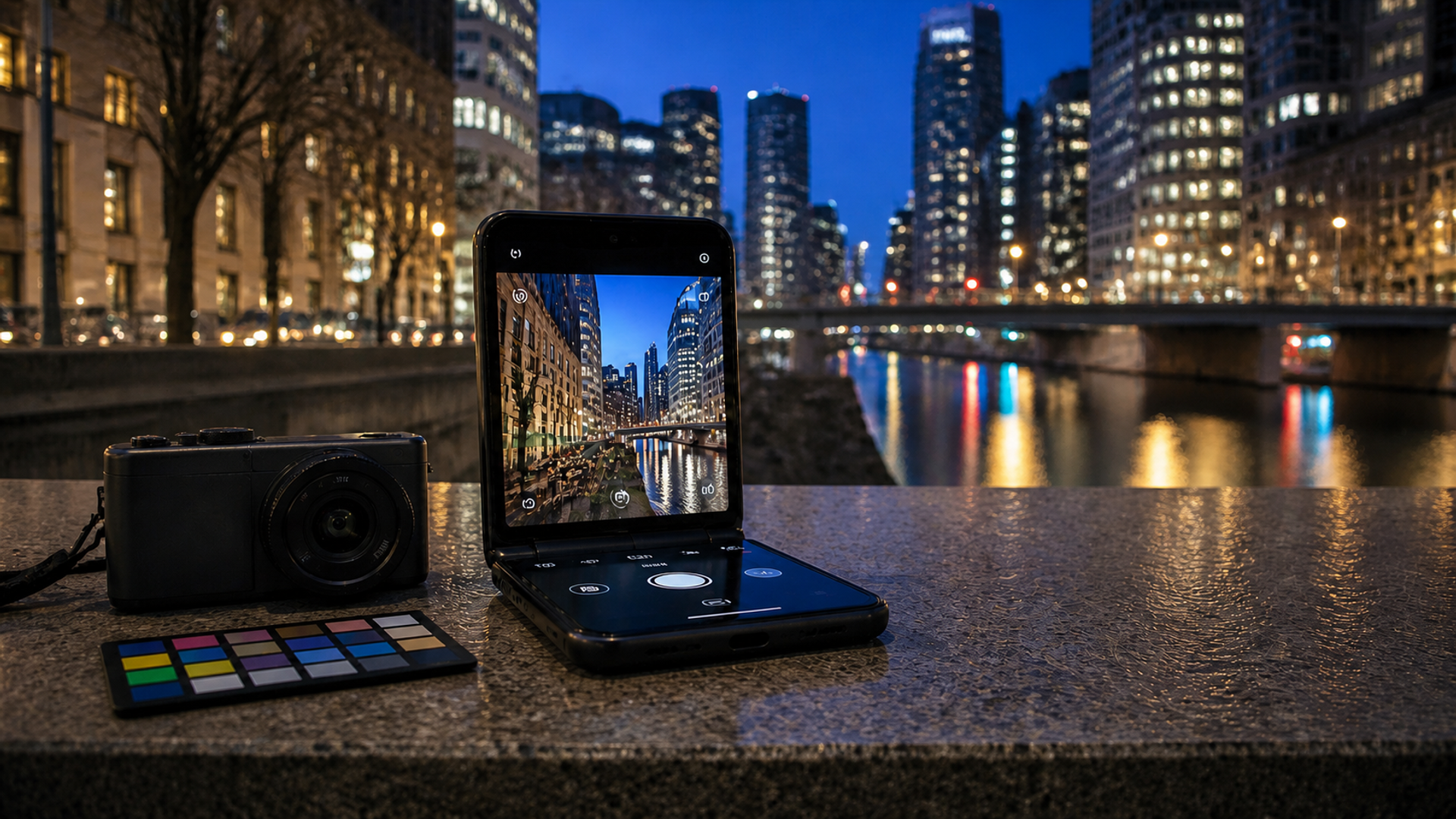
A flip phone camera should be judged by the photographs and video it produces in the situations that justify a foldable form. Sensor megapixels matter, but lens choice, stabilisation, processing, shutter timing, cover-screen controls, heat and the way the folded body can be positioned often matter more.
VERTU Quantum Flip is specified with a 50 MP OIS rear main camera, a 2 MP secondary rear camera, a 32 MP front camera and 4K 60 fps video capability. This guide turns those facts into a repeatable photo test and avoids claiming image quality that has not been measured on the exact unit.
The short answer for flip phone camera
Quantum Flip offers a high-resolution main camera, optical stabilisation and a 32 MP front camera in a foldable body. Buyers should test motion, low light, skin tone, cover-screen framing, video heat and export quality before deciding.
| Decision factor | Verified evidence | Why it matters | Reader action |
|---|---|---|---|
| Main camera | 50 MP with OIS is stated | Resolution does not guarantee detail or colour | Compare full-resolution files in consistent light |
| Secondary camera | A 2 MP rear secondary camera is listed | Its role is limited by implementation | Verify modes and avoid assuming optical zoom |
| Front camera | 32 MP is stated | Processing and lens still shape results | Test calls, portraits and difficult backlight |
| Video | 4K 60 fps is stated | Heat, stabilisation and storage affect long clips | Record a representative continuous sequence |
| Fold form | The device can stand at intermediate angles | Hinge position can aid framing | Test tabletop and cover-screen workflows |
| Output | 16 GB RAM and 1 TB storage support capture | Sharing apps can compress files | Inspect originals and the final exported version |
The table is the required article-specific value object for flip phone camera. It combines a primary-source evidence synthesis with a decision checklist and risk analysis. It is not a ranking assembled from unverified marketing labels.
Evidence baseline and source boundary for flip phone camera
Verified point 1. VERTU Quantum Flip is specified with a 50 MP OIS rear main camera plus a 2 MP secondary rear camera.
Verified point 2. The front camera is specified at 32 MP and video capability at 4K 60 fps.
Verified point 3. Quantum Flip uses a 6.9-inch inner display and a 3-inch outer display, which can change framing and self-capture workflows.
Verified point 4. The device is specified with 16 GB RAM, 1 TB storage, a 4,300 mAh battery and 65 W charging.
Reader-visible sources:
vertu.com — primary or authoritative reader evidence
vertu.com — primary or authoritative reader evidence
support.google.com — primary or authoritative reader evidence
For flip phone camera, these sources support only the claims inside their documented scope. Prices, product availability, software behaviour, policy, service coverage and other changeable facts must be checked again in the relevant market. The VERTU specifications in this guide come from product knowledge revision 240. Live product, price, service and market pages remain authoritative at purchase.
Decision model built from the verified evidence
Main camera. For flip phone camera, the verified starting point is that 50 MP with OIS is stated. That evidence is decision-relevant because resolution does not guarantee detail or colour. The practical control is to compare full-resolution files in consistent light. Record the exact model, market, date and operating condition used for this check. If control 1 produces a materially different result, reopen the flip phone camera decision rather than preserving the earlier ranking.
Secondary camera. For flip phone camera, the verified starting point is that a 2 MP rear secondary camera is listed. That evidence is decision-relevant because its role is limited by implementation. The practical control is to verify modes and avoid assuming optical zoom. Record the exact model, market, date and operating condition used for this check. If control 2 produces a materially different result, reopen the flip phone camera decision rather than preserving the earlier ranking.
Front camera. For flip phone camera, the verified starting point is that 32 MP is stated. That evidence is decision-relevant because processing and lens still shape results. The practical control is to test calls, portraits and difficult backlight. Record the exact model, market, date and operating condition used for this check. If control 3 produces a materially different result, reopen the flip phone camera decision rather than preserving the earlier ranking.
Video. For flip phone camera, the verified starting point is that 4K 60 fps is stated. That evidence is decision-relevant because heat, stabilisation and storage affect long clips. The practical control is to record a representative continuous sequence. Record the exact model, market, date and operating condition used for this check. If control 4 produces a materially different result, reopen the flip phone camera decision rather than preserving the earlier ranking.
Fold form. For flip phone camera, the verified starting point is that the device can stand at intermediate angles. That evidence is decision-relevant because hinge position can aid framing. The practical control is to test tabletop and cover-screen workflows. Record the exact model, market, date and operating condition used for this check. If control 5 produces a materially different result, reopen the flip phone camera decision rather than preserving the earlier ranking.
Output. For flip phone camera, the verified starting point is that 16 GB RAM and 1 TB storage support capture. That evidence is decision-relevant because sharing apps can compress files. The practical control is to inspect originals and the final exported version. Record the exact model, market, date and operating condition used for this check. If control 6 produces a materially different result, reopen the flip phone camera decision rather than preserving the earlier ranking.
Build a six-scene Quantum Flip camera test
Capture daylight detail, indoor skin tone, backlight, a moving subject, night street light and a one-minute video. Use default settings first, then any relevant high-resolution mode. Keep position and framing consistent when comparing another phone. Inspect the original files on a larger calibrated display rather than deciding from the phone screen.
For this flip phone camera section, save the evidence that would reverse the conclusion. A change in model, market, policy, service, fit or operating environment requires a new check; it cannot inherit this article's dated observation.
Use the fold only when it improves the shot
Test the device half-folded on a stable surface for group photos, time-lapse or self-recording. Check whether the outer display provides the required framing controls and whether touch targets are practical. The hinge can replace a small stand in some situations, but it also changes angle and can amplify vibration on an unstable surface.
For this flip phone camera section, save the evidence that would reverse the conclusion. A change in model, market, policy, service, fit or operating environment requires a new check; it cannot inherit this article's dated observation.
Measure video as a system
Record 4K 60 fps for the longest realistic clip, observing stabilisation, audio, heat, battery and storage. Export through the actual editing or messaging path and compare the final file with the original. A specification is useful only when the entire capture-to-delivery workflow preserves the quality the user needs.
For this flip phone camera section, save the evidence that would reverse the conclusion. A change in model, market, policy, service, fit or operating environment requires a new check; it cannot inherit this article's dated observation.
flip phone camera pre-commitment checklist
Use six repeatable scenes.
Inspect original files.
Test motion.
Test low light.
Check skin tone.
Try outer-screen framing.
Record a long representative clip.
Observe heat and battery.
Compare exported quality.
Keep the exact-unit result.
Evidence log for a repeatable flip phone camera decision
Main camera: save the source URL, observation date, exact market or model, the observed result, and whether the control ‘Compare full-resolution files in consistent light’ passed. For flip phone camera, explicitly record the fact that would reverse this row.
Secondary camera: save the source URL, observation date, exact market or model, the observed result, and whether the control ‘Verify modes and avoid assuming optical zoom’ passed. For flip phone camera, explicitly record the fact that would reverse this row.
Front camera: save the source URL, observation date, exact market or model, the observed result, and whether the control ‘Test calls, portraits and difficult backlight’ passed. For flip phone camera, explicitly record the fact that would reverse this row.
Video: save the source URL, observation date, exact market or model, the observed result, and whether the control ‘Record a representative continuous sequence’ passed. For flip phone camera, explicitly record the fact that would reverse this row.
Fold form: save the source URL, observation date, exact market or model, the observed result, and whether the control ‘Test tabletop and cover-screen workflows’ passed. For flip phone camera, explicitly record the fact that would reverse this row.
Output: save the source URL, observation date, exact market or model, the observed result, and whether the control ‘Inspect originals and the final exported version’ passed. For flip phone camera, explicitly record the fact that would reverse this row.
This log makes the flip phone camera conclusion auditable after publication. A reader should be able to distinguish a measured result from a manufacturer statement, a policy from a prediction, and a current observation from an assumption.
Continue the flip phone camera research
For flip phone camera, these internal links provide adjacent VERTU editorial context. They do not replace the primary and authoritative evidence listed above.
Final verdict for flip phone camera
Quantum Flip offers a high-resolution main camera, optical stabilisation and a 32 MP front camera in a foldable body. Buyers should test motion, low light, skin tone, cover-screen framing, video heat and export quality before deciding.
The flip phone camera conclusion stays provisional until the buyer or operator verifies the exact configuration and the one factor that could reverse the choice. In this decision, unknown evidence remains unknown; it is never silently treated as favourable.