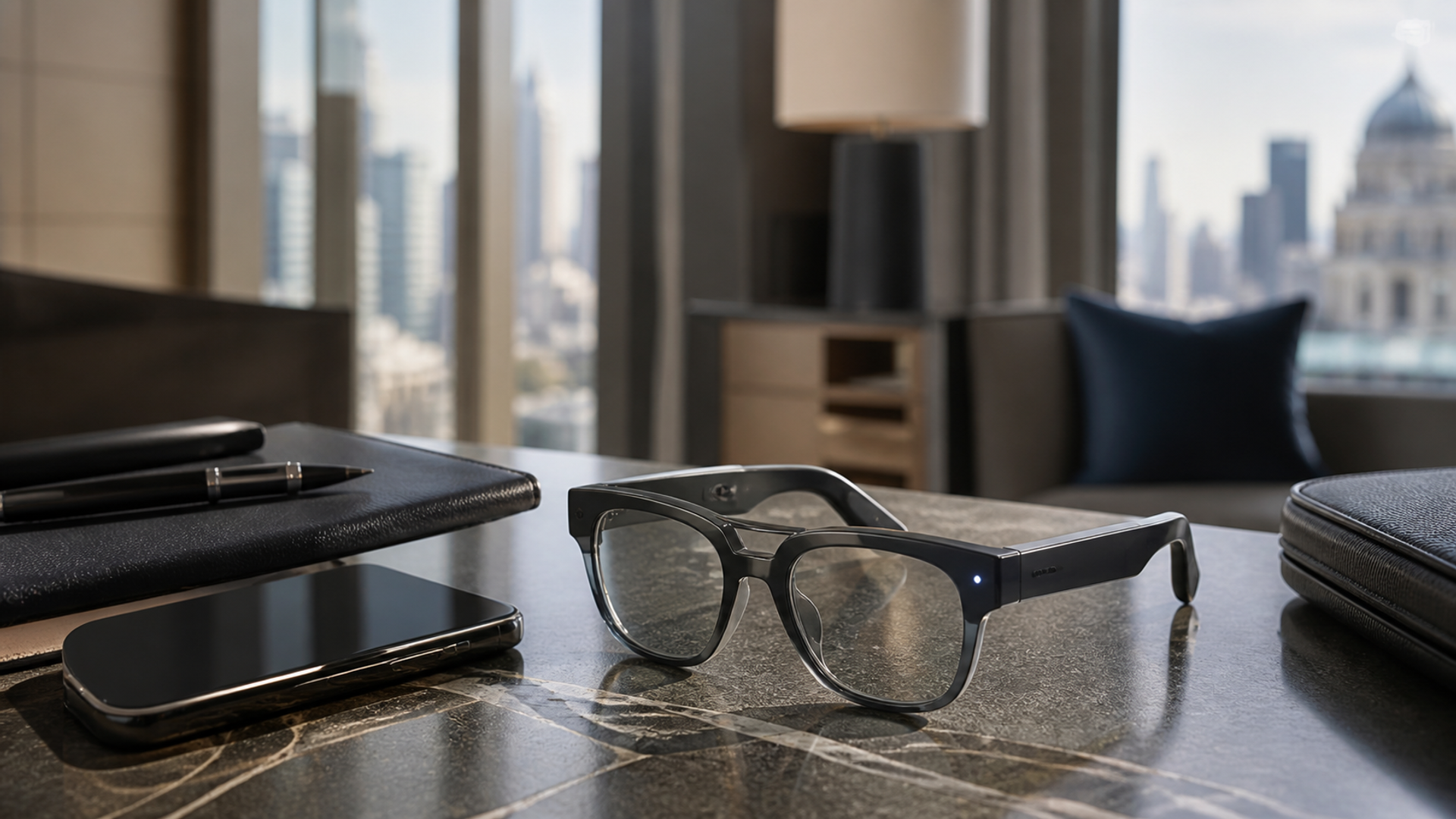
Smart glasses are easy to judge as a gadget and harder to judge as a social object. A camera indicator, an always-near microphone, an AI service and a companion phone can all change how the device feels to the wearer and to everyone nearby. The best pair for 2026 is the one whose useful moments are clear, whose capture state is visible, whose battery and connectivity fit the day, and whose permissions do not quietly exceed the job it is meant to do.
The short answer by wearable objective
Choose camera-enabled glasses only when the capture indicator, controls and local social rules are acceptable; choose audio-first glasses when hands-free sound is the main benefit; or choose an AI-forward pair when the phone, cloud account, language support and data retention are understood. Test prescription fit, heat, audio leakage and battery in a normal day before treating an AI feature as essential.
| Decision factor | Camera-enabled glasses | Audio-first glasses | AI-forward glasses |
|---|---|---|---|
| Main benefit | First-person capture and hands-free context | Calls, music and navigation without a screen | Visual or voice AI assistance is the point |
| Social boundary | A visible capture signal is accepted | No camera makes the social explanation simpler | The wearer can explain AI and recording behaviour |
| Phone dependency | The companion app manages capture and sharing | Bluetooth audio is the main link | Cloud processing and phone permissions are material |
| Audio privacy | Speaker leakage is tested in a quiet room | Open-ear sound remains understandable but audible | Voice replies do not expose private prompts |
| Fit and heat | Frame, camera and prescription insert remain comfortable | Weight and temple pressure stay low | Battery and processor heat fit the full day |
| Failure mode | A mistaken capture is visible and removable | A dead battery removes a convenience | An account or network failure removes the core feature |
This best smart glasses 2026 matrix is the article's working value object. Read the best smart glasses 2026 rows together: the decisive failure mode depends on this topic's evidence, operating context and reader objective.
The privacy and fit questions that matter
Evidence 1. Ray-Ban Meta's official product information describes camera, audio and voice-assistant features; those features make the companion phone, account permissions and capture controls part of the purchase decision.
Evidence 2. Privacy regulators commonly advise people to understand what personal data is collected, why it is collected, how it is shared and how long it is retained; an AI wearable should be tested against those questions before it enters private conversations.
Evidence 3. A camera indicator is a useful signal but does not remove the need to respect venue rules, local law or the expectations of people who may be recorded; the wearer remains responsible for the context in which capture is used.
Evidence 4. Open-ear audio and voice interaction can be convenient while still being audible to nearby people; volume, language, wake words, call handling and notification previews should be tested in the places where the glasses will actually be worn.
Reader-visible sources checked for this article:
ray-ban.com — reader-visible current or official evidence
ftc.gov — reader-visible current or official evidence
For best smart glasses 2026, these sources establish only the claims inside their documented scope. Recheck every changeable specification, availability condition, price, policy or service term in the relevant market before acting.
Make the phone and cloud relationship explicit
Read main benefit as a stop/go test: first-person capture and hands-free context supports the first option; calls, music and navigation without a screen supports the second; and visual or voice AI assistance is the point supports the third. Record which source proves the condition and when it was checked.
A buyer can resolve social boundary without starting from a brand preference. Ask whether a visible capture signal is accepted; compare that with whether no camera makes the social explanation simpler; then use the wearer can explain AI and recording behaviour as the third route's safeguard. An unknown condition stays unknown.
On phone dependency, popularity is not enough. The evidence for option one is that the companion app manages capture and sharing. Option two means bluetooth audio is the main link. Option three is rational where cloud processing and phone permissions are material. Recheck any changeable term immediately before commitment.
The decision changes at audio privacy. Choose the first path only if speaker leakage is tested in a quiet room; move to the second when open-ear sound remains understandable but audible; use the third when voice replies do not expose private prompts. Save the downside that would make this row fail.
For fit and heat, the first route works when frame, camera and prescription insert remain comfortable; the second requires weight and temple pressure stay low. The control for the third is battery and processor heat fit the full day. Verify this row against the exact product, property, account or environment before it can reverse the decision.
The failure mode row exposes a practical boundary. Route one assumes a mistaken capture is visible and removable, while route two is defensible only when a dead battery removes a convenience. Route three depends on an account or network failure removes the core feature. If that evidence is absent, keep the more reversible option.
Facts that would reverse the current choice
Reversal control 1 — Main benefit. Before choosing Camera-enabled glasses, write down how the decision changes if “First-person capture and hands-free context” proves false. Do the same for Audio-first glasses and “Calls, music and navigation without a screen”. Keep the AI-forward glasses route available until “Visual or voice AI assistance is the point” is verified. This control belongs to best smart glasses 2026; update it from the cited source or exact supplier rather than copying a generic checklist.
Reversal control 2 — Social boundary. Before choosing Camera-enabled glasses, write down how the decision changes if “A visible capture signal is accepted” proves false. Do the same for Audio-first glasses and “No camera makes the social explanation simpler”. Keep the AI-forward glasses route available until “The wearer can explain AI and recording behaviour” is verified. This control belongs to best smart glasses 2026; update it from the cited source or exact supplier rather than copying a generic checklist.
Reversal control 3 — Phone dependency. Before choosing Camera-enabled glasses, write down how the decision changes if “The companion app manages capture and sharing” proves false. Do the same for Audio-first glasses and “Bluetooth audio is the main link”. Keep the AI-forward glasses route available until “Cloud processing and phone permissions are material” is verified. This control belongs to best smart glasses 2026; update it from the cited source or exact supplier rather than copying a generic checklist.
Reversal control 4 — Audio privacy. Before choosing Camera-enabled glasses, write down how the decision changes if “Speaker leakage is tested in a quiet room” proves false. Do the same for Audio-first glasses and “Open-ear sound remains understandable but audible”. Keep the AI-forward glasses route available until “Voice replies do not expose private prompts” is verified. This control belongs to best smart glasses 2026; update it from the cited source or exact supplier rather than copying a generic checklist.
Reversal control 5 — Fit and heat. Before choosing Camera-enabled glasses, write down how the decision changes if “Frame, camera and prescription insert remain comfortable” proves false. Do the same for Audio-first glasses and “Weight and temple pressure stay low”. Keep the AI-forward glasses route available until “Battery and processor heat fit the full day” is verified. This control belongs to best smart glasses 2026; update it from the cited source or exact supplier rather than copying a generic checklist.
Reversal control 6 — Failure mode. Before choosing Camera-enabled glasses, write down how the decision changes if “A mistaken capture is visible and removable” proves false. Do the same for Audio-first glasses and “A dead battery removes a convenience”. Keep the AI-forward glasses route available until “An account or network failure removes the core feature” is verified. This control belongs to best smart glasses 2026; update it from the cited source or exact supplier rather than copying a generic checklist.
Treat capture as a social contract
Before wearing camera glasses into a meeting, restaurant or hotel lounge, decide what the camera is for and how someone can ask you to stop. Learn the exact indicator behaviour, shutter control and whether the device can save a clip without an obvious gesture. Do not assume that a small light is understood by everyone. Keep the camera disabled when it adds no value, and never use a wearable to bypass a venue's photography or recording policy. The best technology decision may be leaving the glasses in the case for the most sensitive part of the day.
Separate AI convenience from AI necessity
An assistant that identifies, translates or summarises can be valuable, but if it depends on a cloud account, mobile data and a changing service policy, it is not the same as a static pair of spectacles. List the tasks that genuinely need AI, then test the fallback when the phone is offline, the language is unsupported or the service is unavailable. Avoid turning a convenience into an operational dependency. For confidential work, use a device and account policy that your organisation has actually approved.
Measure audio leakage and notification exposure
Open-ear sound should be evaluated with another person in the room, not only in a quiet shop. Play a call, navigation prompt and message notification at realistic volume. Check whether a contact name, calendar item or AI response can be heard by a neighbouring passenger. Reduce lock-screen and spoken details, and create a physical gesture for pausing audio. Prescription fit also matters: temple pressure, lens thickness and the location of controls can change after a full day of walking or heat.
Plan battery, account and loss recovery
A wearable that travels with you needs a recovery plan. Record the companion account, remove unnecessary permissions, secure the phone and know how to unlink the glasses after loss or sale. Carry the charging case only if it fits the actual day. If the glasses disappear in a taxi, the question is not merely whether the frame can be replaced; it is whether the account can be signed out, captured media can be removed and a connected microphone or camera can be disabled. Rehearse that sequence before the first trip.
Three situations that change the recommendation
The museum and city traveller
Audio-first glasses may provide navigation and calls with a simpler social boundary when cameras are unnecessary. Define the fact that would reverse this recommendation before committing.
The visual-memory traveller
Camera-enabled glasses can be defensible for clearly permitted memories when capture signals, storage and deletion are understood. Define the fact that would reverse this recommendation before committing.
The mobile knowledge worker
AI-forward glasses make sense only when the phone, cloud processing, employer policy and data retention have all been checked. Define the fact that would reverse this recommendation before committing.
Action checklist
Identify the single job the glasses must perform.
Read capture, indicator and deletion controls.
Check local venue and recording expectations.
Test audio leakage with another person nearby.
Review phone permissions and cloud account settings.
Test the assistant with the required language and network.
Confirm prescription and temple comfort over a full day.
Set conservative notification and voice-preview behaviour.
Learn how to unlink and erase the device after loss.
Keep the glasses optional rather than mission-critical.
Continue the decision
The linked VERTU articles expand adjacent parts of the best smart glasses 2026 decision. They do not substitute for the external evidence above.
The smart-glasses verdict
Choose camera-enabled glasses only when the capture indicator, controls and local social rules are acceptable; choose audio-first glasses when hands-free sound is the main benefit; or choose an AI-forward pair when the phone, cloud account, language support and data retention are understood. Test prescription fit, heat, audio leakage and battery in a normal day before treating an AI feature as essential.
Keep the best smart glasses 2026 decision reversible until its material cost, safety, access, privacy and compatibility facts are verified. Unknown evidence stays unknown; it is never silently scored as favourable.