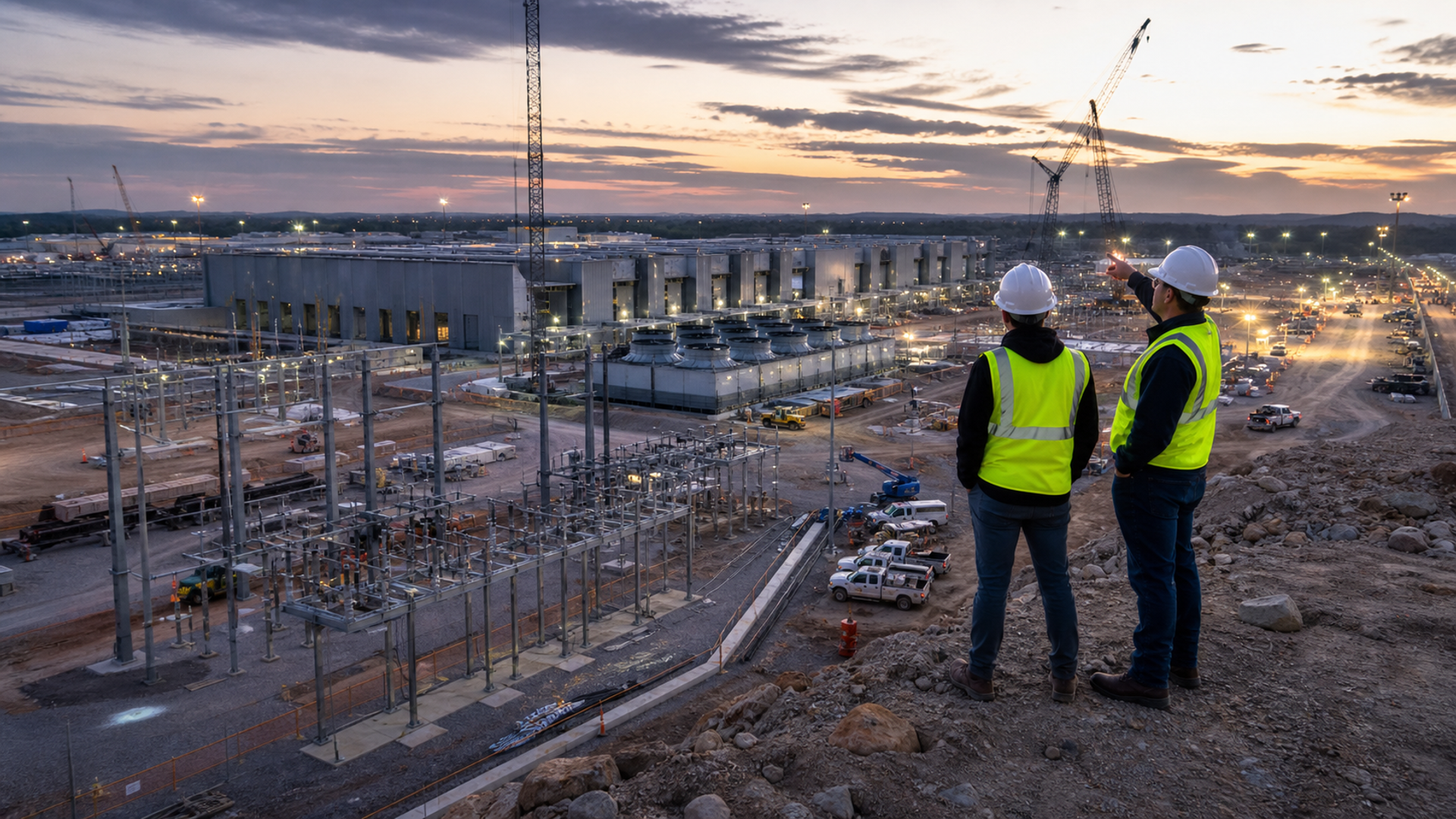
OpenAI's decision to join the Ports Pike project turns the phrase ‘AI data centre’ from an abstract technology topic into a live infrastructure decision. The important questions are no longer limited to GPU count. Power availability, grid connection, water, construction lead time, network capacity, local approvals and the concentration of critical suppliers all shape whether announced capacity becomes usable capacity.
This guide separates the announcement from the operational consequences. It does not treat a project headline as proof of completed compute. Instead, it gives executives, investors and technology buyers a timeline and verification checklist for judging what has changed, which constraints still remain and what evidence would reverse the initial reading.
The short answer for AI data center
Treat Ports Pike as evidence that AI infrastructure is moving closer to energy, land and industrial-policy decisions. It strengthens the case for tracking permitted power and commissioning milestones, but it does not by itself prove capacity, cost, delivery date or model performance.
| Decision factor | Verified evidence | Why it matters | Reader action |
|---|---|---|---|
| Project status | OpenAI has announced participation | A named sponsor is not the same as an operating campus | Confirm construction, energisation and commissioning milestones |
| Power | Large AI clusters require dependable electricity | Grid access can be the binding constraint | Check utility filings, interconnection and backup strategy |
| Location | Ports Pike links compute with an industrial site | Land, fibre and local infrastructure affect delivery | Map the site to substations, fibre routes and permitting |
| Supply chain | Accelerators, memory and cooling remain specialised | A building can open before every rack is productive | Separate shell completion from installed and accepted systems |
| Community impact | Data centres create local load and construction demand | Benefits and externalities arrive on different schedules | Track jobs, tax terms, water and grid-upgrade commitments |
| Business exposure | Cloud capacity may expand over time | Availability and price are not guaranteed | Keep multi-provider, workload and data-residency options open |
The table is the required article-specific value object for AI data center. It combines a primary-source evidence synthesis with a decision checklist and risk analysis. It is not a ranking assembled from unverified marketing labels.
Evidence baseline and source boundary for AI data center
Verified point 1. OpenAI publicly identified Ports Pike as an AI infrastructure project in which it is participating.
Verified point 2. The United States Department of Energy treats data-centre energy demand, grid capacity and efficiency as material infrastructure questions.
Verified point 3. An AI data-centre announcement describes intended capacity; operational capacity requires power, networking, installed hardware, testing and customer availability.
Verified point 4. Business continuity depends on workload portability, data governance and contract terms as well as physical compute supply.
Reader-visible sources:
openai.com — primary or authoritative reader evidence
energy.gov — primary or authoritative reader evidence
nist.gov — primary or authoritative reader evidence
For AI data center, these sources support only the claims inside their documented scope. Prices, product availability, software behaviour, policy, service coverage and other changeable facts must be checked again in the relevant market.
Decision model built from the verified evidence
Project status. For AI data center, the verified starting point is that openAI has announced participation. That evidence is decision-relevant because a named sponsor is not the same as an operating campus. The practical control is to confirm construction, energisation and commissioning milestones. Record the exact model, market, date and operating condition used for this check. If control 1 produces a materially different result, reopen the AI data center decision rather than preserving the earlier ranking.
Power. For AI data center, the verified starting point is that large AI clusters require dependable electricity. That evidence is decision-relevant because grid access can be the binding constraint. The practical control is to check utility filings, interconnection and backup strategy. Record the exact model, market, date and operating condition used for this check. If control 2 produces a materially different result, reopen the AI data center decision rather than preserving the earlier ranking.
Location. For AI data center, the verified starting point is that ports Pike links compute with an industrial site. That evidence is decision-relevant because land, fibre and local infrastructure affect delivery. The practical control is to map the site to substations, fibre routes and permitting. Record the exact model, market, date and operating condition used for this check. If control 3 produces a materially different result, reopen the AI data center decision rather than preserving the earlier ranking.
Supply chain. For AI data center, the verified starting point is that accelerators, memory and cooling remain specialised. That evidence is decision-relevant because a building can open before every rack is productive. The practical control is to separate shell completion from installed and accepted systems. Record the exact model, market, date and operating condition used for this check. If control 4 produces a materially different result, reopen the AI data center decision rather than preserving the earlier ranking.
Community impact. For AI data center, the verified starting point is that data centres create local load and construction demand. That evidence is decision-relevant because benefits and externalities arrive on different schedules. The practical control is to track jobs, tax terms, water and grid-upgrade commitments. Record the exact model, market, date and operating condition used for this check. If control 5 produces a materially different result, reopen the AI data center decision rather than preserving the earlier ranking.
Business exposure. For AI data center, the verified starting point is that cloud capacity may expand over time. That evidence is decision-relevant because availability and price are not guaranteed. The practical control is to keep multi-provider, workload and data-residency options open. Record the exact model, market, date and operating condition used for this check. If control 6 produces a materially different result, reopen the AI data center decision rather than preserving the earlier ranking.
Ports Pike timeline: announcement to usable compute
Read the project in stages: sponsor announcement, land and planning, utility connection, building completion, equipment installation, commissioning and service availability. A credible update should name the stage and date rather than collapse the whole sequence into ‘new AI capacity’. Procurement teams should also ask which workloads, regions and contractual products will actually use the site.
For this AI data center section, save the evidence that would reverse the conclusion. A change in model, market, policy, service, fit or operating environment requires a new check; it cannot inherit this article's dated observation.
Power is the first AI capacity question
Power quality and timing decide how much hardware can run consistently. Nameplate megawatts, interconnection approval and actual energisation are different facts. Cooling design, redundancy and local transmission upgrades can shift both schedule and cost. A buyer should therefore connect infrastructure news to service-level terms, not assume that a large number in a press release immediately lowers compute prices.
For this AI data center section, save the evidence that would reverse the conclusion. A change in model, market, policy, service, fit or operating environment requires a new check; it cannot inherit this article's dated observation.
A resilience test for enterprise users
Businesses should inventory which applications require a specific model or cloud, what data may leave a region, how quickly workloads can move and which contracts cover interruption. The practical hedge is not to build a duplicate stack for every provider. It is to preserve data export, evaluation datasets, model-routing options and a tested fallback for the few workflows whose outage would materially harm operations.
For this AI data center section, save the evidence that would reverse the conclusion. A change in model, market, policy, service, fit or operating environment requires a new check; it cannot inherit this article's dated observation.
AI data center pre-commitment checklist
Record the exact project stage.
Find the utility or grid evidence.
Separate building capacity from commissioned compute.
Identify water and cooling assumptions.
Check the promised service region.
Review data-residency implications.
Keep workload export paths.
Test one business-continuity fallback.
Date every source.
Reopen the decision when commissioning evidence changes.
Evidence log for a repeatable AI data center decision
Project status: save the source URL, observation date, exact market or model, the observed result, and whether the control ‘Confirm construction, energisation and commissioning milestones’ passed. For AI data center, explicitly record the fact that would reverse this row.
Power: save the source URL, observation date, exact market or model, the observed result, and whether the control ‘Check utility filings, interconnection and backup strategy’ passed. For AI data center, explicitly record the fact that would reverse this row.
Location: save the source URL, observation date, exact market or model, the observed result, and whether the control ‘Map the site to substations, fibre routes and permitting’ passed. For AI data center, explicitly record the fact that would reverse this row.
Supply chain: save the source URL, observation date, exact market or model, the observed result, and whether the control ‘Separate shell completion from installed and accepted systems’ passed. For AI data center, explicitly record the fact that would reverse this row.
Community impact: save the source URL, observation date, exact market or model, the observed result, and whether the control ‘Track jobs, tax terms, water and grid-upgrade commitments’ passed. For AI data center, explicitly record the fact that would reverse this row.
Business exposure: save the source URL, observation date, exact market or model, the observed result, and whether the control ‘Keep multi-provider, workload and data-residency options open’ passed. For AI data center, explicitly record the fact that would reverse this row.
This log makes the AI data center conclusion auditable after publication. A reader should be able to distinguish a measured result from a manufacturer statement, a policy from a prediction, and a current observation from an assumption.
Continue the AI data center research
For AI data center, these internal links provide adjacent VERTU editorial context. They do not replace the primary and authoritative evidence listed above.
Final verdict for AI data center
Treat Ports Pike as evidence that AI infrastructure is moving closer to energy, land and industrial-policy decisions. It strengthens the case for tracking permitted power and commissioning milestones, but it does not by itself prove capacity, cost, delivery date or model performance.
The AI data center conclusion stays provisional until the buyer or operator verifies the exact configuration and the one factor that could reverse the choice. In this decision, unknown evidence remains unknown; it is never silently treated as favourable.