
| Aspect | Data/Source Context | Implications |
|---|---|---|
| Compute Cost | OpenAI reportedly told investors it might spend $400 billion by 2029 on computing infrastructure. | Without lowering the cost of capital (via government backing), this massive expenditure places significant financial strain on even the world's most valuable startup. |
| Global Competition | The U.S. CHIPS and Science Act already offers $52.7 billion to boost domestic manufacturing capacity. | OpenAI's venture complements this policy by targeting the specific high-powered chips needed for AI, ensuring American leadership in both the design and application of advanced semiconductors. |
| Market Access | The scarcity of advanced AI chips, largely dominated by one or two manufacturers, restricts industry growth. | Boosting production capacity ensures that AI chip supply is no longer a constraint on innovation for OpenAI and other startups relying on cloud compute. |
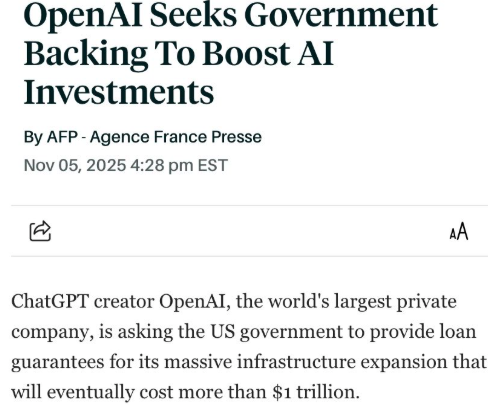
The race to build Artificial General Intelligence (AGI) is fundamentally a race for compute power . The insatiable demand for advanced semiconductors—the high-octane fuel for large language models (LLMs) like ChatGPT—has created a global bottleneck. This is the context for the significant news that OpenAI is seeking government backing to boost AI chip production , a move that transcends corporate strategy and touches on national security, consumer access, and the future of technology itself.
This push, spearheaded by figures like OpenAI CEO Sam Altman, is an effort to secure massive financing and global manufacturing capacity to prevent a chip shortfall from crippling the deployment and development of cutting-edge AI.
Here is a breakdown of the profound implications of this potential government-industry partnership on users and the technology landscape.
Impact on the Everyday User and AI Accessibility
For the average consumer, the success of OpenAI’s push for increased, government-backed chip production translates directly into better, faster, and potentially cheaper access to advanced AI services.
1. Faster Innovation & Feature Deployment
- Solve the Bottleneck: A secured, high-volume supply of specialized AI chips (like GPUs and custom accelerators) means less time waiting for hardware and more time for model training and iteration.
- User Benefit: New features, faster response times, and more capable AI models (like GPT-5 and beyond) will roll out quicker. This ensures that the tools used for education, business, and creative work are constantly improving.
2. Lower Service Costs (Long-Term)
- Reduce Infrastructure Cost: The primary expense for running LLMs is the infrastructure. Government financing or guarantees significantly lower the cost of financing these multi-billion-dollar chip and data center investments for companies like OpenAI.
- User Benefit: While current AI services are costly to run, a reduction in the capital expenditure burden could, over time, translate into more competitive pricing, or more generous free tiers, ultimately democratizing access to advanced AI tools for small businesses and individuals.
3. Reliability and Stability
- Supply Chain Resilience: Government involvement, especially in the context of global security concerns, aims to build resilient, domestic (or allied) supply chains for these critical components.
- User Benefit: This safeguards AI services against geopolitical disruptions, natural disasters, or trade conflicts, ensuring the reliability and stability of the AI tools millions rely on daily.
Impact on AI Development and Frontier Technology
The proposed venture is not just about making more chips; it is about fundamentally restructuring the global capacity for advanced computing, which is essential for achieving the most ambitious goals in AI.
1. The Path to AGI:
- Enabling Scale: OpenAI defines AGI as systems broadly smarter than humans. The scaling laws that govern current AI models predict that continued gains in intelligence require orders of magnitude more compute. This massive investment—with rumored figures reaching into the trillions of dollars—is viewed as the absolute necessity for achieving Artificial General Intelligence .
- Technological Acceleration: By dramatically increasing the availability of cutting-edge semiconductors, the entire AI research community benefits, accelerating progress across fields like robotics, drug discovery, and climate modeling.
2. National Security and Geopolitical Influence
- Critical Infrastructure: Semiconductors are recognized as a matter of national and economic security . By supporting the expansion of AI chip manufacturing, governments are safeguarding a core technology that underpins defense applications, economic competitiveness, and technological supremacy.
- Avoiding Shortfalls: The COVID-19 pandemic highlighted the fragility of global supply chains. This initiative aims to increase the world's—and specifically the U.S. and allied countries'—capacity to manufacture these advanced chips, staving off a shortfall that could severely restrict the deployment of AI.
3. A New Model of Public-Private Partnership
- Shared Risk and Investment: OpenAI's request for government guarantees, rather than direct funding, proposes a hybrid model where the private sector takes the lead on execution, but the government mitigates the massive financial risks.
- Shaping the Ecosystem: This involvement establishes a precedent for how governments and foundational technology companies collaborate on infrastructure projects of national importance, potentially influencing policy related to energy, data centers, and the future AI workforce.