| Metric | Definition | Why it Matters |
|---|---|---|
| Citation Share | How often your brand is cited in AI summaries. | Measures your "Share of Voice" in the AI ecosystem. |
| Sentiment Score | The tone (positive/neutral/negative) the AI uses when mentioning you. | Protects your brand reputation in generative answers. |
| Brand Lift | Increase in users searching specifically for your brand name. | Indicates that AI mentions are driving awareness. |
| Entity Confidence | How accurately an AI can describe your services when prompted. | Ensures your brand identity is correctly "learned" by the model. |
The digital marketing landscape has reached a tipping point. For years, the industry relied on the familiar mechanics of Search Engine Optimization (SEO) to drive traffic via a "ten blue links" model. However, the rise of Large Language Models (LLMs) and generative AI has fragmented the search experience, leading to the emergence of three new pillars: AIO , GEO , and AEO . While some skeptics dismiss these as mere buzzwords, the shift represents a fundamental change in how information is retrieved, synthesized, and delivered to users.
What Do These Terms Actually Mean?
In 2026, staying visible requires a multi-layered approach to "Search Everywhere" optimization. Here is the concise breakdown of how these terms differ and how they work together:
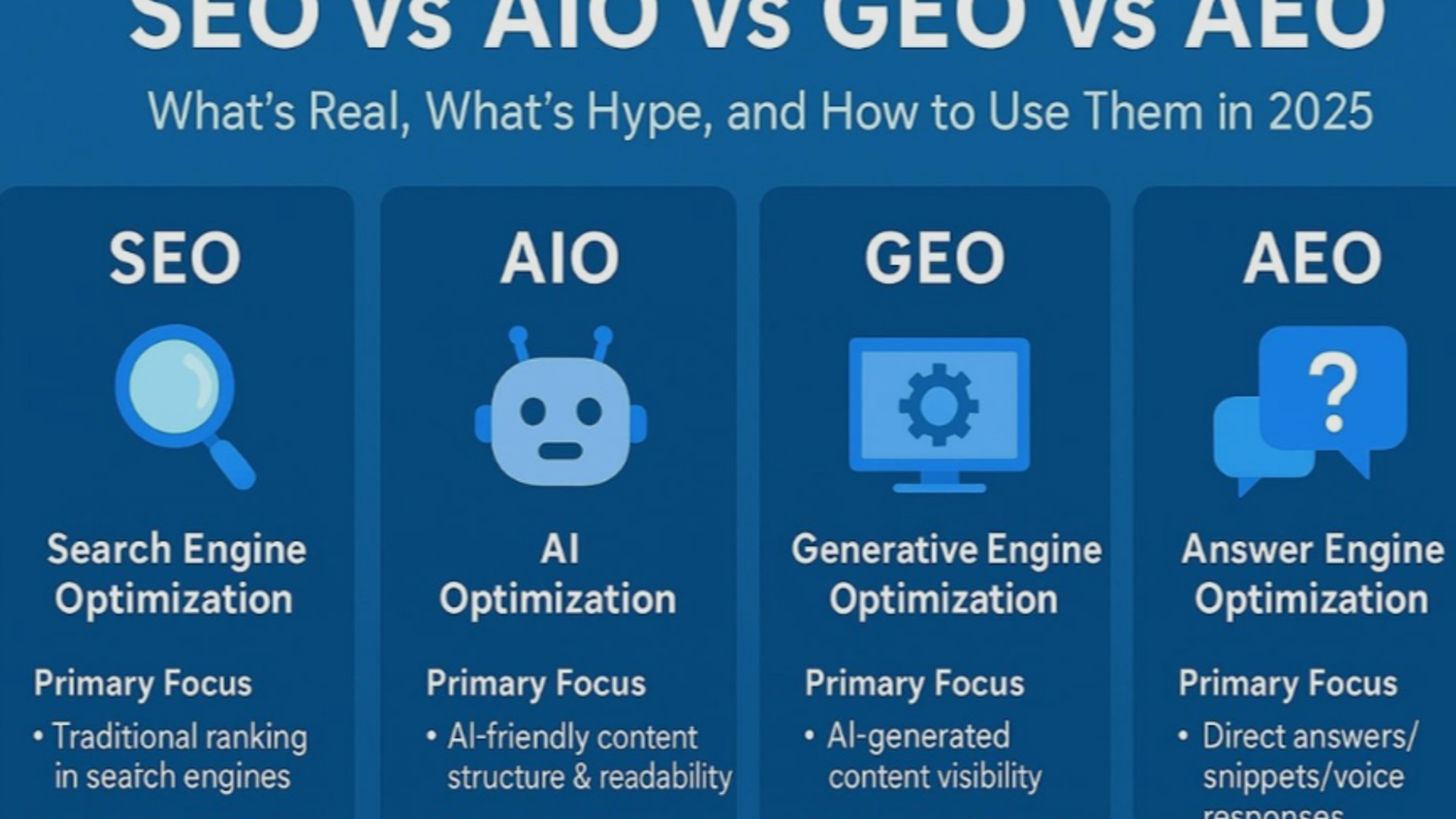
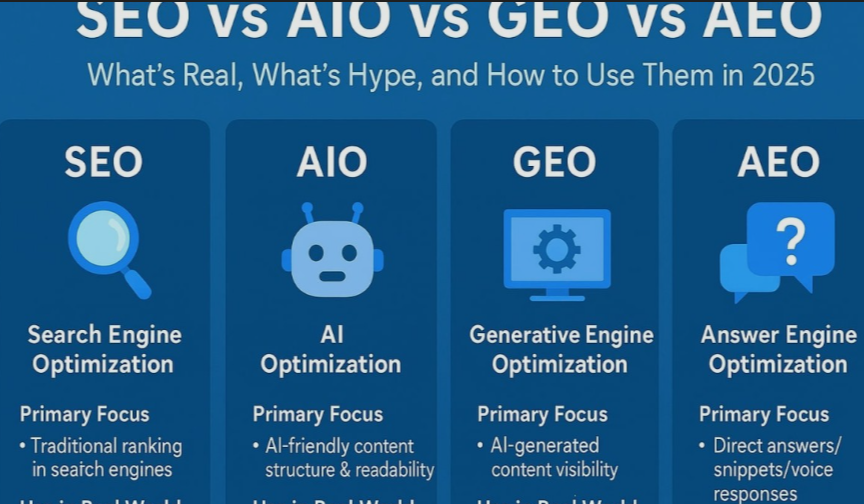
- SEO (Search Engine Optimization): The foundational layer. It focuses on technical health, crawlability, and ranking individual URLs in traditional search engines like Google and Bing to drive organic clicks.
- AIO (AI Optimization / AI Overviews): Specifically refers to optimizing content to appear within Google’s AI Overviews (formerly SGE). It bridges traditional ranking with AI synthesis.
- GEO (Generative Engine Optimization): A broader strategy aimed at getting your brand cited, mentioned, and trusted by Generative Engines such as ChatGPT, Perplexity, and Gemini. It prioritizes "citation" over "ranking."
- AEO (Answer Engine Optimization): The tactical art of becoming the "single source of truth." It focuses on direct, concise answers for voice search, featured snippets, and chatbot responses where users want immediate information without clicking.
The Big Picture: From "Ranking" to "Citation"
The core philosophy of search has shifted. In the past, the goal was to convince an algorithm that your page was the most relevant result for a keyword. Today, the goal is to convince an AI model that your brand is the most authoritative entity for a topic. This is a move from a "link economy" to a "knowledge economy." AI models don't just want to show a list of sites; they want to provide a synthesized answer and cite the most credible sources to back it up.
This transition has created what industry experts call "Fragmentation Anxiety." Users are no longer just "Googling" things; they are asking ChatGPT for recommendations, searching TikTok for visual proof, and using Perplexity for research. To survive, brands must ensure their data is structured in a way that machines can parse and humans can trust.
1. Traditional SEO: The Unshakable Foundation
Despite the hype around AI, traditional SEO remains the "connective tissue" of digital marketing. You cannot have GEO or AEO without a technically sound website. AI crawlers use the same sitemaps, robots.txt files, and internal linking structures that traditional bots have used for decades. If an AI engine cannot crawl your site efficiently, it cannot "learn" from your content, rendering your AI optimization efforts moot.
- Technical Integrity: Fast loading speeds and mobile responsiveness are now "table stakes" for both humans and AI bots.
- Content Clusters: Organizing content into logical hubs helps AI engines understand the depth of your expertise on a specific subject.
- Keyword Intent: While AI is more conversational, understanding the "intent" behind a search remains the best way to structure a helpful page.
2. AIO: Winning the Google AI Overview
AIO (AI Optimization) is the specific practice of targeting Google's AI-generated summaries. Because Google still controls the vast majority of search traffic, AIO is the most immediate priority for most marketers. Google’s AI Overviews typically pull from top-ranking search results, but they favor content that is "extractable"—meaning it provides a clear, factual answer that can be easily summarized in a few sentences.
Winning in AIO requires a shift in formatting. You need to provide "Information Gain"—unique data or perspectives that aren't found in every other article on the web. Google's AI is programmed to synthesize multiple sources, so if your content provides a unique statistic, a first-hand expert quote, or a proprietary framework, you are significantly more likely to be featured as a primary citation.
3. GEO: Influencing the Generative Ecosystem
Generative Engine Optimization (GEO) is the most transformative of the new disciplines. It isn't just about Google; it’s about becoming a part of the "training data" and "retrieval context" for models like ChatGPT, Claude, and Gemini. GEO is less about individual keywords and more about Brand Authority and Sentiment . If an AI "knows" your brand is the leader in "sustainable fashion," it will recommend you even if you don't rank #1 for a specific keyword that day.
- The Power of Mentions: AI models value unlinked brand mentions across the web. Being cited in a reputable news article or a Reddit thread can be as valuable as a backlink.
- Entity Clarity: You must clearly define who your brand is, what services you provide, and which experts work for you. Using consistent terminology across all platforms helps the AI build a "Knowledge Graph" for your business.
- RAG (Retrieval-Augmented Generation): Modern AI search uses RAG to pull real-time data from the web to ground its answers. Your goal is to be the "grounding data" the AI chooses to trust.
4. AEO: Becoming the Definitive Answer
Answer Engine Optimization (AEO) is the most tactical of the three. It is designed for the "Zero-Click" world. When a user asks Alexa "How do I fix a leaky faucet?" or asks a chatbot "What is the best CRM for small businesses?", they aren't looking for a 3,000-word blog post. They want a direct, actionable answer. AEO is about restructuring your content to be the "voice" that speaks that answer.
To succeed in AEO, you must adopt an "Answer-First" structure . This means placing the direct answer to a potential user question at the very top of your page or section. By providing a 40–60 word summary followed by more detailed information, you cater to both the "answer engines" that want brevity and the human readers who want depth.
Pro Tip: Use FAQ schema markup to explicitly tell search engines: "This is a question people ask, and this is our definitive answer."
The Technical Playbook for 2026
Optimizing for AI isn't just a content strategy; it’s a technical one. The way you format your HTML and metadata determines whether an AI "brain" can digest your information correctly. In 2026, "parsability" is more important than "readability."
Key Tactical Shifts:
- Modular Content Design: Write in self-contained paragraphs. Each paragraph should be able to stand alone as a useful "chunk" of information if pulled into an AI summary.
- Schema.org Overdrive: Use as much structured data as possible. Organization, Person, Product, FAQ, and How-To schema provide a "machine-readable" layer to your site.
- Semantic Headings: Instead of "Introduction," use "What is [Topic]?" as your H2. This mirrors how people actually prompt AI engines.
- Factual Density: AI models reward content that contains specific names, dates, numbers, and citations. Vague marketing fluff is ignored in favor of data-rich prose.
Measuring Success in the AI Era
The biggest challenge for the "new SEO" is measurement. Traditional metrics like "sessions" and "clicks" are declining because AI engines provide the answer directly on the search page. This means we have to look for new Key Performance Indicators (KPIs) to prove the value of our work.
The New KPI Dashboard:
Summary: A Holistic "Search Everywhere" Strategy
As the Reddit threads and industry experts suggest, SEO is not dead—it has simply expanded. We are no longer just optimizing for a search engine; we are optimizing for a distributed intelligence network . By stacking these layers, you create a resilient brand that can survive any algorithm update.
- Step 1: Fix your Technical SEO and E-E-A-T signals.
- Step 2: Layer on AEO tactics by making your content "answer-first."
- Step 3: Scale your GEO presence by building authority and earned mentions across the web.
- Step 4: Refine your AIO strategy to capture the high-value summaries on Google.
Conclusion: Adapt or Fade Away
The transition from SEO to AIO, GEO, and AEO is an opportunity for those willing to provide genuine value. AI engines are designed to find and synthesize the truth. If your brand focuses on being the most helpful, most structured, and most authoritative source in your niche, the machines will naturally find and promote you. The era of "gaming the system" with keywords is over; the era of "earning the citation" has begun.