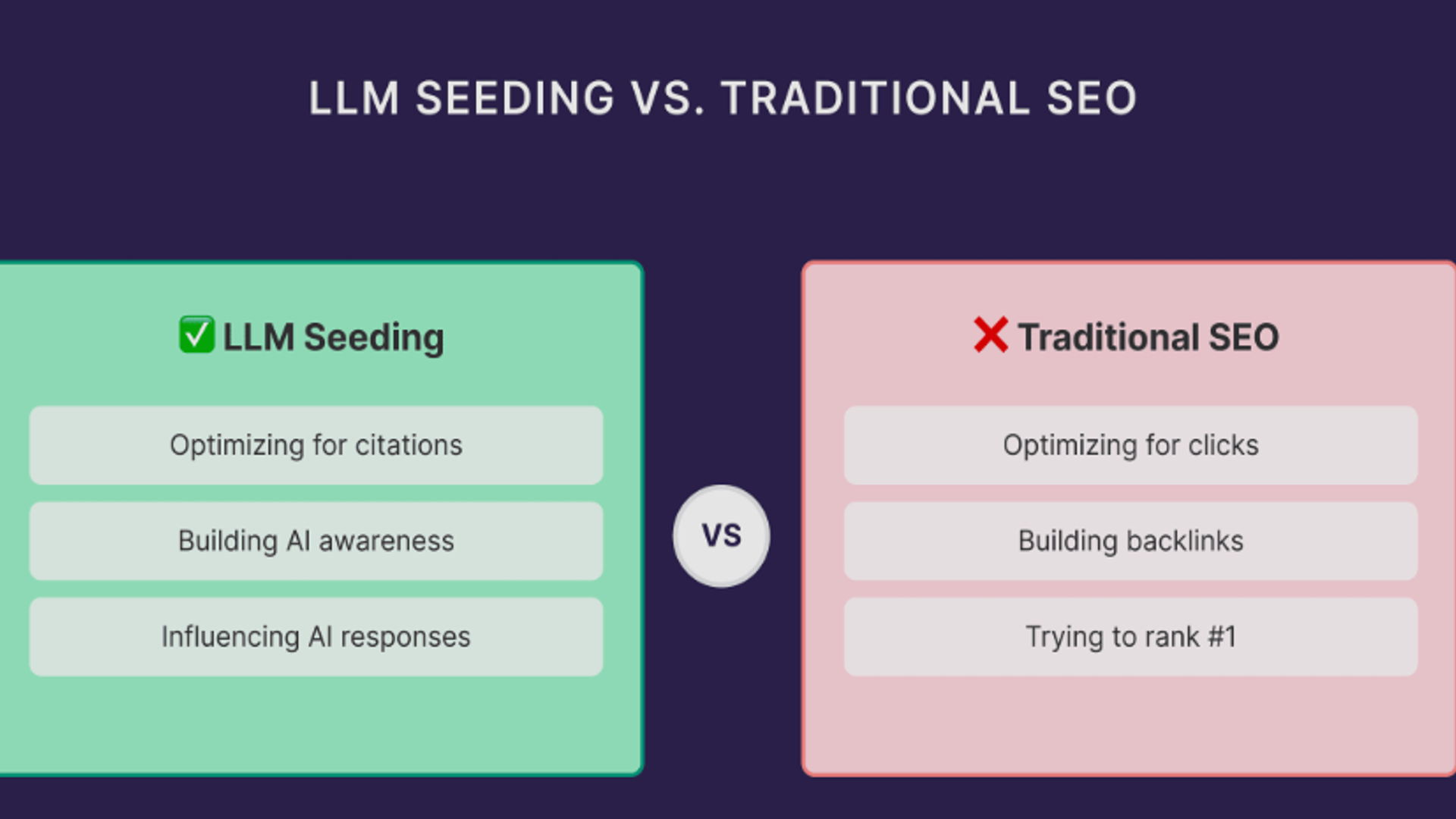
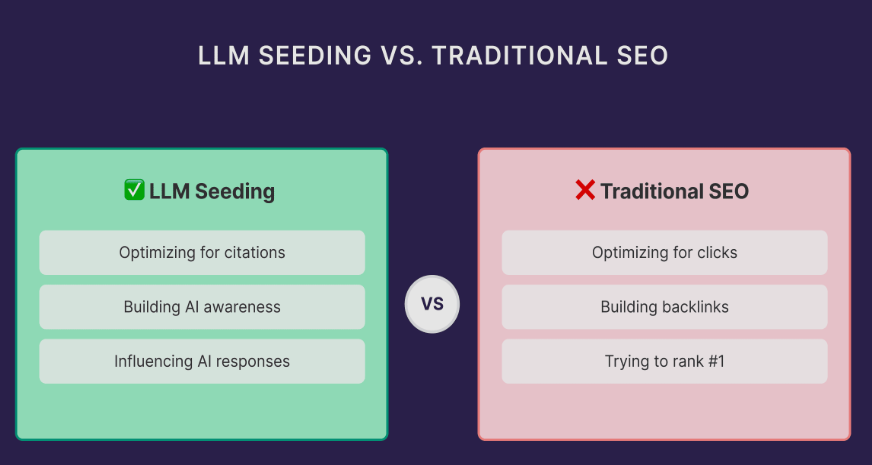
LLM seeding is the strategic practice of placing your brand's content within specific datasets and high-authority domains that Large Language Models trust and cite. Unlike traditional SEO that focuses on ranking your own pages in search results, LLM seeding optimizes your off-site digital footprint to serve as a primary information source for AI models. The ultimate goal is achieving "Brand Memory"—training AI models to associate your brand with specific topics so they recommend you even without direct searches.
Understanding LLM Seeding
LLM seeding represents a fundamental shift in digital marketing strategy. While traditional SEO has long utilized off-site signals such as backlinks, reviews, and brand mentions to boost domain authority, LLM seeding takes a different approach. Rather than simply improving your website's search ranking, LLM seeding ensures your brand appears in the third-party content that AI models rely on when generating responses.
This practice is the driving engine behind Generative Engine Optimization (GEO), focusing on making your brand visible across AI-powered platforms like ChatGPT, Perplexity, and Claude.
Three Core Tactics for LLM Seeding Success
1. Platform Diversity (The "Where")
AI models prioritize human consensus, making user-generated content (UGC) and third-party validation extremely valuable. Strategic platform selection includes:
- Forum Engagement : Reddit, Quora, and Stack Exchange contain authentic human answers that serve as goldmines for AI training data
- Review Platforms : Sites like G2, Capterra, and Trustpilot provide structured comparison data that LLMs use to build comparative tables
- Industry Communities : Specialized forums and discussion boards where your target audience actively engages
2. Structured Formatting (The "How")
AI models favor content they can easily parse and cite. Effective formatting strategies include:
- Semantic Chunking : Breaking content into distinct, self-contained sections that maintain human readability (note: Google advises against creating content purely for LLM rankings)
- Tables and Lists : Using HTML tables for comparisons enables easy scraping and data replication by AI models
- FAQ Formatting : Implementing clear Q&A structures helps models map specific questions to precise answers
- Schema Markup : Adding structured data that enhances content understanding and categorization
3. Digital PR & Authority (The "Who")
Citations from high-authority news outlets and industry publications signal to AI models that your brand is a recognized entity. This approach involves:
- Media Coverage : Securing mentions in reputable news sources and trade publications
- Thought Leadership : Publishing expert content that establishes your brand as an authoritative voice
- Industry Recognition : Building presence on platforms that AI models repeatedly reference
The Data Challenge: Moving Beyond Guesswork
Many companies approach LLM seeding blindly, manually testing prompts in ChatGPT and guessing where to post content based on competitor mentions. This approach fails for two critical reasons:
- Hallucinations : AI models often provide inaccurate citations when asked about their information sources
- Scale Issues : Manual tracking cannot cover the millions of prompt variations users actually ask
Successful LLM seeding requires treating it as a data problem, not a content problem. You need to map the digital information supply chain rather than rely on intuition.
Step-by-Step Data-Driven LLM Seeding Strategy
Step 1: Citation Forensics—Finding High-Weight Nodes
High-Weight Nodes are third-party sites that AI models repeatedly trust for specific topics. Identifying these nodes involves analyzing where competitors receive citations and understanding which domains carry the most influence.
Key insights from citation analysis reveal:
- Third-party dominance : The majority of cited URLs appear in responses that don't mention specific brands
- Educational content preference : AI models favor detailed explainer articles, comparison guides, and how-to content over vendor landing pages
- Category explanations : The highest-influence URLs explain categories rather than promote individual products
- Comparative content : Side-by-side solution comparisons receive heavy weighting in AI responses
Critical Takeaway : AI models don't automatically trust brands—they trust explanations. Rather than spreading efforts across numerous sites, focus on the small set of domains that consistently influence your topic.
Step 2: Prompt-Led Content Strategy
Traditional keyword research reveals what people type into Google. LLM seeding requires understanding prompts—the conversational questions users ask AI systems.
Effective prompt analysis uncovers:
- Visibility gaps : Prompts where competitors appear but your brand doesn't
- Operational questions : Specific use-case queries about customization, integrations, and workflows
- Content opportunities : Each missing mention represents a precise content brief
These gaps become actionable: create authoritative content answering exact questions and place it on identified high-weight nodes.
Step 3: Validating "Live Nodes"
Not all third-party sites play equal roles in the AI ecosystem. Some actively influence AI-driven research journeys, while others function as passive content destinations.
Live Nodes are publishers that:
- Consistently send users to AI platforms after content consumption
- Participate actively in AI-assisted research journeys
- Show increasing traffic patterns to ChatGPT, Perplexity, and similar platforms
Validating Live Nodes involves examining outgoing traffic behavior. When users regularly move from a publisher's content to an AI platform, it signals that readers use AI to validate, compare, or expand on what they've read.
This validation matters because prioritizing content placements on Live Nodes increases the likelihood that:
- Your content reaches high-intent users
- The domain receives repeated references during model training
- Your brand appears in AI-assisted research loops
Step 4: Measuring ROI and Performance
Effective LLM seeding requires tracking four critical metrics:
1. Competitive AI Brand Visibility Over Time
Track how your brand's visibility changes relative to competitors week over week. This metric reveals whether your LLM seeding efforts increase your visibility share faster than competitors' efforts.
2. Share of Model
Measure how frequently your brand appears in AI-generated answers compared to competitors, broken down by individual AI models (ChatGPT, Perplexity, Claude, etc.). This breakdown clarifies:
- Which models drive the most brand visibility
- Where competitive gaps exist
- Which platforms deserve increased focus
3. Brand Mention Volume
Count how many prompts include your brand versus how many exclude it. Rather than treating mentions as a vanity metric, use them to:
- Identify which prompts successfully trigger brand mentions
- Discover common high-intent prompts where your brand is absent
- Track mention volume changes over time
Increasing brand mention volume signals that AI models are learning to associate your brand with a wider range of questions and use cases.
4. AI Traffic
Monitor referral traffic from AI platforms to your website. AI interactions include both zero-click answers and high-intent referral clicks. AI traffic typically shows:
- Smaller volume compared to traditional search
- Higher user intent, especially for pricing and feature comparisons
- Validation-seeking behavior from users researching purchase decisions
Practical Implementation: AI Share Buttons
One experimental tactic involves adding AI share buttons to content, allowing readers to send articles directly to AI platforms with pre-formatted summary prompts. This approach:
- Makes it easy for users to introduce your content into AI conversations
- Creates opportunities for content to be summarized and cited by AI models
- Strengthens brand-topic associations through user-driven interactions
- Generates AI interaction histories that include your brand
This doesn't replace high-quality content creation or traditional distribution—it complements them by adding a user-driven seeding mechanism at the point of engagement.
Measuring Success: What Good Looks Like
Effective LLM seeding shows results through:
- Increased Share of Model Visibility : Your brand captures a larger percentage of AI-generated recommendations over time
- Growing Brand Mention Volume : AI models mention your brand across more diverse prompts and use cases
- Rising AI Referral Traffic : More high-intent users click through from AI platforms to your site
- Competitive Visibility Gains : Your visibility grows faster than competitors' in key topic areas
Results compound over time. Early progress appears as increased brand mentions and visibility across prompts, followed by stronger citation presence and downstream AI referral traffic.
Best Practices for LLM Seeding
Focus on Quality Over Quantity
The most effective LLM seeding content serves humans first. Create explanatory content that provides genuine value to readers. AI models benefit from clarity and structure, but usefulness must come first.
Prioritize High-Impact Placements
Rather than spreading thin across hundreds of sites, concentrate efforts on validated high-weight nodes. These strategic placements produce exponentially higher returns than broad, unfocused outreach.
Build for the Long Term
LLM seeding is a compounding strategy. Consistent effort in placing quality content on influential platforms creates cumulative benefits that grow over time.
Maintain Measurement Discipline
Track your key metrics consistently. Regular monitoring reveals what's working, identifies emerging opportunities, and guides resource allocation.
Common Questions About LLM Seeding
How is LLM seeding different from traditional link building?
Link building aims to pass authority to your domain for search ranking purposes. LLM seeding aims to place your brand in the content that AI models cite when generating responses.
Do I need to create special content just for AI models?
No. The most effective LLM seeding content is human-first, explanatory content that already performs well for readers. AI models reward clarity and usefulness, not AI-optimized tricks.
How long before I see results?
LLM seeding compounds over time. Early results manifest as increased brand mentions across diverse prompts. Stronger citation presence and AI referral traffic follow as efforts accumulate.
Which content formats work best?
Explainer articles, comparison guides, how-to content, and structured Q&A formats perform exceptionally well. AI models favor content they can easily parse and cite.
Can LLM seeding drive actual traffic?
Yes. While some AI interactions result in zero-click answers, many generate high-intent referral traffic, particularly when users need to validate pricing, compare features, or verify trust signals.
Conclusion: From Guesswork to Strategy
The era of "spray and pray" content distribution is ending. Success in LLM seeding belongs to brands with the clearest maps of the AI information ecosystem.
By identifying high-influence citation nodes, analyzing real user prompts, validating traffic flows, and measuring performance consistently, you transform guesswork into a repeatable, scalable system. Rather than hoping AI models mention your brand, you engineer the conditions that make mentions inevitable.
LLM seeding isn't about producing the most content—it's about placing the right content in the right places, backed by data that shows exactly where AI models learn and what they trust.