| Feature | Specification |
|---|---|
| Total Parameters | 1.04 Trillion |
| Active Parameters | 32 Billion |
| Architecture | Mixture-of-Experts (MoE) |
| Pre-training Data | 15 Trillion mixed visual & text tokens |
| Context Window | 256K tokens (Thinking Mode) |
| License | Modified MIT License |
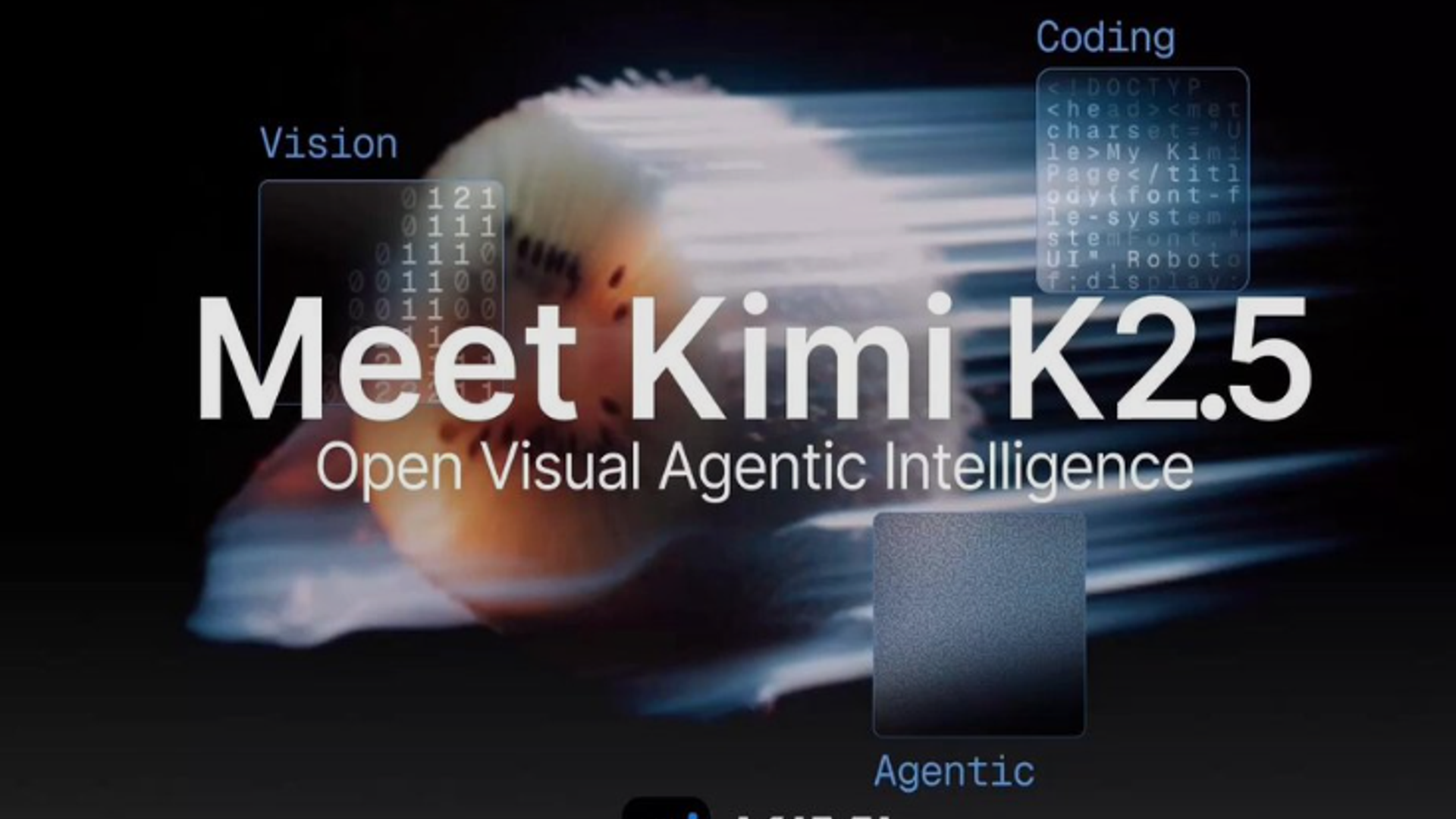
Kimi K2.5 is the most advanced open-source multimodal model released by Moonshot AI as of early 2026. It features a massive 1.04 trillion-parameter Mixture-of-Experts (MoE) architecture with 32 billion active parameters per inference. Key innovations include native support for image and video understanding, a revolutionary "Agent Swarm" capability that coordinates up to 100 sub-agents, and a vision-to-code engine that generates high-fidelity UIs from visual designs. It is currently available under a modified MIT license on Hugging Face.
The Architecture: A Trillion-Parameter MoE Powerhouse
The release of Kimi K2.5 marks a "DeepSeek moment" for 2026, pushing the boundaries of what the open-source community can achieve. By utilizing a Mixture-of-Experts (MoE) architecture, the model maintains the intelligence of a 1T parameter giant while remaining computationally efficient by only activating 32B parameters for any given token.
Technical Specifications at a Glance
This architecture allows Kimi K2.5 to handle incredibly complex reasoning tasks without the massive hardware overhead typically associated with trillion-parameter models. For local enthusiasts, this means high-tier performance is becoming increasingly accessible on consumer-grade setups with sufficient VRAM or through optimized quantization.
Native Multimodality: Vision and Video Integration
Unlike earlier models that "bolted on" vision capabilities using adapters, Kimi K2.5 is natively multimodal . It was trained from the ground up on a massive corpus of 15 trillion tokens that interleave text, images, and videos.
What Natively Multimodal Means for You:
- Visual Reasoning: The model doesn't just describe an image; it understands the spatial relationships and logic within it.
- Video Comprehension: You can upload MP4 files for the model to analyze workflows, summarize events, or even debug video-based UI interactions.
- Cross-Modal Thinking: In "Thinking Mode," the model can reason across different media types to solve a single problem, such as analyzing a floor plan (image) and writing the code (text) to render it in 3D.
The "Agent Cluster" and Swarm Innovation
The most talked-about feature in the r/LocalLLaMA community is the Agent Swarm . Kimi K2.5 introduces a paradigm shift from a single agent trying to do everything to a coordinated cluster of specialized "avatars."
How Agent Swarms Work:
- Decomposition: The main agent receives a complex request (e.g., "Build a full-stack e-commerce app").
- Specialization: It autonomously instantiates sub-agents with specific roles—one for frontend, one for backend, one for security, and one for documentation.
- Parallel Execution: These agents work simultaneously, drastically reducing the end-to-end runtime by up to 80% compared to sequential processing.
- Collaboration: The agents communicate via a shared context, allowing for up to 1,500 sequential tool calls without losing the thread of the project.
This "Agentic Intelligence" allows Kimi K2.5 to solve long-horizon tasks that previously required human project management, making it a true autonomous partner for developers and researchers.
Kimi Code: Bridging the Gap from Design to Deployment
For developers, the standout tool is Kimi Code , a CLI-based agent framework that leverages the model's visual and agentic strengths.
- UI-to-Code: You can take a screenshot of a website or a Figma design, and Kimi K2.5 will generate the responsive React, Vue, or Tailwind code to replicate it perfectly.
- Terminal Integration: It runs directly in your terminal and integrates with VSCode, Cursor, and JetBrains.
- Autonomous Debugging: The model can use visual inputs to "look" at the rendered output of the code it just wrote, detect visual bugs, and fix them autonomously.
"Kimi K2.5 doesn't just write code; it visually inspects its own work like a human developer would, iterating until the design matches the specification." — Community Review
Benchmarking the Giant: Kimi K2.5 vs. the Competition
In the 2026 landscape, benchmarks like Humanity's Last Exam (HLE) and BrowseComp have become the gold standard. Kimi K2.5 has set new records for open-source performance, often matching or exceeding proprietary giants like GPT-5 and Claude 4.5 in specific reasoning and agentic categories.
Key Benchmark Performance:
- Humanity's Last Exam (HLE): Achieved a record-breaking 44.9% with tool use.
- AIME25 (Mathematics): Scored 99.1% using internal Python execution.
- BrowseComp (Agentic Search): Outperformed competitors with a 60.2% success rate in autonomous web navigation tasks.
- SWE-Bench Verified: Solidified its place as a top-tier coding model with a 71.3% resolution rate.
Deployment and Accessibility
Moonshot AI has made Kimi K2.5 remarkably easy to adopt. Whether you are an enterprise developer or a local LLM tinkerer, there is a path for you.
How to Access Kimi K2.5:
- Official API: Available at platform.moonshot.ai , featuring OpenAI-compatible endpoints for easy migration.
- Web & App: Use the "Thinking" or "Agent" modes directly on Kimi.com.
- Local Deployment: The weights are hosted on Hugging Face. It is recommended to run the model using inference engines like vLLM , SGLang , or KTransformers .
- Quantization: Native INT4 quantization is supported, providing a 2x speedup and significantly lower VRAM requirements for local setups.
Conclusion: A New Era for Open Source
Kimi K2.5 is not just another incremental update; it is a foundational shift toward autonomous, visual, and multi-agent AI . By open-sourcing a model of this caliber, Moonshot AI has provided the community with a tool that rivals the most expensive proprietary models in existence.
The combination of a 1T parameter MoE architecture and the innovative "Agent Swarm" makes Kimi K2.5 the primary choice for anyone looking to build the next generation of AI agents. As the local LLM community continues to optimize and fine-tune this beast, the gap between "Open" and "Closed" AI has never been narrower.