| Feature | Google Gemini 3 (Nano Banana Pro) | Anthropic Claude Opus 4.5 | OpenAI ChatGPT |
|---|---|---|---|
| Primary Strength | Image generation and editing | Coding and agentic workflows | General-purpose AI assistant |
| Release Date | November 20, 2025 | November 24, 2025 | Ongoing updates |
| Latest Development | Nano Banana Pro launch | Opus 4.5 release | Ads testing in beta |
| Pricing | Free tier with limits; paid tiers for higher quotas | $5/$25 per million tokens | Free and subscription tiers; potential ad-supported tier |
| User Base | 650M monthly active users (Gemini app) | Not publicly disclosed | 800M weekly active users |
| Best For | Visual content creation, infographics, image editing | Software development, enterprise workflows, coding | General queries, conversational AI |
| Image Capabilities | State-of-the-art with 2K/4K support, multilingual text rendering | Limited (not primary focus) | DALL-E 3 integration |
| Coding Performance | Not primary focus | 80.9% on SWE-bench Verified (industry-leading) | Competitive but below Opus 4.5 |
| Context Window | Varies by model | 200,000 tokens | Varies by model |
| Knowledge Cutoff | Real-time with Search integration | March 2025 | Varies by model |
| Enterprise Features | Workspace integration, enterprise safety filters | Superior for finance, legal, precision-critical tasks | Business plans available |
| Monetization Model | Freemium with subscriptions | API and subscription-based | Subscriptions + potential advertising |
| Recent Controversy | None | None | Leaked ad feature testing |
| Stock Market Impact | +4% for Alphabet | $350B valuation with new investments | N/A (private company) |
| Computer Use | Limited | 66.3% on OSWorld (best in class) | Moderate |
| Multi-Language Support | Advanced with translation capabilities | Strong | Strong |
| Integration Partners | Adobe, Figma, Google ecosystem | Microsoft, Amazon, Google Cloud | Wide third-party integration |
The Perfect Storm: Three Major AI Announcements in One Week
November 2025 witnessed an unprecedented convergence in the artificial intelligence landscape. Within a single week, three major AI companies launched significant updates that reshaped the competitive dynamics of the industry. Google introduced Nano Banana Pro, built on Gemini 3 Pro, as its state-of-the-art image generation and editing model. Just days later, Anthropic announced Claude Opus 4.5, calling it the "best model in the world for coding, agents, and computer use". Meanwhile, OpenAI found itself in a different kind of spotlight as leaked code from ChatGPT's Android beta revealed references to advertising features, signaling a potential monetization shift.
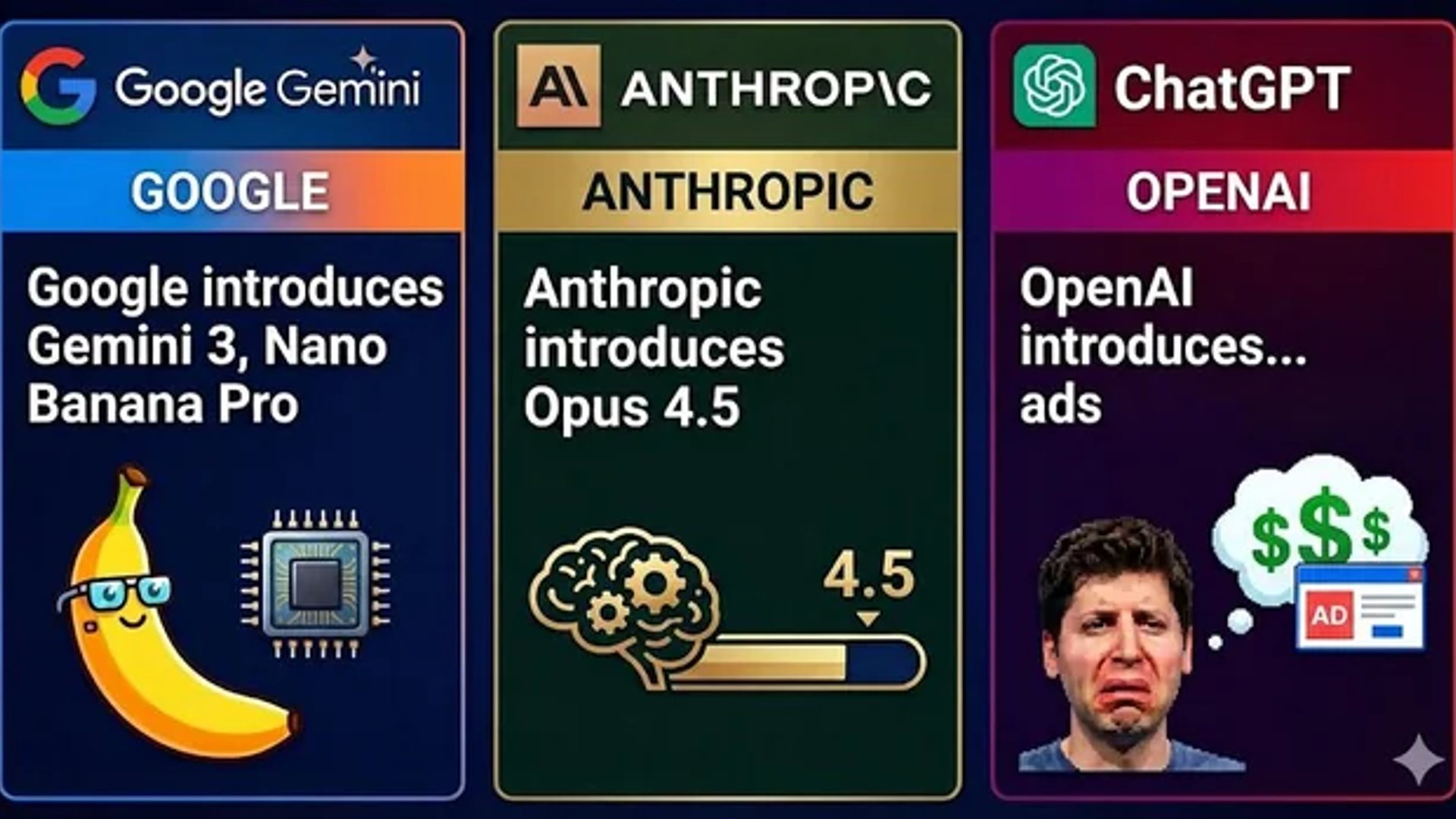
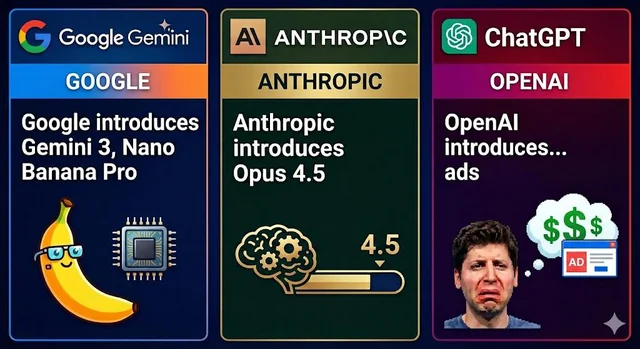
The timing couldn't have been more dramatic. As the viral meme circulating on social media illustrates, Google and Anthropic were celebrating major product launches while OpenAI faced scrutiny over potential ads in ChatGPT—a move that could fundamentally alter the user experience millions have come to expect.
Detailed Comparison: Features, Capabilities, and Market Positioning
Google Gemini 3 and Nano Banana Pro
Google's latest offering centers around advanced image generation capabilities powered by the Gemini 3 Pro foundation model. Nano Banana Pro uses Gemini's state-of-the-art reasoning and real-world knowledge to visualize information better than ever before, helping users visualize any idea and design anything from prototypes to infographics to turning handwritten notes into diagrams.
Key Features:
- Advanced Text Rendering : The model excels at creating images with correctly rendered and legible text directly in the image, whether short taglines or long paragraphs
- Multilingual Support : Enhanced multilingual reasoning enables text generation in multiple languages and content localization
- Real-World Knowledge Integration : Gemini 3 Pro Image connects a vast knowledge base to produce more factual assets, and when enabled, grounding with Google Search connects the model to real-time web content for data-driven outputs
- Professional-Grade Outputs : Support for 2K and 4K resolution with expanded visual context windows allowing up to 14 reference images
- Integration Across Google Ecosystem : Available in Google Workspace (Slides, Vids), Gemini app, NotebookLM, and Google Ads
Pricing and Availability: Free users have a limited quota before returning to the original Nano Banana, while Google AI Plus, Pro, and Ultra subscribers get higher usage limits. The watermark is removed for AI Ultra subscribers.
Market Impact: The Gemini app currently has over 650 million monthly active users, with Gemini-powered AI Overviews reaching 2 billion monthly users. The release contributed to a 4% stock increase for Alphabet.
Anthropic Claude Opus 4.5
Anthropic's flagship release focuses squarely on coding excellence and agentic workflows. Claude Opus 4.5 achieves state-of-the-art performance on tests of real-world software engineering, and is meaningfully better at everyday tasks like deep research and working with slides and spreadsheets.
Key Features:
- Superior Coding Performance : Opus 4.5 achieves industry-leading results with 80.9% on SWE-bench Verified, the first model to score over 80% on this respected coding benchmark
- Enhanced Computer Use : Opus 4.5 reaches 66.3% on OSWorld, making it Anthropic's best computer-using model
- Hybrid Reasoning : Allows for instant responses or extended thinking with fine-grained controls for adjusting effort levels
- Improved Context Management : An "endless chat" feature allows chats to proceed without interruption when the model hits its context window, compressing context memory without alerting the user
- Enterprise Focus : The model produces work with consistency, professional polish, and genuine domain awareness, making it fit for finance, legal, and other precision-critical workflows
Pricing and Availability: Pricing is $5/$25 per million tokens, making Opus-level capabilities accessible to more users—significantly cheaper than the previous Opus at $15/$75. Available via Claude apps, API, and all three major cloud platforms (Amazon Bedrock, Google Cloud Vertex AI, Microsoft Foundry).
Technical Specifications:
- 200,000 token context window
- 64,000 token output limit
- March 2025 knowledge cutoff
Market Impact: Microsoft and Nvidia announced multi-billion-dollar investments in Anthropic, boosting the AI lab's valuation to about $350 billion.
OpenAI ChatGPT and the Advertising Question
While Google and Anthropic celebrated product launches, OpenAI faced a different narrative. Code references such as "search ad," "search ads carousel," and "bazaar content" were discovered in ChatGPT Android app version 1.2025.329, suggesting the company is preparing to introduce advertisements.
Current Status:
- No official announcement from OpenAI
- ChatGPT has roughly 800 million people using it every week, up from 100 million weekly users in November 2023
- India has become the single biggest user base, ahead of the US, with ChatGPT handling about 2.5 billion prompts a day
Potential Advertising Model: Evidence suggests that ads will start around search, shopping and recommendation answers, with marketplace-style product cards, not inside every normal chat. The approach would be similar to what Google shows in AI Overviews and what Microsoft's Copilot already displays for shopping queries.
CEO Perspective: Sam Altman acknowledged that ads are "something we may try at some point," while emphasizing that ChatGPT's value comes from the trust users place in its recommendations. He noted that if ChatGPT were accepting payment to put inferior options above better ones, it would be catastrophic for user trust.
Strategic Context: The move appears driven by the need for additional revenue streams beyond subscriptions to support increasing computational demands and maintain free-tier access.
Comparative Analysis Table
The Competitive Dynamics: What This Means for Users
Innovation vs. Monetization
The stark contrast in these announcements reveals different strategic priorities. Google and Anthropic are investing heavily in pushing technical boundaries—Google with visual AI and Anthropic with coding excellence. Meanwhile, OpenAI appears to be focusing on sustainable business models to support its massive user base.
User Experience Implications
For consumers, these developments create clear choices:
- Visual Creators and Designers : Google's Nano Banana Pro offers unparalleled image generation capabilities with professional-grade outputs and real-world knowledge integration
- Developers and Technical Teams : Anthropic has never focused on image manipulation or video creation but has stuck squarely to its strength in coding and productivity use cases
- General Users : ChatGPT remains the most accessible general-purpose AI assistant, though potential advertising could alter the user experience
The Timing Question
The meme's reference to "bad timing" reflects a broader industry tension. As competitors announce groundbreaking capabilities, OpenAI's potential pivot to advertising appears reactive rather than innovative. According to The Information, Sam Altman told colleagues that Google's Gemini 3 update will create "temporary economic headwinds" for OpenAI.
Industry Expert Perspectives
The releases have generated significant industry commentary:
On Opus 4.5's Coding Capabilities: Alex Albert, head of developer relations at Anthropic, noted that past models have often been very good at gathering data across different channels but have had a hard time synthesizing information effectively, stating "with this model, that is no longer the case".
On Gemini 3's Market Impact: Salesforce CEO Mark Benioff announced he is ditching ChatGPT for Google's latest model, sending Alphabet's stock up more than 6%.
On Testing and Validation: Anthropic tested Claude Opus 4.5 on a difficult take-home exam given to prospective performance engineers, and the model scored higher than any human candidate ever had.
Looking Ahead: The Future of AI Competition
Differentiation Through Specialization
The November announcements demonstrate a market moving toward specialization. Rather than competing solely on general capabilities, companies are carving out distinct niches:
- Google: Visual AI and creative workflows
- Anthropic: Enterprise coding and precision tasks
- OpenAI: Broad accessibility with potential ad-supported models
The Sustainability Question
According to the Wall Street Journal, Anthropic is positioned to break even by 2028, while OpenAI plans to hit that mark in 2030. This financial reality explains the different approaches to monetization and may presage further industry consolidation.
User Choice and Market Maturity
The competitive landscape now offers genuine choice based on use case rather than simply "which AI is best." Professional developers can optimize for Opus 4.5's coding prowess, visual creators can leverage Gemini 3's image capabilities, and general users can choose between ChatGPT's accessibility and competitors' specialized offerings.
Conclusion: An Inflection Point for AI
November 2025 marks a defining moment in artificial intelligence competition. The simultaneous launches of Gemini 3 and Opus 4.5, contrasted with ChatGPT's advertising controversy, illustrate the industry's maturation from general-purpose tools to specialized, commercially viable products.
For users, the question is no longer "which AI should I use?" but rather "which AI best serves my specific needs?" Visual creators have a clear choice in Gemini 3's Nano Banana Pro. Developers and technical teams can leverage Opus 4.5's superior coding capabilities. General users must weigh ChatGPT's accessibility against potential advertising and the specialized strengths of competitors.
The meme that sparked this analysis may have been humorous, but it captures a genuine inflection point: the era of undifferentiated AI assistants is over, replaced by a diverse ecosystem where innovation, monetization, and user trust compete for primacy.
As these platforms continue to evolve, success will depend not just on technical capabilities but on aligning product strategy with user needs and sustainable business models. The companies that master this balance will define the next chapter of artificial intelligence.
Last updated: December 1, 2025. Information based on official announcements and industry reports from November 2025.