Google AI Overviews vs. AI Mode: 2025 Search Systems Comparison
Introduction: Two Systems, Different Approaches
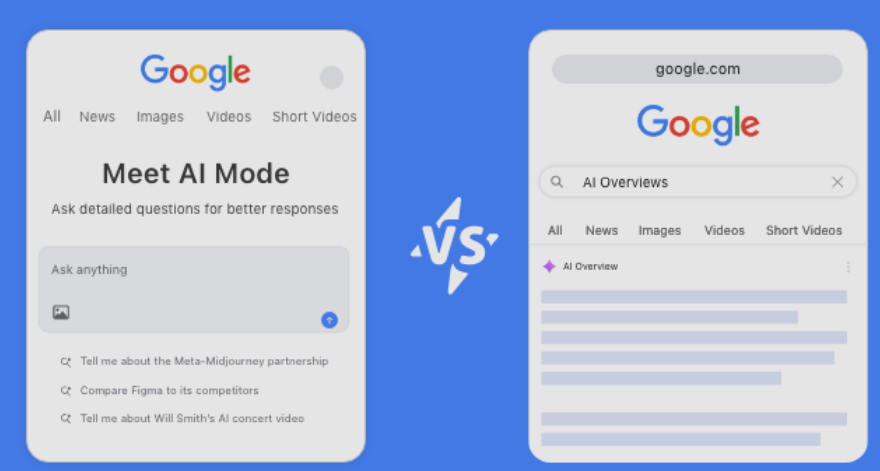
Google's AI search has evolved into two distinct experiences: AI Overviews, which provide concise answers within traditional search results, and AI Mode, an interactive chat interface delivering comprehensive, detailed responses. While they appear to serve similar purposes, a groundbreaking study analyzing 730,000 response pairs reveals they operate as fundamentally different systems.
This comprehensive analysis uncovers surprising insights about how these AI features cite sources, structure content, and ultimately serve different user needs. Understanding these differences is critical for marketers, content creators, and SEO professionals navigating the AI-powered search landscape.
Executive Summary: Key Findings at a Glance
Metric
Finding
Implication
Citation Overlap
Only 13.7% of sources match
Two systems cite different sources for the same query
Word-Level Similarity
Just 16% unique words overlap
Responses are written completely differently
Semantic Similarity
86% agreement on meaning
Both reach similar conclusions despite different approaches
Response Length
AI Mode is 4x longer
Comprehensive vs. concise information delivery
Entity Mentions
AI Mode includes 3.3 entities vs. 1.3
More brands and people mentioned in longer responses
Brand Carryover
61% of AI Overview brands appear in AI Mode
Partial visibility overlap between systems
Citation Gaps
11% of AI Overviews lack citations vs. 3% for AI Mode
Different standards for source attribution
Understanding AI Overviews and AI Mode
What is AI Overviews?
AI Overviews appear at the top of traditional Google search results, providing quick, synthesized answers to user queries. These concise responses typically range from a few sentences to a couple of paragraphs, designed to answer questions without requiring clicks to external websites.
Key Characteristics:
Appears within standard search results pages
Delivers brief, focused answers
Optimized for quick information retrieval
Often includes visual elements like images or videos
Designed for users seeking fast facts
What is AI Mode?
AI Mode represents Google's conversational AI search experience, accessible through a dedicated interface. This interactive system engages in dialogue with users, providing comprehensive, detailed responses with extensive source citations.
Key Characteristics:
Standalone chat-style interface
Generates extensive, multi-paragraph responses
Encourages follow-up questions and exploration
Provides detailed source attribution
Designed for research and deep investigation
Finding #1: Minimal Citation Overlap Between Systems
The Citation Gap: Only 13.7% Overlap
Perhaps the most striking discovery from this analysis is how rarely AI Overviews and AI Mode cite the same sources. When both systems answer identical queries, they share only 13.7% of their citations.
Citation Analysis
Percentage
All Citations Overlap
13.7%
Top 3 Citations Overlap
16.3%
Unique Citations per System
~87%
This means that 87% of the time, these AI systems pull from completely different source pools to answer the same question. Even when examining just the most prominently cited sources (top 3), the overlap increases only marginally to 16.3%.
Domain Preferences: Different Systems, Different Sources
The two systems show distinct preferences for certain types of sources:
Source Type
AI Overviews Citation Rate
AI Mode Citation Rate
Difference
YouTube
#1 most cited
Lower ranking
AI Overviews strongly prefers video
Wikipedia
18.1%
28.9%
AI Mode cites 10% more often
Reddit
Similar usage
Similar usage
Both value community content
Quora
Lower citation
3.5x higher
AI Mode significantly prefers
Health Websites
Moderate citation
2x higher
AI Mode favors medical sources
Facebook
Lower citation
2x higher
AI Mode cites more frequently
Content Format Preferences
Content Type
AI Overviews Preference
AI Mode Preference
Articles
High
High
Videos
2x more likely to cite
Standard citation rate
Core Pages (homepages/category pages)
2x more likely to cite
Standard citation rate
Long-form Content
Standard
Preferred for depth
Key Insight: AI Overviews demonstrates a strong preference for multimedia content (videos, core pages), while AI Mode leans toward encyclopedic and detailed textual sources. Both systems overwhelmingly prefer article-format content but differ in their secondary preferences.
Finding #2: Minimal Word-Level Overlap
Only 16% Unique Words Match
Despite answering identical queries, AI Overviews and AI Mode share remarkably few actual words in their responses.
Similarity Metric
Percentage
What This Means
Jaccard Similarity (unique word overlap)
16%
Only 16 out of 100 unique words match
Identical First Sentence
2.51%
Responses rarely start the same way
Completely Identical Responses
0.51%
Almost never produce duplicate content
This low word-level overlap demonstrates that AI Mode isn't simply expanding on AI Overviews' answers by adding more detail to the same base text. Instead, both systems independently research queries and formulate entirely new responses with minimal textual overlap.
Example: Different Words, Same Information
Consider a query about cloud storage alternatives:
Feature
AI Overviews Approach
AI Mode Approach
Brand Mentions
7 brands mentioned once each
23 brand mentions with repetition
Placement
Brands listed at end of response
Brands integrated throughout, starting in first sentence
Structure
Brief list format
Detailed explanations for each option
Detail Level
Surface-level overview
In-depth feature comparisons
Finding #3: High Semantic Similarity Despite Different Sources
86% Semantic Agreement
Here's where the analysis reveals something truly fascinating: despite citing different sources (13.7% overlap) and using different words (16% overlap), the two systems reach remarkably similar conclusions.
Semantic Similarity Score
Distribution
Above 0.8 (strong agreement)
89.7% of responses
Average Similarity
86%
Scale
0 (completely different) to 1 (identical meaning)
What This Means: Nine out of ten times, AI Mode and AI Overviews agree on what information to convey—they simply express it differently and cite different supporting sources.
Why Different Sources Lead to Similar Answers
Google's documentation confirms both systems use “query fan-out,” a technique that runs multiple related searches to find supporting content while generating responses.
Query Fan-Out Process
How It Works
Step 1
Receives user query
Step 2
Generates multiple related sub-queries
Step 3
Searches across different source pools
Step 4
Synthesizes findings into coherent response
Result
Different paths to similar conclusions
Since AI Mode and AI Overviews use different models and techniques, they naturally discover different sources during this fan-out process. However, both draw from a generally consistent understanding of each topic, explaining why they converge on similar answers despite different research paths.
Analogy: Think of two experts answering the same question. They might reference completely different studies and use entirely different phrasing, but if both are knowledgeable about the topic, their core answers will align. That's exactly what's happening with these AI systems.
Finding #4: Significant Length and Entity Differences
Response Length Comparison
Metric
AI Overviews
AI Mode
Ratio
Average Length
1x (baseline)
4x longer
4:1
Entity Mentions
1.3 per response
3.3 per response
2.5:1
Brand/People Frequency
Single mentions
Multiple mentions throughout
Variable
Brand Mention Patterns
AI Mode's longer format creates fundamentally different opportunities for brand visibility:
Brand Visibility Factor
AI Overviews
AI Mode
Total Brand Mentions
Lower volume
2.5x more brands mentioned
Brand Repetition
Typically mentioned once
Often mentioned multiple times
Placement
Often near end of response
Distributed throughout, including opening
Context Provided
Minimal context
Detailed explanations per brand
Brand Carryover Between Systems
Carryover Metric
Percentage
Implication
Brands in AI Overview that also appear in AI Mode
61%
Good chance of dual visibility
Brands unique to AI Mode
39%
Additional competitors appear in longer responses
Entity Expansion Rate
61% carry forward + new additions
AI Mode builds on similar foundation
Key Insight: If your brand is mentioned in an AI Overview, there's a 61% probability it will also appear in AI Mode's response—but you'll be sharing space with additional competitors who didn't make the shorter AI Overview cut.
Finding #5: Significant Brand and Citation Gaps
Responses Without Brand Mentions
System
Percentage With No Brands/People
Implication
AI Overviews
59.41%
Most responses don't mention brands
AI Mode
34.66%
Fewer responses omit brands
Combined
32.8%
One-third of all AI responses mention no entities
When Brands Are Omitted:
Informational queries where no brand is expected (“November 21 zodiac”)
General concept explanations (“revenue cycle”)
How-to guides without product recommendations (“meditation before bed”)
Quick factual answers that don't require attribution
Citation Gaps Across Systems
Citation Status
AI Overviews
AI Mode
Why the Difference?
Responses With Citations
89%
97%
AI Mode more consistently cites sources
Responses Without Citations
11%
3%
AI Overviews more often omits attribution
Why Citations Are Missing
Scenario
Example Queries
Typical System Response
Simple Calculations
“4 divided by 1/2”
Direct answer without sources
NSFW/Sensitive Content
“sexual abuse”, “domestic violence”
Help center redirects or careful responses
Unsupported Languages
Queries in languages not fully supported
Limited or no response
Edge Cases
Highly specific or unusual queries
May lack appropriate sources
Why AI Mode Cites More Consistently
Factor
Explanation
Length Requirements
4x longer responses require more supporting evidence
User Expectations
Interactive chat format creates expectation of transparency
Query Filtering
AI Mode may pre-filter queries less likely to have quality sources
Research Context
Users engaging with AI Mode are often in research mode, expecting attribution
Strategic Implications for Marketers and SEO Professionals
Optimization Strategy Differences
Optimization Goal
AI Overviews Strategy
AI Mode Strategy
Content Length
Concise, focused answers
Comprehensive, detailed explanations
Source Types
Prioritize video and core pages
Focus on encyclopedic, authoritative content
Citation Standards
Can succeed with indirect attribution
Must provide explicit source grounding
Entity Strategy
Aim for selective brand inclusion
Opportunity for multiple mentions throughout
Format Preference
FAQ formats, featured snippet optimization
Long-form articles, whitepapers, detailed guides
Visibility Monitoring Requirements
What to Track
Why It Matters
Recommended Approach
Both Systems Separately
Only 13.7% citation overlap means independent visibility
Use tools like Ahrefs Brand Radar to monitor each
Citation Sources
Different domain preferences require different optimization
Track which content types get cited in each system
Competitor Presence
AI Mode includes more brands than AI Overviews
Monitor competitive share in both environments
Entity Mentions
Track brand mention frequency and context
Analyze how often and where your brand appears
Content Strategy Framework
Priority
Action Item
Expected Impact
1. Build Semantic Authority
Focus on comprehensive topic coverage, not exact phrases
Positions content as relevant for both systems
2. Optimize for Length Differences
Create both concise and detailed versions of key content
Serves both AI Overview and AI Mode preferences
3. Diversify Source Types
Develop video content, core pages, and long-form articles
Meets different citation preferences
4. Enhance Encyclopedic Value
Create reference-quality resources
Increases AI Mode citation likelihood
5. Maintain Multi-Platform Presence
Be discoverable on Wikipedia, YouTube, authoritative sites
Maximizes chances of citation in either system
Platform-Specific Optimization Tactics
For AI Overviews Success
Tactic
Implementation
Why It Works
Video Content Creation
Develop YouTube videos addressing common queries
AI Overviews strongly prefers video citations
Core Page Optimization
Enhance homepage and main category pages
Cited twice as often as in AI Mode
Concise Answer Formats
Lead with direct answers in first paragraph
Matches AI Overview's brief response style
Featured Snippet Targeting
Structure content for snippet extraction
AI Overviews draws from similar content pools
FAQ Schema Implementation
Add structured FAQ markup
Helps AI parse and extract answers
For AI Mode Success
Tactic
Implementation
Why It Works
Encyclopedic Content Development
Create comprehensive, reference-quality resources
Wikipedia cited 28.9% vs 18.1% in AI Overviews
Long-Form Articles
Develop detailed guides and whitepapers
Supports AI Mode's extensive responses
Source-Heavy Content
Include numerous citations and references
Meets AI Mode's higher attribution standards
Detailed Explanations
Provide context and nuance for concepts
Fills AI Mode's need for comprehensive answers
Brand Context Building
Explain what makes your brand authoritative
Supports inclusion in entity-rich responses
Understanding the User Journey Differences
When Users Choose AI Overviews
User Intent
Example Scenario
What They Need
Quick Facts
“What year was iPhone released?”
Single data point
Simple Definitions
“What is photosynthesis?”
Brief explanation
Direct Answers
“How many ounces in a cup?”
Immediate fact
Initial Research
Starting point before deeper investigation
Overview to determine next steps
When Users Choose AI Mode
User Intent
Example Scenario
What They Need
Comparative Research
“Compare project management software for small teams”
Detailed analysis
Complex Questions
“How does quantum computing affect encryption?”
Nuanced explanation
Multi-Step Problems
“Plan a 7-day Italy itinerary with specific dietary needs”
Comprehensive solution
Learning New Topics
“Explain machine learning from basics to advanced”
Progressive information
Measuring Success Across Both Systems
Key Performance Indicators
KPI Category
AI Overviews Metrics
AI Mode Metrics
Visibility
Appearance frequency, position in results
Citation frequency, mention prominence
Citation Quality
Source diversity, authoritative domain citations
Attribution context, citation placement
Brand Presence
Brand mention rate, context of mentions
Frequency of mentions, repeated references
Competitive Position
Share of voice vs competitors
Entity inclusion rate vs competitors
Recommended Monitoring Frequency
What to Monitor
Suggested Frequency
Why
Citation Tracking
Weekly
Identify emerging patterns and opportunities
Competitor Presence
Bi-weekly
Stay aware of competitive landscape changes
Content Performance
Monthly
Assess which content types drive citations
Strategic Adjustments
Quarterly
Refine approach based on performance data
Common Mistakes to Avoid
Mistake
Why It's Problematic
Better Approach
Assuming Success in One Guarantees Success in Both
Only 13.7% citation overlap
Monitor and optimize for each system independently
Focusing Only on Keywords
86% semantic similarity shows theme matters more
Build topical authority and comprehensive coverage
Creating Single Content Format
Different systems prefer different content types
Diversify content across formats and lengths
Ignoring Citation Standards
AI Mode requires more rigorous sourcing
Strengthen source attribution across all content
Treating AI Features as One Channel
Fundamentally different systems with different needs
Develop separate strategies for each
Future Trends and Preparations
Emerging Patterns to Watch
Trend
Current State
Anticipated Evolution
Citation Diversity
Low overlap between systems
May converge as systems mature
Response Personalization
Limited personalization
Increasing user-specific customization
Multi-Modal Integration
Primarily text-based citations
More image, video, and audio source integration
Real-Time Updates
Relatively static responses
More dynamic, current information incorporation
Preparing for AI Search Evolution
Preparation Area
Action Steps
Timeline
Content Infrastructure
Build systems supporting multiple formats
Ongoing
Monitoring Capabilities
Implement comprehensive AI tracking tools
Immediate
Team Training
Educate on AI optimization best practices
Within 3 months
Strategic Flexibility
Create adaptable content strategies
Ongoing
Case Study Examples
E-Commerce Brand Optimization
Scenario
AI Overviews Approach
AI Mode Approach
Product Questions
Brief feature lists with key benefits
Detailed comparisons with use cases
Buying Guides
Quick recommendation summaries
Comprehensive guides with multiple options
Technical Specs
Highlight top 3-5 specifications
Complete specification tables and explanations
B2B Software Company
Content Type
AI Overviews Strategy
AI Mode Strategy
Solution Overviews
Concise value propositions
Detailed capability explanations
Implementation Guides
Quick-start summaries
Step-by-step comprehensive guides
Comparison Content
Feature comparison highlights
In-depth competitive analysis
Local Service Business
Optimization Focus
AI Overviews Tactics
AI Mode Tactics
Service Descriptions
Key services with brief details
Complete service explanations with process
Location Information
Core NAP (Name, Address, Phone) data
Extended area coverage, parking, accessibility
FAQ Content
Most common 5-10 questions
Comprehensive FAQ covering all scenarios
Conclusion: Two Systems, One Comprehensive Strategy
The analysis of 730,000 AI responses reveals that AI Overviews and AI Mode are not simply short and long versions of the same answer—they're fundamentally different systems that happen to reach similar conclusions through distinct paths.
Key Takeaways
Independent Optimization Required: With only 13.7% citation overlap, success in one system doesn't guarantee visibility in the other
Focus on Semantic Authority: 86% semantic similarity shows both systems value comprehensive topical expertise
Diversify Content Formats: Different systems prefer different content types—from videos to encyclopedic articles
Monitor Both Systems: Track visibility separately to understand your complete AI search presence
Prepare for Competition: AI Mode includes more brands, meaning more competitive presence even if you're cited
The Bottom Line
Treat AI Overviews and AI Mode as separate distribution channels with overlapping goals but different requirements. Optimize for both, monitor performance independently, and build content strategies that serve the unique characteristics of each system. The brands that succeed in AI search will be those that understand these differences and adapt accordingly.
The future of search visibility lies not in choosing between traditional SEO, AI Overviews, or AI Mode—but in developing integrated strategies that win across all three.
Find the perfect Valentine’s Day gift for outdoorsman in 2026. Explore our top 10 gear picks, from e-bikes to hiking tech, to impress your adventurous guy.
A diamond ring for women in 2025 blends luxury with smart health features, tracking heart rate, sleep, and more for style and wellness in one elegant piece.
Choosing a diamond ring for yourself shows real confidence. You celebrate what makes you special and respect your successes. You do not just do what others expect. Many people buy
Vertu AI Diamond Ring blends luxury, smart features, and personalization, making your diamond ring a unique statement that elevates your modern lifestyle.