1. The Technological Schism: Z-Fold vs. G-Fold Logic
By 2026, the "arms race" for screen folds has reached a physical peak. The industry has moved beyond standard dual-fold devices, which have become "basic models" in professional environments, to embrace tri-fold "pocket tablets" .
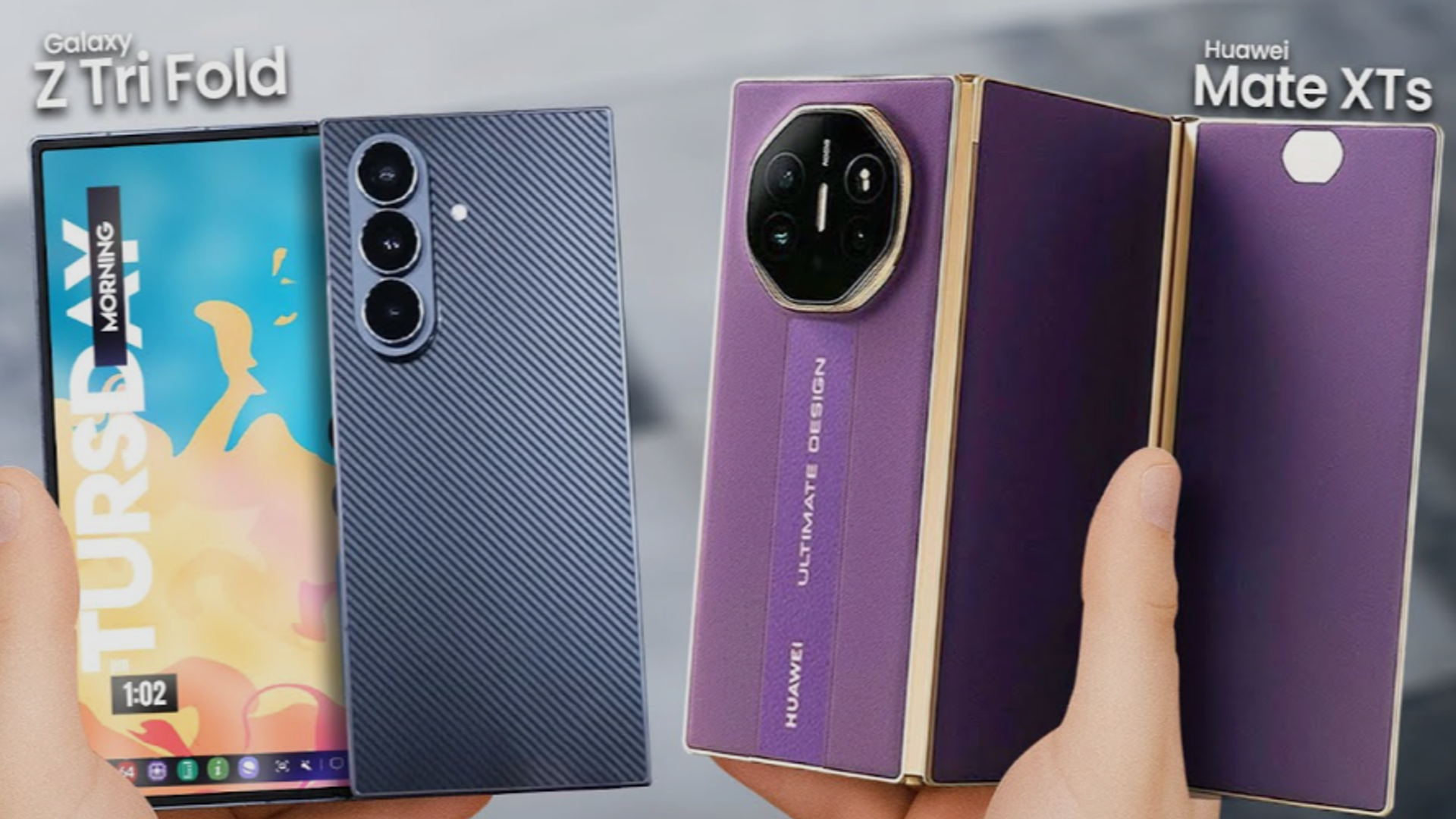
Huawei Mate XT: The "Z-Shape" Pioneer
Huawei took the initial lead with a design logic that emphasizes intuitive expansion and extreme thinness .
Structure: Utilizes a Z-shape accordion fold (one inward, one outward) .
Screen Real Estate: Expands a 6.4-inch phone screen into a massive 10.2-inch 3K resolution display (3184×2232) .
Functional Versatility: Offers three distinct modes: a standard thick smartphone, a "handled" partial tablet, and a full productivity workstation .
The Trade-off: The outward-folding side leaves a portion of the screen permanently exposed, making the device as delicate as "fine porcelain" and highly susceptible to wear and tear .
Samsung Galaxy Z TriFold: The "G-Shape" Fortress
Samsung’s delayed entry into the tri-fold space focuses on a "violent aesthetic" of durability and raw power .
Structure: Features a G-shape double inward-fold, protecting the primary screen surfaces when closed .
Hardware Focus: Powered by the Snapdragon 8 Elite for Galaxy, prioritizing IP48 dust and water resistance .
Productivity Logic: Unlike Huawei’s "expanded phone" concept, Samsung treats the device as a "portable workstation" or a "phone that can call," heavily integrating its DeX desktop mode .
The Trade-off: With a weight of 309g, it is significantly heavier than its competitors, leading some critics to label it a "heavy tool" rather than a sleek consumer device .
2. Competitive Comparison Table: 2026 Tri-Fold Leaders
3. Who is Buying the $2,800 "Pocket Tablet"?
At a price point exceeding 19,999 RMB, the tri-fold smartphone has transcended the category of "consumer electronics" to become a "technological asset" or "social currency" . Three primary user groups sustain this high-margin market:
The High-Efficiency Business Traveler
Found predominantly in business-class lounges and high-speed rail VIP cabins, these users view the tri-fold as a "digital Swiss Army Knife" .
The Use Case: They utilize the 10-inch "Golden Deck" to run multi-window setups—editing WPS documents, monitoring video conferences, and responding to instant messages simultaneously .
The Value: It replaces the need for a laptop or a bulky iPad during short layovers or commutes .
The Digital Status Seeker (Tech Geeks)
For this group, the tri-fold is a physical manifestation of being at the "bleeding edge" of innovation .
The Value: The social prestige comes from the physical act of "unfolding" the device in a public or social setting, which serves as a visible marker of wealth and technological savvy .
The Logic: They are less concerned with cost-performance ratios and more with the "rarity" of a device that can fold three times .
The Professional Content Creator
Female influencers and tech-savvy creators find the tri-fold's split-screen capabilities essential for modern workflows .
The Use Case: Running a reference video on the left, a video editor in the center, and social media feedback on the right .
The Value: It provides a level of immersion and multi-tasking efficiency that traditional "slab" phones or even dual-foldables cannot match .
4. The Industry Paradox: Hardware 2026 vs. Software 2023
Despite the hardware breakthroughs, the tri-fold market in 2026 faces a "bone-chilling" reality: the software ecosystem has not kept pace with the hardware evolution .
Scaling Issues: Many applications, when unfolded on a 10-inch tri-fold screen, simply perform an "equal proportion zoom," leading to an empty, unoptimized visual experience .
Lack of Native Adaptation: The software often fails to utilize the unique three-pane layout effectively, reminding users that they have purchased a "hardware miracle" with "software ambitions" that remain unfulfilled .
Physical Constraints: To achieve mainstream adoption, the industry must solve two "Hard Indicators": Weight Reduction: Reducing the device weight to under 260g for comfortable daily carry .
System Integration: Achieving true native system adaptation for the tri-fold logic .
5. Why is Apple Still Missing from the Fold?
While the Android camp—led by Huawei and Samsung—engages in a "war of folding counts," Apple remains noticeably absent . This caution is driven by two strategic factors:
Risk Aversion: Apple traditionally avoids being a "guinea pig" for new form factors. They prefer to wait until the supply chain is stable, the "crease" is invisible, and durability is perfected before setting a new industry standard .
Product Line Protection: A 10-inch tri-fold iPhone would directly threaten the sales of the iPad mini and blur the lines between the iPhone and the MacBook Air . Apple’s strategy relies on precisely segmenting user needs into different devices; a "universal" tri-fold device could cannibalize its own tightly integrated product ecosystem .
6. Future Outlook: Beyond the Third Fold
Looking past 2026, the market is expected to diversify further .
The Third Path: New materials may lead to even lighter tri-folds, or manufacturers may pivot toward "rollable screens" that unfurl like a scroll .
The Convergence: The ultimate goal of the tri-fold is to provide desktop-level processing power in a mobile terminal. When combined with future XR (Extended Reality) devices, the very concept of a "phone" may eventually be dissolved into a more versatile, deforming computing unit .
FAQ: Understanding the 2026 Tri-Fold Market
Q: Is a tri-fold smartphone more durable than a standard foldable? A: Generally, no. While Samsung’s G-fold offers better protection for the inner screen, tri-folds are inherently more complex. Huawei’s Z-fold, in particular, is considered very delicate due to its partially exposed outer screen .
Q: Why are these phones so expensive (approx. $2,800)? A: The price reflects the extreme manufacturing difficulty and low yields of tri-fold hinges and 3K resolution flexible panels. They are currently positioned as "luxury tech assets" rather than mass-market consumer goods .
Q: Can a tri-fold phone replace my laptop? A: For mobile tasks like editing documents, attending meetings, and multi-app workflows, yes. However, the software ecosystem in 2026 still lacks the full optimization required to replace a dedicated desktop or laptop for heavy professional use .
Q: What are the main physical drawbacks of the current tri-fold models? A: The two primary issues are the weight (often exceeding 300g, making them feel heavy in a pocket) and the "fragile" nature of the thin, multi-hinge structure .