

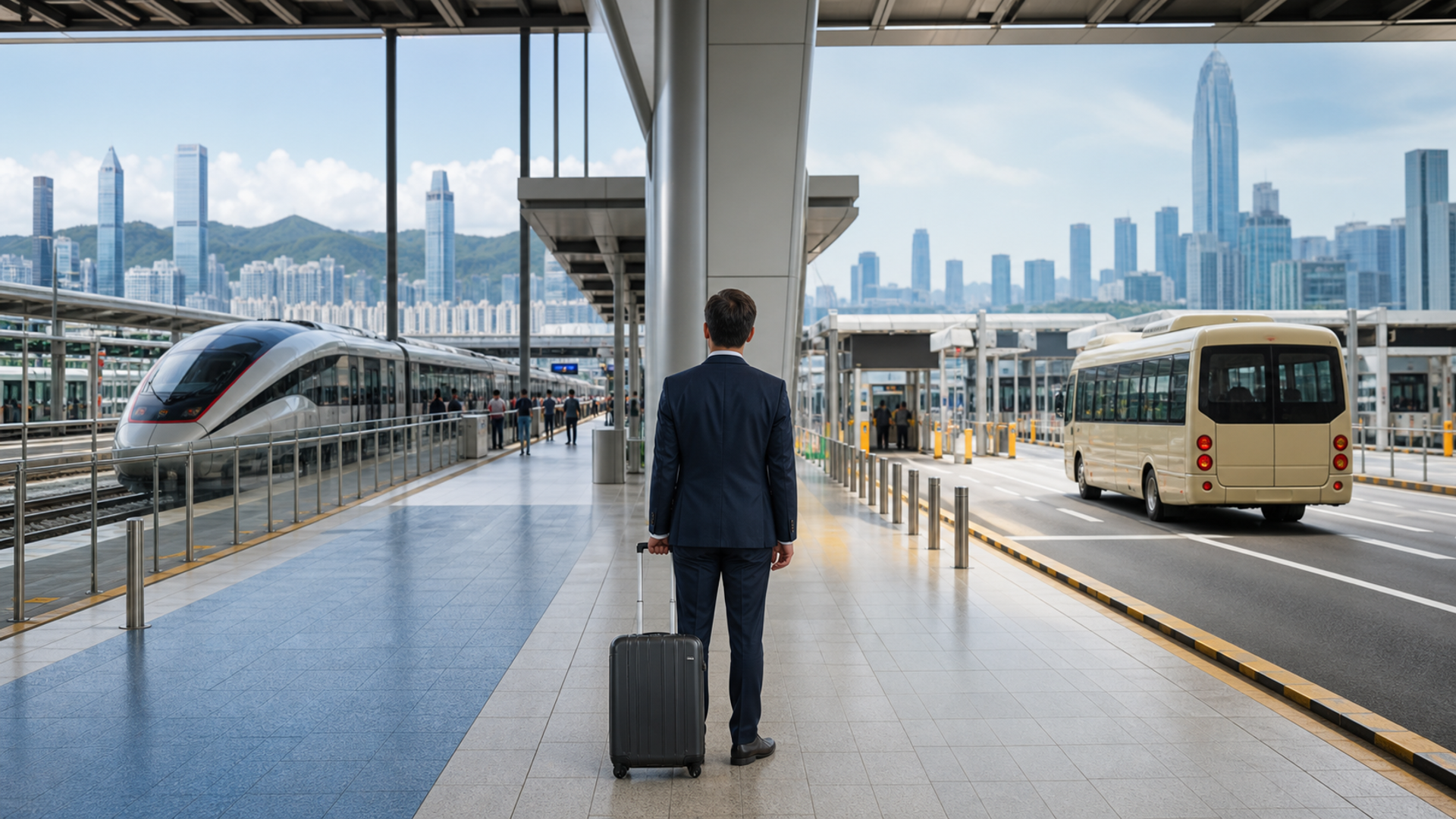
The fastest Hong Kong–Shenzhen crossing depends on where the journey actually starts and ends. West Kowloon high-speed rail can put a passenger in Futian quickly once aboard, but a traveller beginning near the East Rail Line may reach central Shenzhen more simply through Lok Ma Chau Spur Line or Lo Wu. A late-night arrival, several suitcases or a destination near Shenzhen Bay changes the answer again.
This 2026 guide compares passenger routes by access, operating window, luggage and district fit. Border hours, train schedules and temporary arrangements can change at short notice. Recheck the Hong Kong Immigration Department, Transport Department, MTR or High Speed Rail operator on the travel day, and allow extra time around weekends and public holidays.
The short answer
Use Hong Kong West Kowloon high-speed rail for the most direct reserved-seat journey to Futian or Shenzhen North when the timetable and ticket suit you. Use Lok Ma Chau Spur Line/Futian Checkpoint for metro continuity into Futian and the East Rail network in Hong Kong. Use Lo Wu/Luohu for destinations around Luohu and the traditional East Rail route. Use Shenzhen Bay for road access to Nanshan, Qianhai, the airport side or a door-to-door car plan. Use the 24-hour Lok Ma Chau/Huanggang vehicle crossing when the journey falls outside rail-passenger windows, subject to the live shuttle or vehicle service.
The redeveloped Huanggang Port had not been officially opened to the public in the latest cited government announcement. Do not plan around a projected opening date until both governments publish it.
Route decision matrix
Official hours below are those listed by Hong Kong Immigration on its current control point page. They are not a promise that a connecting train, coach or ticket remains available until the control point closes.
| Crossing | Listed passenger window | Best for | Luggage and booking notes |
|---|---|---|---|
| West Kowloon Express Rail Link | 06:30–23:30 | Futian, Shenzhen North, reserved-seat city-centre rail | Security, ticketing and train cut-offs require early arrival |
| Lok Ma Chau Spur Line | 06:30–22:30 | Futian CBD and Shenzhen Metro Line 4/10 connections | Walk-through clearance; manageable luggage is easiest |
| Lo Wu | 06:30–00:00 | Luohu and East Rail users | Traditional high-volume route; queues can rise at peaks |
| Shenzhen Bay passenger clearance | 06:30–00:00 | Nanshan, Qianhai, road transfers and some airport-side journeys | Coach, bus, taxi or licensed car logistics matter |
| Lok Ma Chau vehicle crossing | 24 hours | Late-night road travel via Huanggang services | Confirm shuttle/coach/private-car service, not just border opening |
| Heung Yuen Wai/Liantang | 07:00–22:00 | Eastern Shenzhen and some road itineraries | Road-based; useful only if onward location aligns |
West Kowloon high-speed rail: best when the train itself simplifies the trip
High-speed rail removes several transfers. Passengers complete the relevant departure and arrival formalities at Hong Kong West Kowloon, then board a reserved train to Futian, Shenzhen North or other listed destinations. MTR's current High Speed Rail destination page is the correct starting point for live services.
It is strongest for a traveller staying in Kowloon, Central with easy Airport Express/MTR access, or near a direct taxi route to West Kowloon. Futian station is useful for the central business district; Shenzhen North connects to national high-speed rail and northern parts of the city.
The weakness is schedule dependence. Missing a specific departure can erase the theoretical time advantage. Build time for station navigation, security, ticket checks and immigration. Confirm passport or travel-document details match the booking. During major travel periods, buy through official channels early rather than relying on walk-up availability.
With large luggage, high-speed rail can still be comfortable, but review current size rules and storage. Arrive early enough to locate the carriage without rushing. A door-to-door car may beat rail if the passenger has equipment, multiple cases or a destination far from either station.
Lok Ma Chau Spur Line/Futian: best for metro continuity
The East Rail Line reaches Lok Ma Chau station, where passengers clear the Hong Kong side, cross on foot and enter the Futian Checkpoint system. On the Shenzhen side, metro connections provide access to Futian and beyond. This route is often the most intuitive for travellers whose origin is near the East Rail corridor and destination is central Shenzhen.
Unlike high-speed rail, the route behaves more like urban transit and does not require a reserved intercity train. That flexibility is valuable when meeting times may shift. The trade-off is more walking, standing and movement with luggage, plus possible queues at peak periods.
Do not confuse Lok Ma Chau Spur Line passenger hours with the separate 24-hour Lok Ma Chau vehicle crossing. They are different operations. If a dinner runs late, the East Rail route can close before the road crossing.
For business travel, map the final Shenzhen Metro exit before leaving Hong Kong. Futian stations and underground passages can be large. A ten-minute train advantage disappears if the traveller exits on the wrong side with luggage.
Lo Wu/Luohu: best for the traditional eastern city route
Lo Wu is the long-established East Rail passenger crossing and connects directly to Luohu on the Shenzhen side. It is a strong choice for Luohu commercial districts, Shenzhen Railway Station and travellers already positioned along Hong Kong's East Rail Line.
Its operating window extends later than Lok Ma Chau Spur Line according to the current Immigration listing, but connecting rail service and last-train times must also be checked. Lo Wu can experience heavy peak queues, especially around weekends and holidays. A less crowded route may be faster door to door even if the map distance is longer.
The station environment involves walking and changes of level. Travellers with mobility requirements should review lift routes and assistance before departure. With several large cases, a road crossing may be less physically demanding.
Shenzhen Bay: best for Nanshan and road-first itineraries
Shenzhen Bay is geographically useful for Nanshan, Qianhai, Shekou and some western Shenzhen destinations. It is road-based from the Hong Kong perspective, with public transport, cross-boundary coaches, taxis or eligible private vehicles forming the approach. The Transport Department's land-based cross-boundary transport hub links current access guidance.
The right calculation includes the Hong Kong pickup location, road traffic, border queue and final Shenzhen transfer. From Hong Kong Island or the airport side, a licensed through-car or coach can be appealing when luggage and directness matter. From the New Territories East, rail may be more predictable.
Passenger clearance is not 24 hours under the current Immigration listing, even though goods-vehicle operations differ. Roads or specific services may stop earlier than the border building. Confirm the last practical departure, not simply the formal closing time.
Only use lawful, properly licensed transport. Verify vehicle, driver and price through the service's official channel. Do not hand travel documents to an unknown intermediary.
Late-night travel: the 24-hour distinction
Hong Kong Immigration lists Lok Ma Chau as a 24-hour vehicle control point. That does not mean every bus, shuttle, coach or car service operates continuously at the frequency you expect. Check the live Lok Ma Chau–Huanggang shuttle and onward transport before leaving a venue. After crossing, local metro service may have ended, requiring a taxi or booked car.
A safe late-night plan includes the exact pickup point, official ticket method, destination address in Chinese, offline maps, sufficient battery and a second payment method. Keep the hotel phone number accessible without data.
Do not route late travel through the redeveloped new Huanggang facility based on construction news. The current government statement concerns legal establishment and preparation, not confirmed public opening.
What the 2026 Huanggang announcement actually means
On 17 July 2026, the Hong Kong Government announced passage of the bill connected with the Huanggang Port Hong Kong Port Area. The official release states that commissioning of the Hong Kong Port Area allows joint tests, trials and drills, and that Guangdong and Hong Kong will finalise and announce the public opening date after readiness is confirmed. Read the primary government announcement.
The important distinction is between legal commissioning of an area and public passenger opening. As of that announcement, the latter remained future work. Any guide that states the new port is already open without a later official source is unsafe.
When opening is confirmed, route recommendations will need revision because the new co-location and clearance model may change travel time and capacity. Until then, use the existing crossings.
District-first route selection
Start from the Shenzhen destination:
Futian CBD, Convention and Exhibition Center, or central business meetings: West Kowloon to Futian or Lok Ma Chau Spur Line.
Luohu, Dongmen or Shenzhen Railway Station: Lo Wu is often the natural route.
Shenzhen North onward high-speed train: direct train from West Kowloon where available.
Nanshan, Qianhai, Shekou or western technology districts: Shenzhen Bay road route may reduce backtracking.
Eastern Shenzhen: Heung Yuen Wai/Liantang can be relevant, subject to onward transport.
After normal rail windows: 24-hour Lok Ma Chau vehicle route, with service confirmed.
Then calculate the Hong Kong origin. A route that is optimal from Central may be wrong from Sha Tin or the airport.
Business-travel timing model
For a fixed meeting, work backwards from the required arrival. Add: final Shenzhen local transfer, border clearance buffer, approach journey, waiting or check-in, and a contingency margin. During holidays, extend the border component. Never use the scheduled train duration as the door-to-door estimate.
For West Kowloon, ticket the train that leaves enough recovery time for station processes. For East Rail crossings, monitor crowd conditions and carry a second route. For a car, build traffic and driver-clearance uncertainty.
If the meeting is critical, cross the night before and stay near the destination. The cost of a hotel can be lower than the operational risk of a same-morning border.
Documents, payments and digital preparation
Entry eligibility depends on nationality, residency and travel-document status. Check the official Hong Kong and Mainland immigration requirements applicable to you. This guide cannot determine visa rights.
Keep the travel document, ticket and any permits in a secure but accessible place. Ensure ticket names and document numbers match. Download addresses and confirmations offline. Set up local payment and connectivity lawfully before the trip, but carry a backup method.
The business travel luggage guide helps reduce friction across rail and road transfers. A human Concierge may assist eligible clients with itinerary coordination, transfers and contingency planning, subject to service terms, user authorisation and supplier availability. It cannot guarantee border clearance, road conditions, train inventory or official decisions. The travel concierge decision guide explains those boundaries.
Luggage, mobility and family travel
With one cabin case, rail routes are usually manageable. With multiple large cases, samples, sports equipment, children or limited mobility, count every transfer and lift. A direct licensed car through an appropriate road crossing may be worth the premium.
Check stroller and wheelchair routes, not simply station accessibility labels. Reserve assistance where available. Keep medicines and essential documents in a small bag that remains with the traveller even if larger luggage is handled by a driver.
Travel-day checklist
Recheck control-point hours and service notices.
Confirm the exact destination district and local exit.
Verify travel-document eligibility and ticket match.
Screenshot tickets, hotel and driver details.
Charge the phone and power bank; retain offline maps.
Add holiday or weekend queue buffer.
Confirm the fallback crossing and late-night transport.
Avoid relying on an unannounced future Huanggang opening.
Final verdict
West Kowloon high-speed rail is the strongest scheduled option for Futian and Shenzhen North. Lok Ma Chau Spur Line is the flexible metro-led choice for central Shenzhen. Lo Wu remains practical for Luohu and East Rail users. Shenzhen Bay is the road-led choice for western Shenzhen and heavier luggage. The 24-hour Lok Ma Chau vehicle crossing is the essential late-night fallback when actual transport services are confirmed.
Choose from origin to destination, not border to border. Verify hours on the travel day and separate official opening facts from project announcements. The best crossing is the one that reduces total transfers and leaves a credible recovery route when the first plan changes.
![How to Scan Receipts and Documents with Your Phone [Full Guide]](https://cdn.sanity.io/images/e0gp1l2g/production/0db13feec1d5e72b8a8a5f976d1f3e86619c9228-3840x1860.webp?w=180&h=180&q=78&auto=format&fit=crop)
![How to Scan Receipts and Documents with Your Phone [Full Guide]](https://cdn.sanity.io/images/e0gp1l2g/production/0db13feec1d5e72b8a8a5f976d1f3e86619c9228-3840x1860.webp?w=800&h=450&q=82&auto=format&fit=crop)
![Top 10 Two-Tone Carbon-Fibre Watches for Men [2026 List]](https://cdn.sanity.io/images/e0gp1l2g/production/18870799ba33fab0e038968359cd5772d7d7db30-1024x576.webp?w=800&h=450&q=82&auto=format&fit=crop)
![Top 10 Luxury Watches with Digital Complication Displays for Men [Latest]](https://cdn.sanity.io/images/e0gp1l2g/production/c4f6bf8c080f291c39f7cc85c7344ecff2fd3799-1024x553.webp?w=800&h=450&q=82&auto=format&fit=crop)