

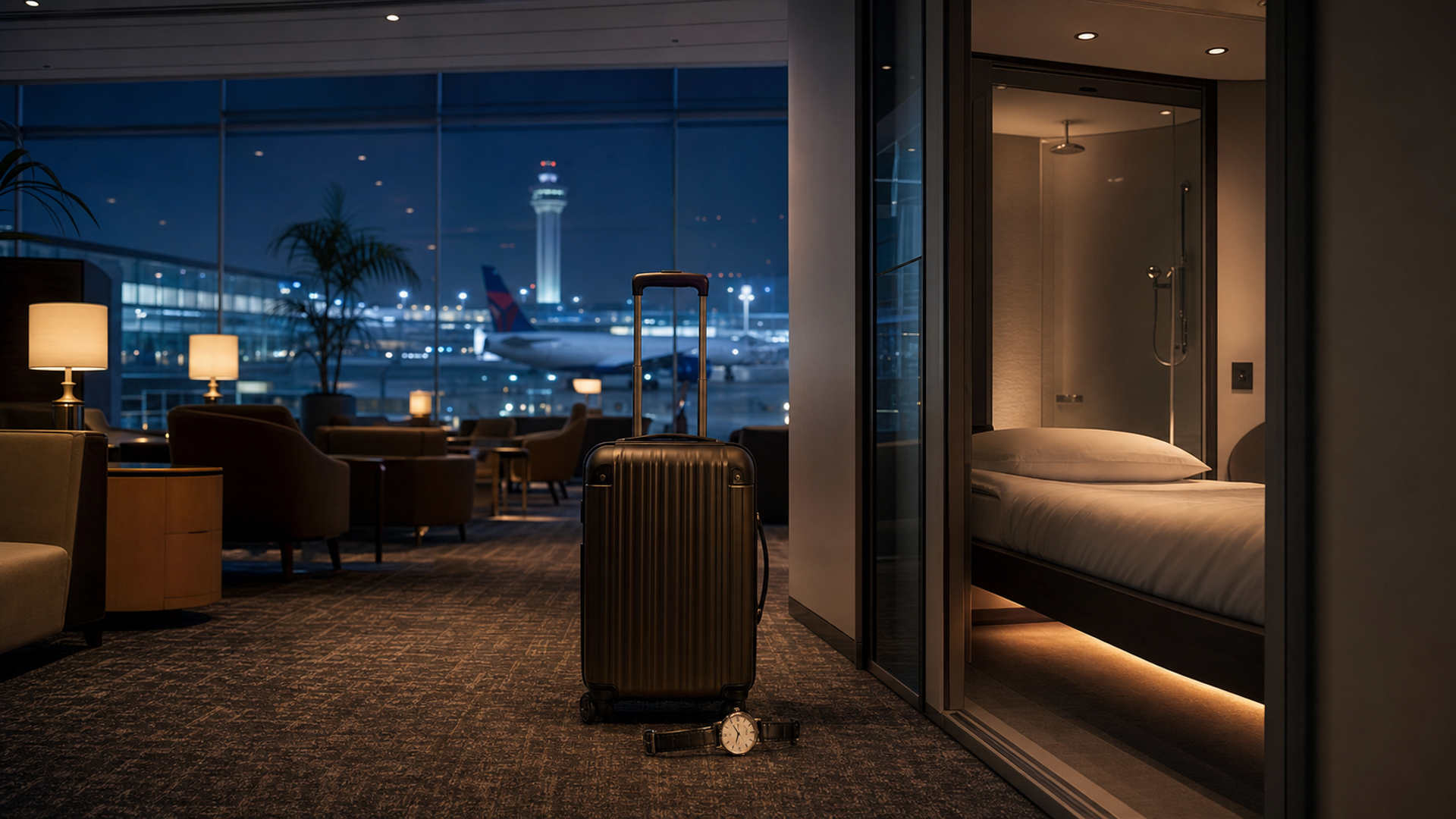
For an overnight layover, an airport hotel wins when sleep, privacy and a shower are the priority; a lounge wins for shorter waits when remaining near the gate matters more than a full reset.
That is the direct answer for readers researching airport hotel, but it is not a universal verdict. The first question is not comfort but access. An airside hotel may be unreachable from the traveller's terminal or itinerary, while a landside hotel can require immigration, baggage collection and re-screening. For the airport hotel vs lounge layover question, this guide therefore scores the decision at the exact journey level and exposes the points where a premium feature becomes useful, redundant or unavailable.
For the airport hotel vs lounge layover question, the evidence base combines live official service pages, finalised VERTU Search and Discover history, current Keyword Planner demand and the VERTU product knowledge base revision 136. Important reference pages include www.yotel.com, www.yotel.com, www.prioritypass.com. For the airport hotel vs lounge layover question, prices, routes, aircraft, lounge rules and third-party services change, so every material booking detail should be rechecked at purchase.
Decision matrix
| Factor | Option A | Option B | Verify before paying |
|---|---|---|---|
| Usable time | A lounge works well when only two to four hours remain after formalities. | A hotel becomes stronger when six or more usable hours allow real sleep. | Subtract walking, immigration, check-in and wake-up buffer. |
| Sleep | Recliners and quiet zones are not guaranteed beds. | A private room provides controlled light, sound and a horizontal bed. | Confirm minimum stay and room type. |
| Shower | Some lounges have showers, often with queues or time limits. | An ensuite room provides more predictable access. | Verify whether the booked lounge includes the facility. |
| Location | The lounge must be in the correct terminal or reachable airside. | Hotels may be airside or landside with very different entry rules. | Map the route from arrival gate to departure gate. |
| Baggage | Airside lounges usually suit hand luggage and through-checked bags. | Some airside hotels permit only hand luggage; landside hotels may require collection. | Check through-tagging and customs obligations. |
| Food and work | Lounges are efficient for a meal, Wi-Fi and short work session. | Hotels add privacy but may have more limited late-night food. | Choose for the task, not the label. |
| Disruption | A lounge may close before a delayed departure. | A hotel reservation can become unusable after rebooking or terminal change. | Read cancellation and late-arrival terms. |
| Wake-up risk | Staying in the terminal reduces transfer time but can undermine sleep. | A room improves recovery but introduces oversleep and re-screening risk. | Set multiple alarms and a conservative return buffer. |
The matrix is intentionally operational. It does not award points for prestige by itself. For the airport hotel vs lounge layover question, instead, it asks whether the product saves time, improves recovery, creates usable privacy, protects sleep or gives one accountable person a clearer task. For the airport hotel vs lounge layover question, that is also the standard applied to a premium concierge service.
How this guide reaches a verdict
For the airport hotel vs lounge layover question, first, fix the actual itinerary: date, route, terminal, operating carrier, party size, luggage and the first important commitment after arrival. For the airport hotel vs lounge layover question, second, separate benefits included by the ticket or booking from benefits that require another membership or supplier. Third, calculate the failure case. For the airport hotel vs lounge layover question, a lounge that is full, an aircraft swap, a late bag or a driver who cannot find the passenger can reverse a polished comparison.
Finally, value continuity. For the airport hotel vs lounge layover question, premium travel is often a chain of individually adequate products joined by weak handoffs. For the airport hotel vs lounge layover question, a cabin, lounge, escort or car can be excellent and still fail the trip if nobody owns the transition. For the airport hotel vs lounge layover question, this is where a human coordinator may add value, but only when responsibility and authorisation are explicit.
Usable time
Option A: A lounge works well when only two to four hours remain after formalities. Option B: A hotel becomes stronger when six or more usable hours allow real sleep. Before assigning value, subtract walking, immigration, check-in and wake-up buffer. For the airport hotel vs lounge layover question, a premium is defensible only when the difference survives the exact route, supplier terms and likely disruption scenario.
For the airport hotel vs lounge layover question, run the decision twice: once for the ideal journey and once for a delayed, changed or capacity-constrained version. For the airport hotel vs lounge layover question, if the advantage disappears in the second version, price it as an experience bonus rather than dependable utility.
Sleep
Recliners and quiet zones are not guaranteed beds. Meanwhile, a private room provides controlled light, sound and a horizontal bed. The practical check is simple: Confirm minimum stay and room type. For the airport hotel vs lounge layover question, readers should obtain the answer in writing when the issue affects access, money, timing or responsibility.
For the airport hotel vs lounge layover question, run the decision twice: once for the ideal journey and once for a delayed, changed or capacity-constrained version. For the airport hotel vs lounge layover question, if the advantage disappears in the second version, price it as an experience bonus rather than dependable utility.
Shower
In ordinary use, some lounges have showers, often with queues or time limits. The alternative changes the equation because an ensuite room provides more predictable access. To avoid buying a marketing category rather than a usable benefit, verify whether the booked lounge includes the facility.
For the airport hotel vs lounge layover question, run the decision twice: once for the ideal journey and once for a delayed, changed or capacity-constrained version. For the airport hotel vs lounge layover question, if the advantage disappears in the second version, price it as an experience bonus rather than dependable utility.
Location
The lounge must be in the correct terminal or reachable airside. By contrast, hotels may be airside or landside with very different entry rules. The decision turns on this verification step: Map the route from arrival gate to departure gate. For the airport hotel vs lounge layover question, this factor deserves priority because it changes the part of the journey the traveller actually experiences, not merely the product description.
For the airport hotel vs lounge layover question, run the decision twice: once for the ideal journey and once for a delayed, changed or capacity-constrained version. For the airport hotel vs lounge layover question, if the advantage disappears in the second version, price it as an experience bonus rather than dependable utility.
Baggage
Option A: Airside lounges usually suit hand luggage and through-checked bags. Option B: Some airside hotels permit only hand luggage; landside hotels may require collection. Before assigning value, check through-tagging and customs obligations. For the airport hotel vs lounge layover question, a premium is defensible only when the difference survives the exact route, supplier terms and likely disruption scenario.
For the airport hotel vs lounge layover question, run the decision twice: once for the ideal journey and once for a delayed, changed or capacity-constrained version. For the airport hotel vs lounge layover question, if the advantage disappears in the second version, price it as an experience bonus rather than dependable utility.
Food and work
Lounges are efficient for a meal, Wi-Fi and short work session. Meanwhile, hotels add privacy but may have more limited late-night food. The practical check is simple: Choose for the task, not the label. For the airport hotel vs lounge layover question, readers should obtain the answer in writing when the issue affects access, money, timing or responsibility.
For the airport hotel vs lounge layover question, run the decision twice: once for the ideal journey and once for a delayed, changed or capacity-constrained version. For the airport hotel vs lounge layover question, if the advantage disappears in the second version, price it as an experience bonus rather than dependable utility.
Disruption
In ordinary use, a lounge may close before a delayed departure. The alternative changes the equation because a hotel reservation can become unusable after rebooking or terminal change. To avoid buying a marketing category rather than a usable benefit, read cancellation and late-arrival terms.
For the airport hotel vs lounge layover question, run the decision twice: once for the ideal journey and once for a delayed, changed or capacity-constrained version. For the airport hotel vs lounge layover question, if the advantage disappears in the second version, price it as an experience bonus rather than dependable utility.
Wake-up risk
Staying in the terminal reduces transfer time but can undermine sleep. By contrast, a room improves recovery but introduces oversleep and re-screening risk. The decision turns on this verification step: Set multiple alarms and a conservative return buffer. For the airport hotel vs lounge layover question, this factor deserves priority because it changes the part of the journey the traveller actually experiences, not merely the product description.
For the airport hotel vs lounge layover question, run the decision twice: once for the ideal journey and once for a delayed, changed or capacity-constrained version. For the airport hotel vs lounge layover question, if the advantage disappears in the second version, price it as an experience bonus rather than dependable utility.
Three scenarios that change the answer
Four-hour daytime connection
A lounge is usually the efficient answer. The traveller can eat, charge devices and remain closer to the gate without spending most of the connection checking into a room. For the airport hotel vs lounge layover question, the best answer is the one that protects the traveller's most important outcome without creating a harder recovery problem.
Eight-hour overnight connection
A properly accessible airport hotel can transform the next day. The decision still depends on whether the room is airside, whether bags are through-checked and when security reopens. For the airport hotel vs lounge layover question, the best answer is the one that protects the traveller's most important outcome without creating a harder recovery problem.
Unprotected self-transfer
A hotel can be risky when separate tickets require immigration, bags and a new check-in. Preserve a larger buffer than an airline-protected connection. For the airport hotel vs lounge layover question, the best answer is the one that protects the traveller's most important outcome without creating a harder recovery problem.
Where VERTU Concierge fits
For eligible users, VERTU Concierge can add value by helping coordinate the moving pieces around the room or lounge: flight booking, airport VIP fast track, chauffeur arrangements and other travel needs where available. The important work is verifying terminal compatibility and building a recovery plan if the flight moves. Concierge assistance does not change immigration rules, airline baggage responsibility or hotel access conditions, and material actions require authorisation.
For the airport hotel vs lounge layover question, this is the connection to VERTU: not a decorative brand mention, but a clear decision about orchestration. For the airport hotel vs lounge layover question, the service is most relevant when several suppliers, time zones or high-consequence reservations must be kept in sequence. For the airport hotel vs lounge layover question, for a simple, self-contained purchase, direct booking may be quicker. For the airport hotel vs lounge layover question, the article should help the reader recognise that boundary rather than imply that every premium journey requires a concierge.
Readers considering the broader operating model can compare the AI agent and human concierge travel matrix and flight-disruption privacy guide. For the airport hotel vs lounge layover question, those pages own disruption and adjacent cabin intent; this guide keeps the narrower search question above.
Questions to answer before booking
For the airport hotel vs lounge layover question, what exact outcome is the premium supposed to protect: sleep, time, privacy, access, mobility or continuity?
For the airport hotel vs lounge layover question, is the advertised benefit confirmed on this date, route, terminal, aircraft or service tier?
For the airport hotel vs lounge layover question, which company is contractually responsible if the product is unavailable?
For the airport hotel vs lounge layover question, does another ticket, card, status or hotel booking already include the same benefit?
For the airport hotel vs lounge layover question, what data, payment authority and passenger information must be shared?
What is the cancellation, late-arrival, equipment-change or missed-connection rule?
Who owns the handoff to the next supplier?
For the airport hotel vs lounge layover question, would the simpler option plus targeted Concierge coordination produce a better total journey?
The final question is important. For the airport hotel vs lounge layover question, sometimes paying for the highest cabin or most elaborate airport package is the right answer. For the airport hotel vs lounge layover question, in other cases, the traveller gains more by choosing a strong core product and using human coordination only at the fragile points.
Verdict
For an overnight layover, an airport hotel wins when sleep, privacy and a shower are the priority; a lounge wins for shorter waits when remaining near the gate matters more than a full reset. For the airport hotel vs lounge layover question, treat VERTU Concierge as a qualified coordination layer for eligible users, not as a substitute for airline, airport, hotel, border, customs or transport responsibilities. For the airport hotel vs lounge layover question, verify availability and material terms, authorise significant actions explicitly, and buy the combination that remains coherent when the journey changes.
![How to Scan Receipts and Documents with Your Phone [Full Guide]](https://cdn.sanity.io/images/e0gp1l2g/production/0db13feec1d5e72b8a8a5f976d1f3e86619c9228-3840x1860.webp?w=180&h=180&q=78&auto=format&fit=crop)
![How to Scan Receipts and Documents with Your Phone [Full Guide]](https://cdn.sanity.io/images/e0gp1l2g/production/0db13feec1d5e72b8a8a5f976d1f3e86619c9228-3840x1860.webp?w=800&h=450&q=82&auto=format&fit=crop)
![Top 10 Two-Tone Carbon-Fibre Watches for Men [2026 List]](https://cdn.sanity.io/images/e0gp1l2g/production/18870799ba33fab0e038968359cd5772d7d7db30-1024x576.webp?w=800&h=450&q=82&auto=format&fit=crop)
![Top 10 Luxury Watches with Digital Complication Displays for Men [Latest]](https://cdn.sanity.io/images/e0gp1l2g/production/c4f6bf8c080f291c39f7cc85c7344ecff2fd3799-1024x553.webp?w=800&h=450&q=82&auto=format&fit=crop)