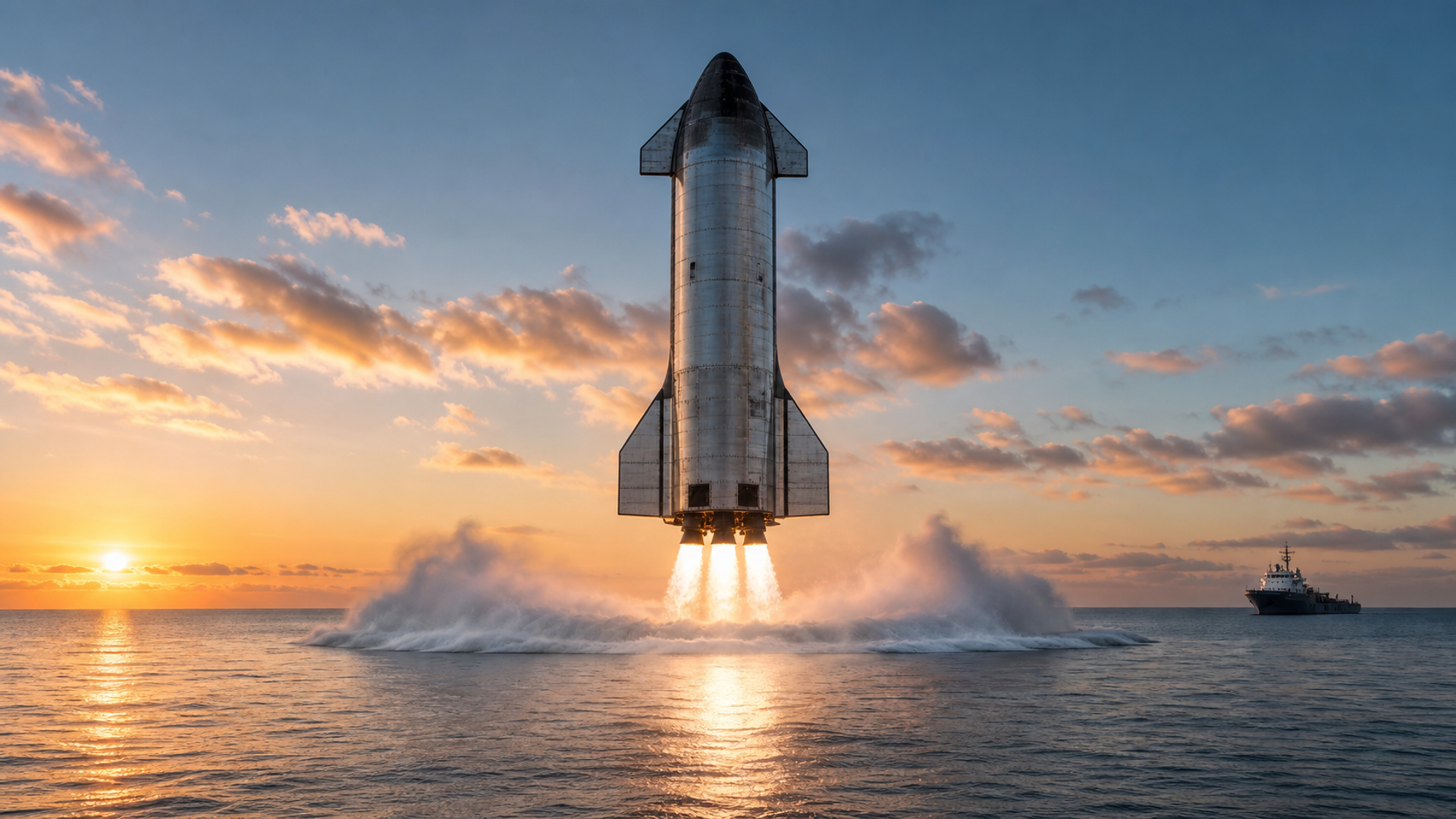
Starship Flight 13 launched on 24 July 2026 and ended with the upper stage making its softest ocean splashdown so far. SpaceX also deployed 20 advanced Starlink units during the flight, gathering data from a third-generation vehicle intended to support higher launch cadence and more capable missions.
The visual of a full-scale spacecraft reaching the water intact is powerful, but the engineering significance lies in the sequence before it. A test flight is not a single pass or fail. It is a chain of objectives across ascent, stage separation, payload operations, re-entry, control and terminal descent. Flight 13 moved several of those objectives forward while leaving major work before routine reusability.
This scorecard uses SpaceX’s official Flight 13 mission page and the Associated Press report. Where SpaceX describes its own results, that is identified as company reporting rather than independent certification.
Flight 13 mission scorecard
| Objective | Reported result | Why it matters | What it does not yet prove |
|---|---|---|---|
| Launch and ascent | Completed | Validates integrated propulsion and guidance through a high-energy phase | Routine airline-like reliability |
| Stage separation | Completed | Confirms the vehicle can transition between booster and ship phases | Recoverable operation on every mission |
| Starlink deployment | 20 advanced units deployed | Demonstrates a real payload sequence and dispenser operation | Full commercial deployment economics |
| In-space ship operations | Mission profile continued to re-entry | Provides thermal, propulsion and control data | Long-duration orbital operations |
| Atmospheric re-entry | Survived to terminal descent | Tests heat shield, structure and guidance under extreme loads | A vehicle ready for immediate reuse |
| Ocean splashdown | Softest ship splashdown to date; remained afloat | Shows improved landing control and survivability | Tower catch or dry recovery |
| Booster recovery | Test-profile dependent | Generates data for reusable first-stage operations | Operational recovery cadence |
The mission’s most credible interpretation is “meaningful progress in an iterative development campaign”, not “the programme is finished”.
What was different about Flight 13
Flight 13 used the newer Starship V3 architecture. SpaceX has described V3 as an evolution intended to improve performance, propellant capacity and operational capability. Each major vehicle revision introduces opportunity and risk: systems can be simplified or strengthened, but new interfaces and flight conditions must be validated.
The payload was also more consequential than a passive test article. Deploying 20 advanced Starlink units exercises doors, mechanisms, timing and attitude control in an operationally relevant sequence. Payload deployment is central to the economic case for any launch system. A vehicle that reaches space but cannot reliably release useful payload has not completed the commercial job.
The splashdown adds another layer. Earlier flights generated data even when the vehicle broke up or missed a target. A gentler arrival, with the ship remaining afloat, allows engineers to compare predictions with a more complete vehicle and to inspect how structures, thermal protection and control systems behaved.
Why “soft splashdown” is not the same as landing
An ocean splashdown is a test endpoint. It avoids the complexity and public-safety requirements of returning a massive experimental spacecraft to land or a launch tower. The vehicle can practise its descent profile without needing to be recovered for another flight.
A soft splashdown means the ship reduced velocity and controlled its attitude sufficiently to reach the water with lower impact. Remaining afloat suggests structural survival at the end of the sequence. It does not mean the vehicle is undamaged, refillable or ready to fly again.
Operational reuse will require:
a consistently survivable re-entry;
accurate terminal guidance;
a safe land or tower-recovery method;
rapid inspection;
limited refurbishment;
reliable ground handling;
regulatory approval for repeated operations.
Those are separate milestones. Flight 13 contributes evidence to the first two and perhaps to structural durability, but it cannot settle the entire reuse question.
Re-entry remains the central technical challenge
Starship returns from space at orbital energy. Atmospheric drag converts much of that energy into heat. The vehicle must maintain the correct attitude, protect its structure and keep control surfaces working while plasma, vibration and rapidly changing aerodynamic forces act on it.
Thermal protection is difficult because thousands of tiles and their attachments must operate as a system. A small local weakness can expose underlying structure. Reusability raises the bar further: surviving once is different from surviving repeatedly with a predictable inspection burden.
Flight data can reveal heat distribution, tile performance, flap loads, propellant behaviour and guidance accuracy. Engineers then update models and decide whether the next vehicle needs hardware changes, software changes or both.
This is why intact arrival has analytical value even when the spacecraft is not recovered. More of the system remains observable through the final seconds, and telemetry can be correlated with the actual condition after splashdown where inspection is possible.
The 20 Starlink units matter
Payload deployment converts a spectacular test into an operational rehearsal. SpaceX’s vertically integrated business links launch capability with the Starlink communications network. Larger or more efficient satellites can increase service capacity, but they also create new mass, volume and deployment requirements.
A successful sequence must:
reach the intended flight condition;
open the payload path;
control attitude;
release units without collision;
maintain communications and navigation;
leave each unit able to begin its own commissioning process.
The mission report confirms deployment, but long-term performance of the units is a downstream question. Deployment success should not be confused with every satellite reaching final service.
What Flight 13 says about programme velocity
SpaceX develops Starship through repeated full-scale flights. That approach accepts visible setbacks in exchange for data from integrated hardware. It works only when each test produces evidence that changes the next design or operation.
Flight cadence therefore matters, but number of launches alone is not the success metric. The better questions are:
Are failures becoming less repetitive?
Are more objectives completed on each flight?
Does the vehicle survive deeper into the profile?
Are payload operations becoming real rather than simulated?
Is recovery accuracy improving?
Can lessons be incorporated without creating new systemic problems?
Flight 13 appears positive on several of those dimensions. The soft splashdown and deployment sequence expand the evidence base. The next proof will be whether the performance repeats.
What has not been proved
Routine reliability
One strong flight cannot establish a dependable launch service. Reliability is statistical. It emerges from repeated missions across vehicle builds, weather conditions and operational teams.
Rapid reuse
A ship that reaches the ocean intact has not demonstrated turnaround. Rapid reuse requires recovery, inspection, repair, refuelling and another flight within a commercially meaningful period.
Tower catch
Precision recovery at a tower presents different risks from a targeted splashdown. It requires exceptional guidance, structural interfaces, ground systems and public-safety controls.
Orbital refuelling
Long-distance missions beyond low Earth orbit are expected to depend on transferring cryogenic propellant in space. Flight 13’s success does not resolve that separate challenge.
Human-rating
Crewed missions require escape planning, life support, reliability evidence and regulatory scrutiny beyond an uncrewed flight test. A successful vehicle test is necessary but not sufficient.
A milestone ladder for future flights
| Stage | Evidence to watch | Why it changes the programme |
|---|---|---|
| Repeat Flight 13-level performance | Second clean ascent, deployment and controlled return | Separates repeatability from a one-off result |
| Precision recovery improvement | Smaller landing error and robust terminal control | Supports safe catch or land recovery |
| Ship recovery | Vehicle returned to controlled ground systems | Enables detailed inspection and reuse work |
| Refly major hardware | Booster or ship component flies again | Begins proving economic reuse |
| In-space propellant transfer | Measured transfer and storage performance | Opens architecture for lunar and deep-space missions |
| High-cadence operations | Multiple launches with stable ground turnaround | Tests real system throughput |
| Crew-relevant demonstrations | Safety systems and human-rated mission evidence | Moves from cargo experimentation toward people |
This ladder keeps the public narrative tied to verifiable outcomes rather than schedule promises.
The commercial question
Starship’s scale is intended to lower launch cost per unit of payload by combining high capacity with reuse. The cost argument depends on utilisation. A large reusable vehicle flown frequently can spread fixed costs and carry substantial payload. A complex vehicle requiring extensive refurbishment may not achieve that advantage even if it is technically reusable.
Starlink provides SpaceX with an internal customer and a reason to fly. Each payload mission can expand the network while testing the launch system. That creates a feedback loop unavailable to launch companies that must wait for external customers.
The broader technology market should still distinguish company claims from audited unit economics. Launch price, marginal cost, refurbishment hours and fleet availability will become more informative as operations mature.
Why the mission belongs in a frontier-technology portfolio
Starship sits at the intersection of aerospace, communications, manufacturing and automation. Its progress affects launch markets, satellite capacity, lunar planning and the pace at which large systems can be iterated.
It also offers a useful lesson for evaluating frontier AI. Model launches and spacecraft tests both attract dramatic headlines, but buyers need objective-specific scorecards. Our Claude Opus 5 explainer applies the same principle to a new AI model: identify the actual capability change, cost and remaining limitation.
The honest verdict
Flight 13 appears to be a substantive step forward. It completed a useful payload deployment and brought the ship through re-entry to a remarkably controlled ocean arrival. Those are not cosmetic wins.
The mission did not prove routine reuse, human safety or programme economics. It did prove that the latest vehicle and operating sequence can complete more of the intended chain while preserving the ship through the endpoint. In an iterative test campaign, that is exactly the kind of evidence that matters.
The next milestone is repetition. If subsequent flights reproduce the result, improve recovery precision and move hardware toward actual reuse, Flight 13 will be remembered as more than the mission with the gentlest splash. It will be the point at which an experimental sequence began to resemble an operating system.