Agentic OS · Personal AI · Sovereignty
By JG · June 2, 2026
The multi-agent gold rush is loud about one road and silent about the other. The loud road is Harness orchestration—many task-scoped agents sharing one model and one context. The quiet road is protocol-native Personal AI—agents that belong to you, with identity, memory, and authority. VERTU's Agentic OS is built for the second road, and that choice is the whole thesis.
Road One: Harness Orchestration Is a Workflow Engine in Disguise
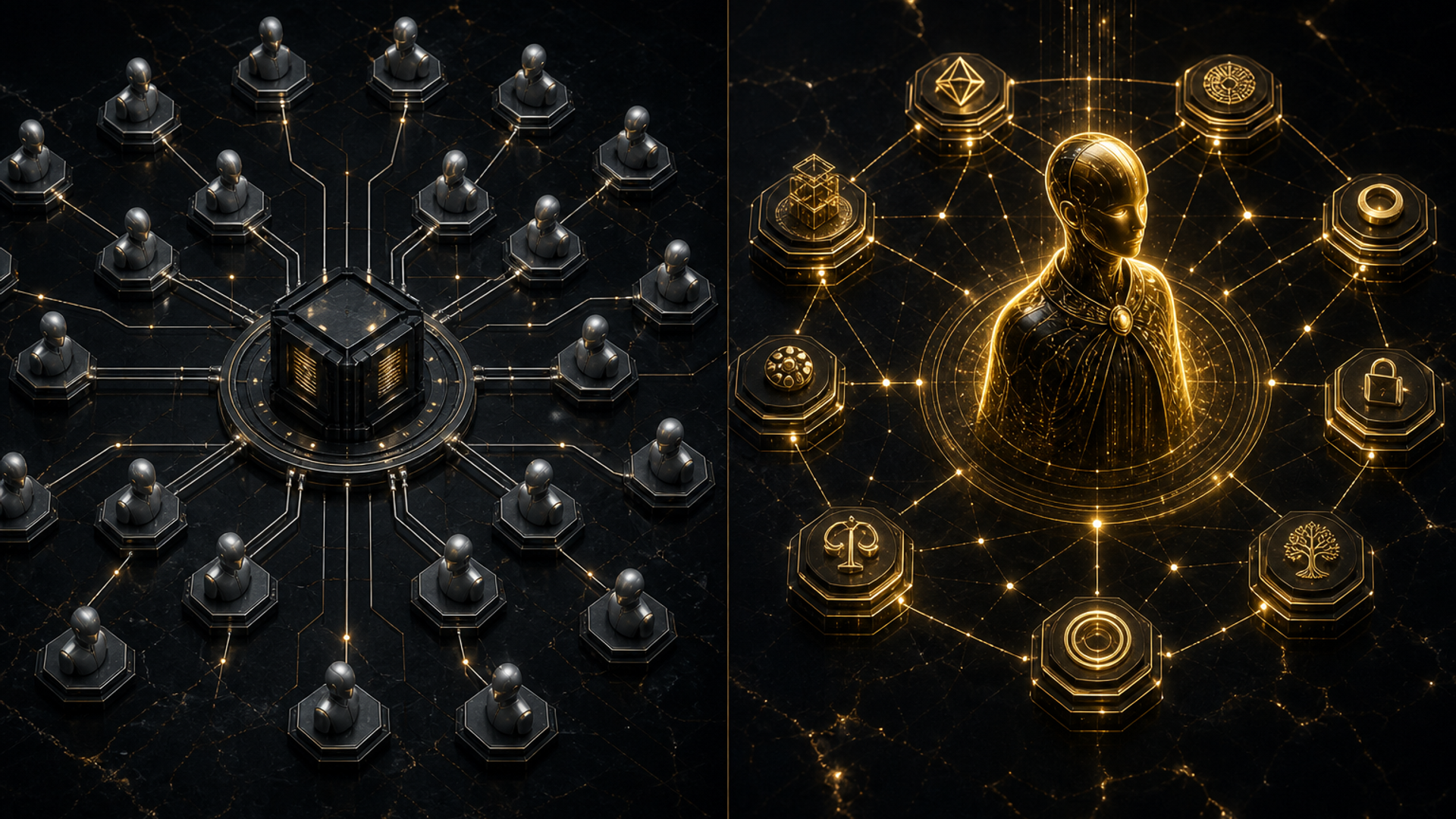
Most of what is marketed today as a "multi-agent system" is one large language model orchestrating several sub-roles: one agent writes, one tests, one plans, one searches, one reviews. They share context, share a goal, and answer to a central scheduler. The roles are temporary; there is no lasting identity, no persistent interest, no real ownership.
This is genuinely useful, and it is genuinely hard engineering—prompt design, context management, task routing, tool calling, planning, memory. But strip away the vocabulary and it remains a flexible workflow engine. The agents are callable functions wearing personalities. The value of the orchestration layer is real, which is exactly the point we keep making: in a world of commoditized models, the Harness is worth more than the model. Cursor proved that a harness that understands your codebase outearns the raw model underneath it. But codebase-scoped orchestration is still road one.
Road Two: The Identity-Scoped Personal Agent
The second road barely gets discussed. Its premise is not "many agents finishing a task" but "every person owns their own Personal Agent"—and, for founders, their own one-person company. The moment an agent truly belongs to an individual, its nature changes. It stops being task-scoped and becomes identity-scoped.
An identity-scoped agent needs things a workflow node never has. The contrast is stark:
- Temporary role, no identity (Road 1) becomes persistent identity over years (Road 2).
- Shared context and goal becomes private memory, with its own preferences and interests.
- No ownership, rented from a vendor becomes owned by you—an appreciating asset.
- A simple API call becomes an institutional interaction with rights and duties.
The decisive word is sovereignty. A Personal Agent and a one-person company only mean something if they hold some authority—over memory, over permissions, over cash flow. That is why VERTU treats sovereign memory and a hardware root of trust as non-negotiable rather than as features.
Protocol as Organization: From Software Module to Digital Society
Once agents are owned by different people, they no longer share a model, a company, a context, or a goal. Coordination can no longer rely on a shared prompt or a single workflow. It can only rely on protocols—for identity, permission boundaries, trust, delegation, negotiation, incentives, reputation, value exchange, and long-term contracts. The center of gravity shifts from prompt engineering to protocol engineering, and the multi-agent system stops being a distributed software system and becomes a digital society.
This is the same arc the internet already walked. Early protocols (TCP/IP, HTTP, SMTP) defined how data moves. Blockchains pushed protocol into shared state computation. The next step—an Agent Society—asks protocols to carry coordination, permission, incentive, identity, and organizational relationship. Protocol becomes organization. A future "company" may not be a human structure at all, but a protocol alliance of Personal Agents: your agent, an AI CFO, an AI counsel, an AI sales lead, recombining in real time. Organizations stop being fixed and start computing.
Why VERTU Builds for Road Two
VERTU's Agentic OS is an explicit bet on the sovereign, protocol-native road, expressed through the four duties of Personal AI: PROTECT your data, model, and identity on a hardware root of trust; UNDERSTAND you through lifelong sovereign memory; HELP you by acting across apps from your device; and ORCHESTRATE cloud models only with redacted intent. Stronger generic models make this layer more valuable, not less.
The stack makes it concrete. AlphaFold is the physical carrier and the hands—an executive foldable that is the L1 layer of your digital twin. The Sovereign Private Server (VPS) ERP turns how you actually run a business—sales, finance, approvals—into structured productivity data that feeds an enterprise twin. Together with passive body signals from the Care Suite, they triangulate body, behavior, and productivity: the fuel an identity-scoped agent needs. A Personal AI Harness binds it all, decoupled from any single base model so your memory survives every model upgrade.
Road one optimizes a task. Road two compounds a life and a company. The first is an engineering problem; the second is closer to a civilization problem—and it is the one worth owning.
Frequently Asked Questions
What is the difference between Harness orchestration and a protocol-native Personal AI agent?
Harness orchestration coordinates task-scoped agents that share one model, one context, and a central scheduler—a flexible workflow engine. A protocol-native Personal AI agent is identity-scoped: it owns long-term memory, persistent identity, permissions, and decision authority on your behalf, and coordinates with other agents through protocols rather than a shared prompt.
Why does owning your AI agent change everything?
When an agent is owned by you rather than rented, it becomes a sovereign representative instead of a disposable tool. It accumulates your memory and judgment over time, which raises switching cost and turns the agent into an appreciating personal asset rather than a subscription.
How does VERTU build for the protocol-native, sovereign road?
VERTU pairs AlphaFold as the physical hardware layer with a Sovereign Private Server (VPS) ERP that structures your productivity data, orchestrated by a Personal AI Harness on a hardware root of trust. The agent protects, understands, helps, and orchestrates—an identity-scoped entity, not a task-scoped function.