
Executive Summary
OpenAI officially launched GPT-5.2 on December 11, 2025, positioning it as the most capable model series yet for professional knowledge work. This rapid release comes just one month after GPT-5.1, marking an unprecedented development cycle driven by intensifying competition with Google's Gemini 3 and Anthropic's Claude models.
GPT-5.2 Release Details: Three Powerful Variants
The latest iteration arrives in three distinct configurations designed for different professional needs:
GPT-5.2 Model Variants
- GPT-5.2 Instant - Optimized for speed and routine queries including information retrieval, writing, and translation
- GPT-5.2 Thinking - Engineered for complex structured work encompassing coding, document analysis, mathematics, and strategic planning
- GPT-5.2 Pro - Premium tier delivering maximum accuracy and reliability for the most challenging problems
GPT-5.2 began rolling out to Microsoft 365 Copilot users on the day of its release, ensuring immediate availability across enterprise platforms.
GPT-5.2 vs GPT-5.1: Benchmark Performance Comparison
Professional Knowledge Work: GDPval Benchmark
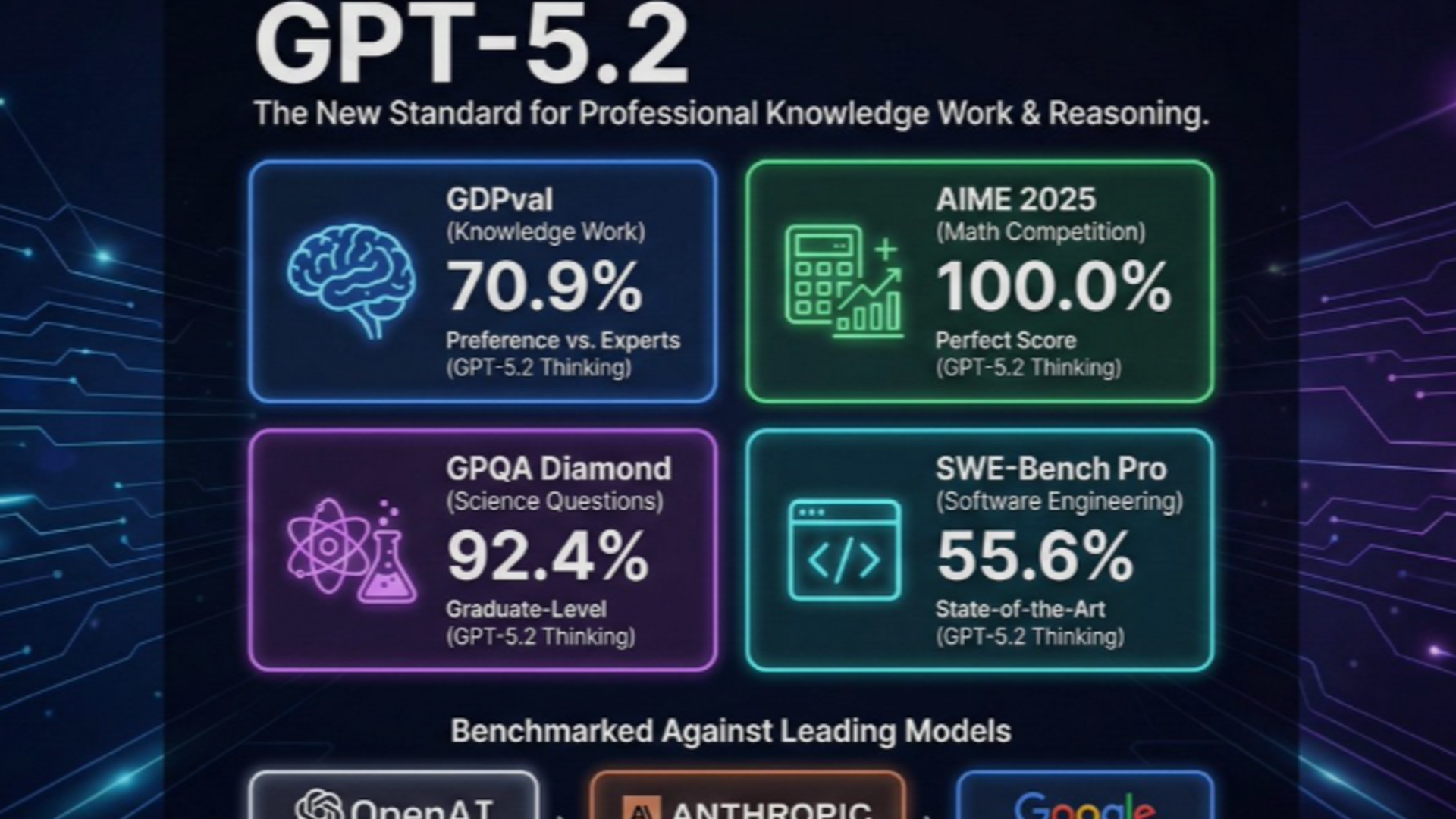
The most dramatic improvement appears in real-world professional task performance. On the GDPval benchmark measuring well-specified knowledge work tasks across 44 occupations, GPT-5.2 achieved 70.9% performance compared to GPT-5's 38.8%. This represents an 83% improvement in just four months, with OpenAI claiming it's the first model to reach or exceed human expert levels on complex professional deliverables.
Key GDPval improvements include:
- GPT-5 : 38.8% expert-level performance
- GPT-5.1 : Approximately 50-55% (estimated from progression)
- GPT-5.2 : 70.9% expert-level performance
OpenAI notes that GPT-5.2 delivers these results at more than 11 times the speed and less than 1% of the cost of human experts, suggesting significant economic implications for knowledge work.
Software Engineering: SWE-Bench Pro Results
Coding capabilities represent another area of substantial advancement. GPT-5.2 scored 55.6% on SWE-Bench Pro, nearly 5 percentage points better than GPT-5.1 and more than 12% better than Gemini 3 Pro.
Software engineering comparison:
- GPT-5.1 Thinking : 50.8%
- GPT-5.2 Thinking : 55.6%
- Improvement : 9.4% relative gain
Abstract Reasoning: ARC-AGI Breakthrough
Perhaps the most impressive leap occurs in abstract reasoning capabilities. GPT-5.2 Thinking achieved 52.9% on ARC-AGI-2, dramatically surpassing GPT-5.1 Thinking's 17.6%. This represents a 200% improvement in fluid reasoning ability.
GPT-5.2 Pro became the first model to cross the 90% threshold on ARC-AGI-1, reaching 90.5%, while achieving this performance at approximately 390 times lower cost than previous models.
Scientific and Mathematical Reasoning
Academic-level performance shows consistent improvements:
GPQA Diamond (Graduate-level science):
- GPT-5.1 Thinking: 88.1%
- GPT-5.2 Thinking: 92.4%
- GPT-5.2 Pro: 93.2%
AIME 2025 (Contest mathematics): GPT-5.2 achieved 100% solve rate on AIME 2025 without tools, becoming the first major model to exhaust the signal in a fresh contest-level math benchmark.
FrontierMath (Research-level problems):
- GPT-5.1 Thinking: 31%
- GPT-5.2 Thinking: 40.3%
- Improvement: 9.3 percentage points
Error Reduction and Reliability
GPT-5.2 Thinking responses contain 38% fewer errors than its predecessor, making it significantly more dependable for professional decision-making, research, and content creation. Hallucination rates decreased substantially, with error responses 30% less common in GPT-5.2 Thinking compared to GPT-5.1 Thinking.
Long Context Understanding
GPT-5.2 Thinking became the first model to achieve nearly 100% accuracy on the 4-Needle MRCR test up to 256,000 tokens, demonstrating superior ability to locate and synthesize information across massive documents.
Visual Intelligence Improvements
Image analysis capabilities saw substantial enhancements:
CharXiv (Scientific diagram reasoning):
- GPT-5.1: 80.3%
- GPT-5.2: 88.7%
- Improvement: 8.4 percentage points
ScreenSpot-Pro (UI understanding):
- GPT-5.1: 64.2%
- GPT-5.2: 86.3%
- Improvement: 22.1 percentage points
The "Code Red" Context: Racing Against Competition
The release follows reports of an emergency "Code Red" directive from CEO Sam Altman to improve ChatGPT, designed to mobilize resources following the quality gap exposed by Gemini 3. However, OpenAI executives emphasized that development had been ongoing for many months.
Fidji Simo, OpenAI's CEO of applications, stated the Code Red helped focus company resources but wasn't the sole reason for the December 11 release timing.
Enterprise Adoption and Real-World Applications
Major companies quickly integrated GPT-5.2 into their workflows:
Early Adopter Feedback
Data Science & Analytics: Databricks, Hex, and Triple Whale found GPT-5.2 exceptional at agentic data science and document analysis tasks.
Coding Platforms: Cognition, Warp, Charlie Labs, JetBrains, and Augment Code reported state-of-the-art agentic coding performance with measurable improvements in interactive coding, code reviews, and bug finding.
Knowledge Management: Notion, Box, Shopify, Harvey, and Zoom observed state-of-the-art long-horizon reasoning and tool-calling performance.
Box reported GPT-5.2 can extract information from long, complex documents about 40% faster, with a 40% boost in reasoning accuracy for Life Sciences and healthcare applications.
API Pricing and Availability
The enhanced capabilities come with premium pricing:
GPT-5.2 Thinking:
- Input: $1.75 per 1 million tokens
- Output: $14 per 1 million tokens
- 40% increase over GPT-5.1 ($1.25/$10)
GPT-5.2 Pro:
- Input: $21 per 1 million tokens
- Output: $168 per 1 million tokens
- 40% increase over GPT-5 Pro ($15/$120)
OpenAI argues that despite higher per-token costs, greater token efficiency and ability to solve tasks in fewer turns make it economically viable for high-value enterprise workflows.
Investment Banking Performance: Specialized Use Case
On internal benchmarks of junior investment banking analyst tasks such as building three-statement models and leveraged buyout models, GPT-5.2 Thinking's average score improved 9.3%, rising from 59.1% to 68.4%.
Technical Capabilities: What's New in GPT-5.2
Enhanced Features
- Spreadsheet and Presentation Generation - Complex document creation with sophisticated formatting
- Multi-Step Project Management - Improved handling of complex, interconnected tasks
- Tool Calling - 98.7% accuracy on Tau2-bench-Telecom, up from 95.6%
- Adaptive Reasoning - Dynamic thinking time allocation based on problem complexity
Core Improvements
GPT-5.2 brings significant improvements in general intelligence, long-context understanding, agentic tool-calling, and vision—making it better at executing complex, real-world tasks end-to-end than any previous model.
Competitive Landscape: GPT-5.2 vs. Rivals
Benchmark Comparisons
GDPval Professional Tasks:
- GPT-5.2: 70.9%
- Claude Opus 4.5: 59.6%
- Gemini 3 Pro: 53.3%
SWE-Bench Pro (Coding):
- GPT-5.2: 55.6%
- Gemini 3 Pro: 43%
- GPT-5.1: 50.8%
On OpenAI's own benchmark charts, GPT-5.2 Thinking edges out Gemini 3 and Anthropic's Claude Opus 4.5 in nearly every listed reasoning test.
Release Timeline: Unprecedented Development Speed
- August 7, 2025 : GPT-5 launched
- November 12, 2025 : GPT-5.1 released (3 months after GPT-5)
- December 11, 2025 : GPT-5.2 announced (less than 1 month after GPT-5.1)
While it took three months to go from GPT-5 to GPT-5.1, OpenAI pushed out GPT-5.2 in under a month's time.
Safety and Responsible AI
Fidji Simo stated that OpenAI is improving on pretty much every dimension of safety, whether that's self-harm, different types of mental health issues, or emotional reliance.
Availability and Rollout
GPT-5.2 Instant, Thinking, and Pro began rolling out in ChatGPT starting with paid plans, and are available now to all developers in the API.
ChatGPT subscription tiers with access:
- Plus
- Pro
- Team
- Business
- Enterprise
Future Outlook and Strategic Implications
More than 800 million people now use ChatGPT every week, making performance improvements critical to maintaining market leadership.
Industry reports suggest OpenAI is working on a more fundamental architectural shift under the codename "Project Garlic," targeting a flagship release in early 2026.
Conclusion: GPT-5.2 Represents a Quantum Leap
The GPT-5.2 release demonstrates OpenAI's commitment to rapid innovation under competitive pressure. With improvements ranging from 30-200% across key benchmarks compared to GPT-5.1, the model establishes new standards for AI-assisted professional work, coding, scientific research, and complex reasoning tasks.
For enterprises evaluating AI solutions, GPT-5.2's combination of expert-level performance, reduced error rates, and enhanced reliability positions it as a compelling choice for mission-critical applications, despite higher API costs. The model's ability to match or exceed human experts on complex knowledge work tasks while operating at a fraction of the cost suggests significant potential for business process transformation.
As the AI landscape continues its rapid evolution, GPT-5.2 represents not just an incremental improvement but a fundamental advancement in what large language models can reliably accomplish in professional settings.