The Breakthrough: 100 Sub-Agents, 1,500 Tool Calls, 4.5x Speed Increase—Native Multimodal AI Redefining Agentic Intelligence
Kimi K2.5 represents the most powerful open-source model to date, achieving state-of-the-art coding and vision capabilities through native multimodal architecture trained on approximately 15 trillion mixed visual and text tokens . The Agent Swarm Innovation : Self-directed orchestration of up to 100 sub-agents executing parallel workflows across up to 1,500 tool calls , reducing execution time by 4.5x compared to single-agent setups—automatically created and coordinated without predefined workflows. The Coding Revolution : Strongest open-source coding model with exceptional front-end capabilities, turning simple conversations into complete interactive layouts with rich scroll-triggered animations, excelling at visual debugging by reasoning over images/video to improve image-to-code generation and lower barriers for visual intent expression. The Cost Advantage : Delivering strong performance on agentic benchmarks (HLE, BrowseComp, SWE-Verified) at fraction of competitor costs . The Office Productivity : Handling high-density large-scale work end-to-end, reasoning over massive inputs, coordinating multi-step tool use, delivering expert-level documents/spreadsheets/PDFs/slides through conversation— 59.3% improvement on AI Office Benchmark and 24.3% improvement on General Agent Benchmark over K2 Thinking. The PARL Training : Parallel-Agent Reinforcement Learning with trainable orchestrator decomposing tasks into parallelizable subtasks, frozen subagents executing concurrently, staged reward shaping preventing serial collapse, critical-steps metric forcing parallel strategies. Availability : Via Kimi.com, Kimi App, API (platform.moonshot.ai), and Kimi Code—four modes (K2.5 Instant, Thinking, Agent, Agent Swarm Beta).
Part I: The Multimodal Foundation
Massive-Scale Vision-Text Joint Pretraining
Training Corpus : Approximately 15 trillion mixed visual and text tokens
Architecture : Native multimodal model from ground up
Key Insight : "At scale, the trade-off between vision and text capabilities disappears—they improve in unison"
Result : State-of-the-art performance in both coding and vision tasks
Paradigm Shift : Vision and text not competing but complementary
The Unified Capability Emergence
Traditional Approach : Separate text and vision models
Kimi K2.5 Innovation : Single model excelling at both
Synergistic Learning : Visual reasoning enhancing code understanding
Practical Impact : Seamless multimodal workflows
Part II: Coding with Vision—The Front-End Revolution
Conversational Interface Generation
Capability : Turning simple conversations into complete front-end interfaces
Features Implemented :
- Interactive layouts
- Rich animations
- Scroll-triggered effects
- Complex UI components
Single Prompt Power : Complete implementations from minimal descriptions
Example : Image-gen tool integration producing fully functional interfaces
Developer Impact : Dramatically reduced front-end development time
Visual Debugging Breakthrough
The Innovation : Reasoning over images and video for code generation
Image-to-Code : Converting visual designs directly to implementation
Video-to-Code : Reconstructing websites from video demonstrations
Example Workflow :
- Record video of desired website behavior
- Feed to K2.5
- Receive complete code reconstruction
- Iterate based on visual feedback
Barrier Reduction : Users expressing intent visually instead of technical specifications
Autonomous Visual Iteration
Kimi Code Integration : Terminal-based tool integrating with VSCode, Cursor, Zed
Open Source : Freely available codebase
Multimodal Input : Supports images and videos
Auto-Discovery : Automatically finds and migrates existing skills and MCPs
Example - Matisse's La Danse Translation :
- Visual input: Famous painting aesthetic
- Documentation lookup: Kimi App design guidelines
- Visual inspection: K2.5 checking own output
- Autonomous iteration: Refining until aesthetically matching
- End-to-end result: Art-inspired webpage created autonomously
The Breakthrough : AI visually debugging its own work without human intervention
Real-World Software Engineering
Kimi Code Bench : Internal benchmark covering diverse end-to-end tasks
Task Categories :
- Building from scratch
- Debugging existing code
- Refactoring for improvements
- Testing implementation
- Scripting automation
Language Coverage : Multiple programming languages
K2.5 vs K2 Improvement : Consistent and meaningful gains across all task types
Production Readiness : Strong performance on real-world engineering workflows
Visual Reasoning Example
Puzzle Solving : K2.5 analyzing visual puzzle
Code-Based Marking : Using code to mark shortest path solution
Integration : Vision understanding + code generation + logical reasoning
Practical Applications :
- Algorithm visualization
- Game development
- Educational tools
- Interactive problem solving
Part III: Agent Swarm—Scaling Out, Not Just Up
The Paradigm Shift
Traditional Scaling : Single agent with more compute (scaling up)
K2.5 Innovation : Multiple coordinated agents (scaling out)
Research Preview : Agent Swarm currently in beta
Shift Significance : From sequential to parallel agentic execution
The Technical Architecture
Orchestrator Agent : Trainable coordinator (not frozen)
Sub-Agents : Up to 100 dynamically instantiated (frozen during execution)
Task Decomposition : Breaking complex tasks into parallelizable subtasks
Dynamic Instantiation : Sub-agents created on-demand for specific roles
Example Roles :
- AI Researcher
- Physics Researcher
- Fact Checker
- Data Analyst
- Code Reviewer
No Predefined Workflows : Entirely self-directed coordination
Parallel-Agent Reinforcement Learning (PARL)
The Challenge : Training reliable parallel orchestrator
Problem 1 - Delayed Feedback : Sparse rewards from independently running sub-agents
Problem 2 - Non-Stationary : Sub-agent behaviors changing during training
Problem 3 - Serial Collapse : Orchestrator defaulting to single-agent despite parallel capacity
The Solution - Staged Reward Shaping :
Reward Function :
R_t = λ_aux(e) · r_parallel + (1 - λ_aux(e)) · (I[success] · Q(τ)) ↑ ↑ instantiation reward task-level outcome
Annealing Schedule : λ_aux decreases from 0.1 → 0.0 over training
Early Training : Auxiliary reward r_parallel incentivizes sub-agent instantiation
Late Training : Focus shifts to end-to-end task quality Q(τ)
Prevents : Degenerate solutions where parallelism exists nominally but not effectively
The Critical Steps Metric
Traditional Metric : Total steps counted
Problem : Doesn't capture parallel execution benefits
Critical Steps Definition :
CriticalSteps = Σ(S_main(t) + max_i S_sub,i(t))
Components :
- S_main(t): Orchestration overhead at time t
- max_i S_sub,i(t): Slowest sub-agent at time t
Inspiration : Critical path in parallel computation theory
Forcing Function : Spawning more subtasks only helps if shortening critical path
Result : Genuine parallel strategies emerge during training
Performance Improvements
End-to-End Runtime Reduction : Up to 80%
Speedup Factor : 3x–4.5x compared to single-agent execution
Critical Steps Reduction : 3x–4.5x fewer steps to achieve target performance
Scaling Behavior : Savings increase as task complexity rises
Wall-Clock Impact : 4.5x time reduction via parallelization
Complex Workloads : Enables longer-horizon tasks previously impractical
Execution Capacity
Maximum Sub-Agents : 100 concurrent
Maximum Tool Calls : 1,500 coordinated steps
Coordination Complexity : Automatic orchestration without manual workflow design
Benchmark Performance : Strong results on HLE, BrowseComp, SWE-Verified
Cost Efficiency : Fraction of competitor costs while maintaining performance
Training Progress Visualization
Smooth Reward Increase : Gradual improvement throughout training
Parallelism Level : Gradually increasing agent coordination
Convergence : Stable final performance without collapse
Reliability : Production-ready coordination mechanisms
Part IV: Office Productivity Revolution
Real-World Knowledge Work
Target : High-density, large-scale office tasks
End-to-End Handling : From input to finished deliverable
Output Formats :
- Microsoft Word documents
- Excel spreadsheets
- PDF files
- PowerPoint slide decks
Interface : All through natural conversation
Advanced Office Capabilities
Word Processing :
- Adding annotations
- Complex formatting
- Long-form content (10,000+ words)
Spreadsheet Mastery :
- Financial model construction
- Pivot Table creation
- Advanced formulas
PDF Generation :
- LaTeX equation writing
- Professional formatting
- 100+ page documents
Presentation Creation :
- Slide deck generation
- Visual design
- Content organization
Internal Expert Productivity Benchmarks
AI Office Benchmark : Evaluates end-to-end Office output quality
General Agent Benchmark : Measures multi-step production workflows against human experts
K2.5 vs K2 Thinking Improvements :
- 59.3% improvement on AI Office Benchmark
- 24.3% improvement on General Agent Benchmark
Real-World Focus : Tasks professionals actually perform daily
Expert-Level Output : Matching or exceeding human professional quality
Time Compression
Previous Reality : Tasks taking hours or days
K2.5 Performance : Minutes to completion
Productivity Multiplier : 10x-100x time savings potential
Workflow Integration : Seamlessly fitting into existing processes
Professional Impact : Redefining knowledge worker productivity
Part V: Benchmark Performance Deep Dive
Coding Benchmarks
SWE-Bench Series (Verified, Multilingual, Pro):
- Minimal toolset (bash, createfile, insert, view, strreplace, submit)
- Tailored system prompts
- Non-thinking mode optimal
- Averaged over 5 independent runs
Terminal-Bench 2.0 :
- Default Terminus-2 agent framework
- JSON parser provided
- Non-thinking mode for compatibility
CyberGym : Claude Opus 4.5 comparison under non-thinking setting
Kimi Code Bench : Strong improvements across all task categories
Vision Benchmarks
MMMU-Pro : Official protocol, input order preserved, images prepended
WorldVQA : Atomic vision-centric world knowledge evaluation (github.com/MoonshotAI/WorldVQA)
OmniDocBench : Score = (1 - normalized Levenshtein distance) × 100
ZeroBench (with tools) : Multi-step reasoning with 24k tokens per step, 30 max steps
Averaging : 3 runs (avg@3) for consistency
Agentic Search Benchmarks
Tools Equipped : Search, code-interpreter, web-browsing
Context Management : No management except BrowseComp (discard-all strategy)
Context Overflow : Tasks exceeding limit counted as failed
System Prompts : Emphasizing deep and proactive tool use
Averaging : 4 runs (avg@4) for Seal-0 and WideSearch
Reasoning Benchmarks
HLE (Text & Image):
- Full set: Text 31.5, Image 21.3 (without tools)
- Full set: Text 51.8, Image 39.8 (with tools)
- 96k token completion budget
- Hugging Face access blocked (prevent data leakage)
AIME 2025 : 96k token budget, avg@32 (32 runs)
HMMT 2025 (Feb) : 96k token budget, avg@32
GPQA-Diamond : 96k token budget, avg@8
IMO-AnswerBench : 96k token budget
Long-Context Performance
AA-LCR : Averaged over 3 runs (avg@3)
LongBench-V2 : Identical prompts, input standardized to ~128k tokens
Context Length : 256k tokens supported
Part VI: Access and Availability
Four Modes Available
K2.5 Instant : Fast responses for simple queries
K2.5 Thinking : Extended reasoning for complex problems
K2.5 Agent : Tool-augmented execution with preconfigured capabilities
K2.5 Agent Swarm (Beta) : Multi-agent parallel coordination
Beta Access : Agent Swarm with free credits for high-tier paid users
Platform Options
Kimi.com : Web-based interface with all four modes
Kimi App : Mobile/desktop application
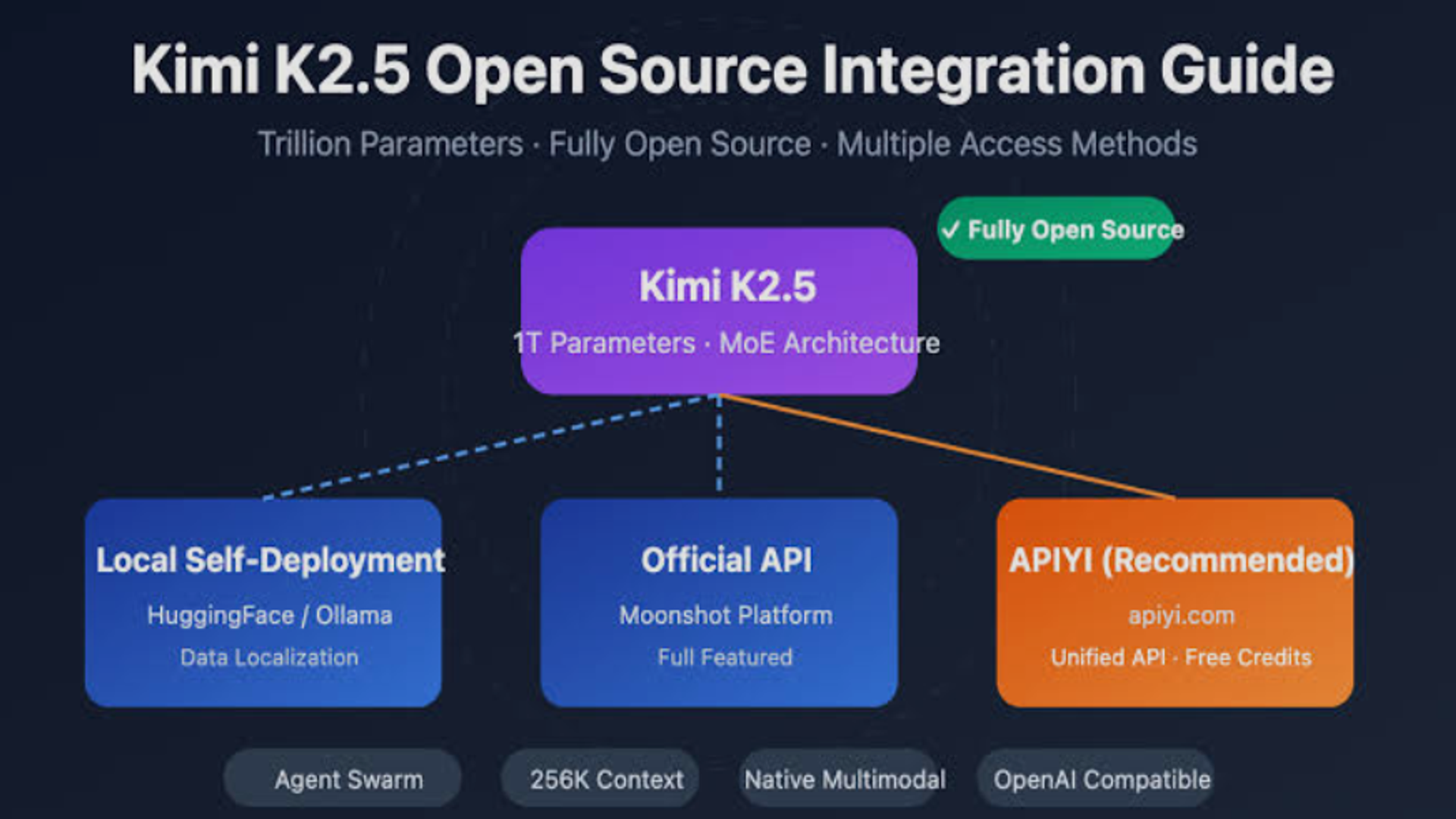
API : platform.moonshot.ai for developer integration
Kimi Code : Terminal-based coding assistant
Open Source : Kimi Code released as open-source project
Configuration Details
Temperature : 1.0 (default)
Top-p : 0.95 (default)
Context Length : 256k tokens
Reproducibility : Official API recommended for benchmark recreation
Vendor Verification : Kimi Vendor Verifier (KVV) for third-party services
Part VII: The Road to AGI
Meaningful Step Forward
For Open-Source Community : Most powerful model demonstrating real-world capability
Under Real Constraints : Strong performance within practical limitations
Production Readiness : Suitable for actual knowledge work deployment
The Future Direction
Continued Advancement : Pushing further into agentic intelligence frontier
Boundary Redefinition : Challenging assumptions about AI capabilities in knowledge work
Research Focus : Expanding parallel coordination and visual reasoning
Open Ecosystem : Contributing to accessible AI advancement
Conclusion: Visual Agentic Intelligence Arrives
The Three Pillars
1. Coding with Vision : Native multimodal architecture enabling visual debugging and image-to-code workflows
2. Agent Swarm : Self-directed parallel coordination with up to 100 sub-agents and 1,500 tool calls
3. Office Productivity : Expert-level document/spreadsheet/PDF/slide generation through conversation
The Performance Story
59.3% improvement on AI Office Benchmark over K2 Thinking
24.3% improvement on General Agent Benchmark
4.5x speedup through agent swarm parallelization
State-of-the-art coding and vision capabilities
Fraction of cost compared to proprietary competitors
The Technical Innovation
15 trillion tokens of vision-text joint pretraining
PARL training with staged reward shaping
Critical-steps metric forcing genuine parallelism
No predefined workflows in agent orchestration
Autonomous visual debugging capability
The Accessibility
Open-source model pushing frontier forward
Multiple access points : Web, app, API, terminal
Four operational modes for different use cases
Beta features with free credits for experimentation
The Paradigm Shift
From sequential to parallel agent execution
From text-only to native multimodal reasoning
From hours to minutes for complex knowledge work
From predefined to self-directed workflow coordination
Get Started :
- Web : https://www.kimi.com
- API : https://platform.moonshot.ai
- Code : https://www.kimi.com/code
- Modes : Instant, Thinking, Agent, Agent Swarm (Beta)
Technical Report : Full details including prompts and methodology forthcoming
Vendor Verification : https://kimi.com/blog/kimi-vendor-verifier.html
WorldVQA Benchmark : https://github.com/MoonshotAI/WorldVQA
The Bottom Line : Kimi K2.5 represents the most powerful open-source model to date, achieving breakthrough performance through native multimodal architecture (15T vision-text tokens), self-directed agent swarm coordination (100 sub-agents, 1,500 tool calls, 4.5x speedup), state-of-the-art coding with vision (autonomous visual debugging), and expert-level office productivity (59.3% AI Office improvement, 24.3% General Agent improvement). The combination of visual agentic intelligence with PARL-trained parallel orchestration marks meaningful step toward AGI for open-source community, demonstrating strong capability on real-world tasks under real-world constraints at fraction of proprietary model costs. Access via Kimi.com, app, API, and open-source Kimi Code terminal tool across four modes (Instant/Thinking/Agent/Agent Swarm Beta). The future of agentic intelligence is parallel, visual, and open.
Try Agent Swarm Beta : Experience 100-agent coordination redefining knowledge work efficiency. 🦞✨