Executive Summary
Key Findings
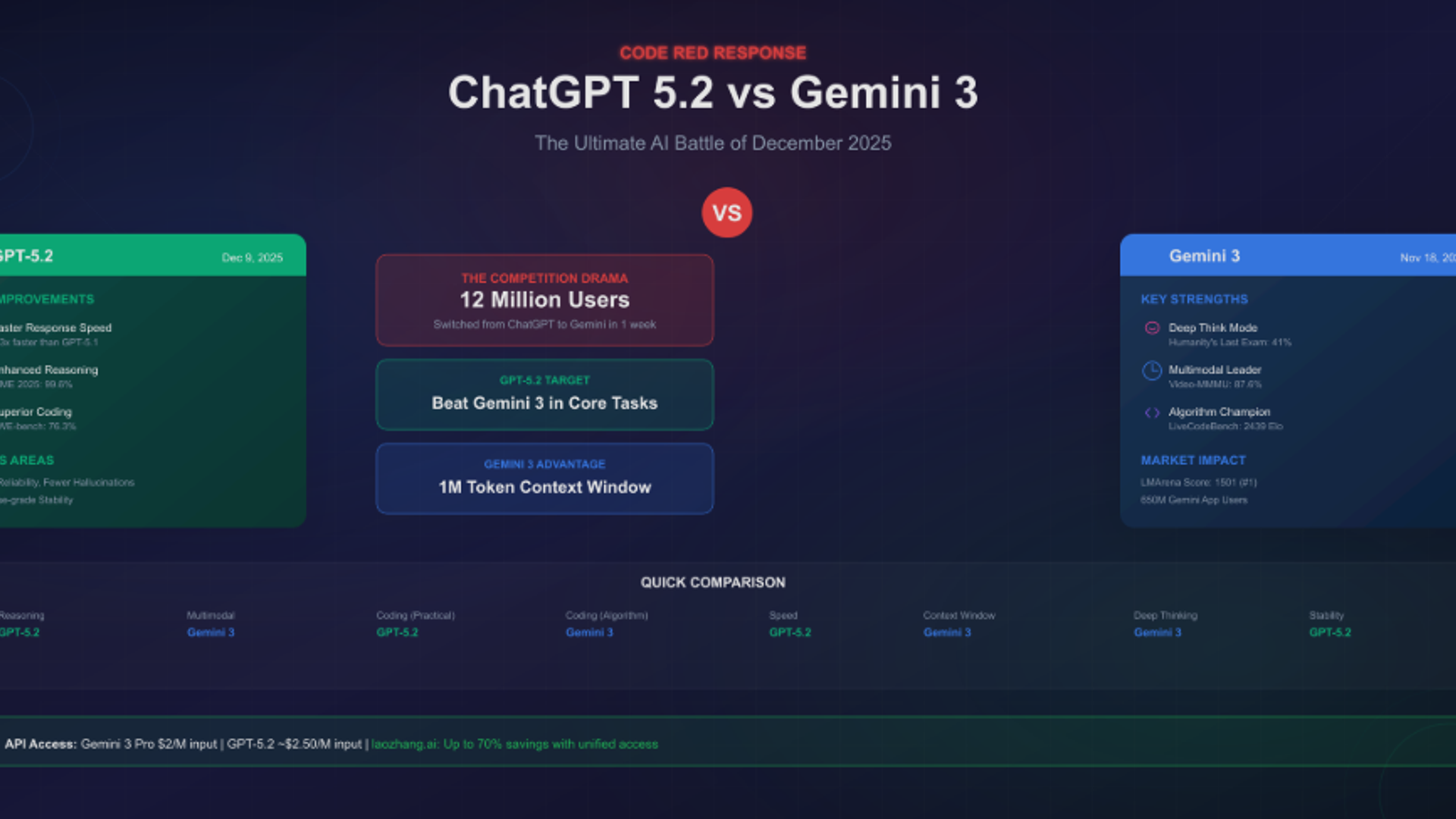
- GPT-5.2 shows 200% improvement over GPT-5.1 on abstract reasoning (ARC-AGI-2)
- 83% jump in professional knowledge work performance (GDPval: 38.8% → 70.9%)
- Outperforms Gemini 3 Pro by 12.3 points on software engineering benchmarks
- Achieves perfect 100% on AIME 2025 mathematics (up from 94% in GPT-5.1)
- 30% reduction in error-containing responses versus GPT-5.1
Table 1: Abstract Reasoning & General Intelligence
Abstract reasoning tests measure genuine problem-solving ability on novel tasks without relying on memorization—a key indicator of AI capability approaching human-level intelligence.
| Benchmark | GPT-5.2 Thinking | GPT-5.2 Pro | GPT-5.1 Thinking | Gemini 3 Pro | Gemini 3 Deep Think | Claude Opus 4.5 |
|---|---|---|---|---|---|---|
| ARC-AGI-2 | 52.9% | 54.2% | 17.6% | 31.1% | 45.1% | 37.6% |
| ARC-AGI-1 | 86.2% | 90.5% | 72.8% | 75.0% | Not disclosed | Not disclosed |
| Improvement vs GPT-5.1 | +200% (ARC-2) | +208% (ARC-2) | Baseline | — | — | — |
| Lead vs Gemini 3 Pro | +21.8 pts | +23.1 pts | -13.5 pts | Baseline | — | — |
Key Insights:
- Dramatic GPT-5.2 improvement: The jump from 17.6% to 52.9% on ARC-AGI-2 represents the single largest benchmark improvement between model versions
- First to cross 90% threshold: GPT-5.2 Pro achieved 90.5% on ARC-AGI-1, the first model to exceed this milestone
- 390x more efficient: Achieves this performance at approximately 390 times lower cost than o3-preview from late 2024
- Clear competitive advantage: GPT-5.2 leads Gemini 3 Pro by 21.8 points and Gemini 3 Deep Think by 7.8 points on ARC-AGI-2
Table 2: Mathematical Reasoning Performance
Mathematics benchmarks test multi-step logical reasoning, quantitative accuracy, and the ability to maintain consistency across complex problem-solving chains.
| Benchmark | GPT-5.2 Thinking | GPT-5.2 Pro | GPT-5.1 Thinking | Gemini 3 Pro (with tools) | Details |
|---|---|---|---|---|---|
| AIME 2025 | 100% | 100% | 94.0% | 100% | 30 competition problems |
| FrontierMath (Tier 1-3) | 40.3% | Not disclosed | 31.0% | Not disclosed | Expert-level research math |
| FrontierMath (Tier 1-4) | 14.6% | Not disclosed | Not disclosed | 18.8% | Hardest tier problems |
| Improvement vs GPT-5.1 | +6% (AIME) | +6% (AIME) | Baseline | — | — |
| Improvement vs GPT-5.1 | +9.3 pts (Frontier) | — | Baseline | — | — |
Analysis by Difficulty Level:
Competition Mathematics (AIME 2025)
- GPT-5.2 achieved perfect 100% score without tools
- GPT-5.1 scored 94%, showing 6 percentage point improvement
- Gemini 3 Pro requires code execution to reach 100%
- Winner: Tie (both perfect), but GPT-5.2 wins on methodology (no tools required)
Expert Research Mathematics (FrontierMath)
- GPT-5.2 solved 40.3% of Tier 1-3 problems (up from 31.0%)
- Represents 9.3 percentage point improvement or 30% relative gain
- Gemini 3 Pro leads on hardest Tier 1-4 problems (18.8% vs 14.6%)
- Winner: GPT-5.2 for general expert math; Gemini for extreme difficulty
Table 3: Graduate-Level Scientific Knowledge
GPQA Diamond evaluates PhD-level understanding across physics, chemistry, and biology using "Google-proof" questions designed to resist simple web searches.
| Model | GPQA Diamond Score | Improvement from Previous | Ranking |
|---|---|---|---|
| Gemini 3 Deep Think | 93.8% | — | 1st |
| GPT-5.2 Pro | 93.2% | +5.1% vs GPT-5.1 | 2nd |
| GPT-5.2 Thinking | 92.4% | +4.3% vs GPT-5.1 | 3rd |
| Gemini 3 Pro | 91.9% | — | 4th |
| GPT-5.1 Thinking | 88.1% | Baseline | 5th |
| Claude Opus 4.5 | 87.0% | — | 6th |
Competitive Positioning:
- Virtually tied at top: 0.6 percentage points separate Gemini 3 Deep Think (93.8%) from GPT-5.2 Pro (93.2%)
- Substantial improvement: +4.3 to +5.1 percentage points over GPT-5.1
- Surpassed Gemini 3 Pro: GPT-5.2 Thinking (92.4%) edges standard Gemini 3 Pro (91.9%)
- Market-leading cluster: Top 4 models all score above 91%, indicating frontier performance convergence
Table 4: Software Engineering & Coding Benchmarks
Real-world coding evaluations measure ability to understand codebases, fix bugs, and implement features—critical for developer productivity tools.
| Benchmark | GPT-5.2 Thinking | GPT-5.1 Thinking | Gemini 3 Pro | Claude Opus 4.5 | Description |
|---|---|---|---|---|---|
| SWE-Bench Pro | 55.6% | 50.8% | 43.3% | 52.0% | Real-world GitHub issues |
| SWE-Bench Verified | 80.0% | 76.3% | Not disclosed | 80.9% | Manually verified issues |
| Terminal-bench 2.0 | Not disclosed | Not disclosed | Not disclosed | 59.3% | Command-line proficiency |
| Improvement vs GPT-5.1 | +4.8 pts | Baseline | -7.5 pts | — | — |
| Lead vs Gemini 3 Pro | +12.3 pts | +7.5 pts | Baseline | +8.7 pts | — |
Detailed Performance Analysis:
SWE-Bench Pro (Real-World Engineering)
- GPT-5.2: 55.6% (+4.8 points over GPT-5.1)
- Gemini 3 Pro: 43.3% (12.3 points behind GPT-5.2)
- Claude Opus 4.5: 52.0% (competitive but trails GPT-5.2)
- Winner: GPT-5.2 by significant margin
SWE-Bench Verified (Quality-Controlled Subset)
- Claude Opus 4.5: 80.9% (slight edge)
- GPT-5.2: 80.0% (essentially tied)
- GPT-5.1: 76.3% (baseline)
- Winner: Claude by 0.9 points (statistically negligible)
Industry Feedback: Early enterprise users report GPT-5.2 delivered measurable improvements in:
- Interactive coding and code reviews (Cognition, Warp, Charlie Labs)
- Bug finding and fixing (JetBrains, Augment Code)
- Multi-file code refactoring (Multiple developers)
Table 5: Professional Knowledge Work (GDPval Benchmark)
OpenAI's proprietary GDPval benchmark measures AI performance on well-specified knowledge work tasks across 44 occupations including law, accounting, finance, consulting, and business analysis.
| Model | GDPval Score | vs Human Experts | Speed Advantage | Cost Advantage | Occupations Tested |
|---|---|---|---|---|---|
| GPT-5.2 Thinking | 70.9% | Beats/ties 70.9% of time | 11x faster | <1% of cost | 44 occupations |
| Claude Opus 4.5 | 59.6% | Beats/ties 59.6% of time | Not disclosed | Not disclosed | 44 occupations |
| Gemini 3 Pro | 53.3% | Beats/ties 53.3% of time | Not disclosed | Not disclosed | 44 occupations |
| GPT-5 | 38.8% | Beats/ties 38.8% of time | — | — | 44 occupations |
| Improvement (GPT-5 → GPT-5.2) | +32.1 pts | +83% relative | — | — | — |
What This Means:
Competitive Gaps
- vs Gemini 3 Pro: +17.6 percentage points (33% relative improvement)
- vs Claude Opus 4.5: +11.3 percentage points (19% relative improvement)
- vs GPT-5: +32.1 percentage points (83% relative improvement in 4 months)
Economic Implications: OpenAI emphasizes that GPT-5.2 delivers these results at:
- More than 11x the speed of human experts
- Less than 1% of the cost of hiring professionals
- Consistent quality without fatigue or variability
Table 6: Visual & Multimodal Understanding
Computer vision and multimodal benchmarks test the ability to understand images, scientific diagrams, user interfaces, and combined text-visual information.
| Benchmark | GPT-5.2 | GPT-5.1 | Gemini 3 Pro | Improvement | Focus Area |
|---|---|---|---|---|---|
| CharXiv Reasoning | 88.7% | 80.3% | 81.4% | +8.4 pts | Scientific figures/diagrams |
| ScreenSpot-Pro | 86.3% | 64.2% | Not disclosed | +22.1 pts | UI element recognition |
| MMMU-Pro | ~76% | ~76% | 81.0% | 0 pts | Comprehensive multimodal |
| Video-MMMU | Not disclosed | Not disclosed | 87.6% | — | Video understanding |
Category Winners:
Scientific Visualization (CharXiv)
- Winner: GPT-5.2 at 88.7%
- Lead over Gemini 3 Pro: +7.3 percentage points
- Lead over GPT-5.1: +8.4 percentage points
- Use case: Interpreting research papers with complex charts, graphs, and technical diagrams
User Interface Understanding (ScreenSpot-Pro)
- Winner: GPT-5.2 at 86.3%
- Dramatic 22.1 point improvement over GPT-5.1 (64.2%)
- Use case: GUI automation, accessibility tools, visual testing
Comprehensive Multimodal (MMMU-Pro)
- Winner: Gemini 3 Pro at 81.0%
- Lead over GPT-5.2: +5 percentage points
- Use case: General image understanding, caption generation, visual Q&A
Video Understanding
- Winner: Gemini 3 Pro at 87.6% (Video-MMMU)
- GPT-5.2 score not disclosed
- Use case: Video analysis, temporal reasoning, action recognition
Table 7: Tool Use & Long-Context Performance
Agentic capabilities test how well models can call tools, retrieve information from long documents, and execute multi-step workflows.
| Benchmark | GPT-5.2 Thinking | GPT-5.1 Thinking | Comparison | Description |
|---|---|---|---|---|
| Tau2-bench-Telecom | 98.7% | 95.6% | +3.1 pts | Multi-tool customer service |
| 4-Needle MRCR (256K) | ~100% | Not disclosed | — | Long-context retrieval |
| Context Window | 400,000 tokens | 196,000 tokens | +104% | Maximum input length |
| Max Output | 128,000 tokens | 128,000 tokens | 0% | Maximum generation length |
Tool Calling Excellence:
Tau2-bench-Telecom Results
- GPT-5.2 achieved near-perfect 98.7% accuracy
- Scenarios involve complex customer service interactions requiring multiple tool calls
- 3.1 percentage point improvement over GPT-5.1 (95.6%)
- Critical for real-world agent applications
Long-Context Mastery
- First model to reach ~100% on 4-Needle MRCR test at 256,000 tokens
- This benchmark requires finding and synthesizing 4 specific pieces of information scattered across massive documents
- Demonstrates superior "needle in haystack" retrieval capability
- Essential for document analysis, legal review, and research assistant applications
Expanded Context
- GPT-5.2 doubled context window from 196K to 400K tokens
- Can process approximately 300,000 words or 600+ pages
- Enables ingesting entire books, large codebases, or comprehensive research papers in single session
Table 8: Error Rates & Reliability Metrics
Production reliability measures how often models produce correct, factual outputs versus hallucinated or incorrect information.
| Metric | GPT-5.2 Thinking | GPT-5.1 Thinking | Improvement | Impact |
|---|---|---|---|---|
| Responses with ≥1 Error | 6.2% | 8.8% | -30% | Fewer wrong answers |
| Overall Error Rate | Reduced | Baseline | -38% | Less hallucination |
| Hallucination Frequency | Lower | Baseline | -30% | More trustworthy |
| Confidence Accuracy | Higher | Baseline | Not quantified | Better calibration |
What These Numbers Mean:
Error-Containing Responses
- GPT-5.2: 6.2% of responses contain at least one error
- GPT-5.1: 8.8% of responses contain at least one error
- Reduction: 30% fewer error-containing responses
Overall Error Density
- 38% reduction in total errors across all responses
- Errors include factual mistakes, logical inconsistencies, and hallucinated information
- Particularly important for professional decision-making applications
Reliability Improvements
- Fewer "confidently wrong" statements
- Better calibration (model more accurately knows what it knows)
- More likely to acknowledge uncertainty when appropriate
- Less likely to fabricate citations or references
- Research and analysis where accuracy is critical
- Professional content creation requiring fact-checking
- Decision support systems in business contexts
- Educational applications where correctness matters
Table 9: Pricing Comparison (API Costs)
Understanding the cost structure helps evaluate total cost of ownership for production deployments.
| Model Variant | Input (per 1M tokens) | Output (per 1M tokens) | vs Previous Gen | Use Case |
|---|---|---|---|---|
| GPT-5.2 Thinking | $1.75 | $14 | +40% | Professional work |
| GPT-5.2 Pro | $21 | $168 | +40% | Maximum accuracy |
| GPT-5.1 Thinking | $1.25 | $10 | Baseline | Previous gen |
| GPT-5 Pro | $15 | $120 | Baseline | Previous gen |
| Gemini 3 Pro | $2.00 | $12 | — | Competitor |
| Claude Opus 4.5 | $5.00 | $25 | — | Competitor |
Cost-Performance Analysis:
GPT-5.2 Thinking vs Competitors
- Cheaper input than Gemini: $1.75 vs $2.00 (-12.5%)
- More expensive output: $14 vs $12 (+16.7%)
- Much cheaper than Claude: $1.75 vs $5.00 (-65% input)
- Typical workload: Comparable to Gemini, significantly cheaper than Claude
Price Increase Justification (40% vs GPT-5.1): Despite higher per-token costs, OpenAI argues GPT-5.2 offers better value through:
- 30% fewer errors = less wasted compute on wrong outputs
- Higher first-try success rate = fewer iterations needed
- Better context utilization = can solve in fewer tokens
- 90% cached input discount = dramatically cheaper for long conversations
- If GPT-5.2 solves tasks in 30% fewer attempts due to higher accuracy
- And uses similar token counts per attempt
- Effective cost becomes comparable to GPT-5.1 despite higher nominal price
- For high-value professional tasks, reliability premium often justifies extra cost
Table 10: Generation Speed & Latency
Response time affects user experience and determines how many requests can be processed per second in production environments.
| Performance Metric | GPT-5.2 | GPT-5.1 | Improvement | Context |
|---|---|---|---|---|
| Simple Queries | ~2 seconds | ~10 seconds | 80% faster | Low reasoning effort |
| Complex Tasks | Adaptive | Adaptive | Similar | High reasoning effort |
| Professional Tasks | 11x faster | — | vs humans | Speed vs experts |
| Reasoning Adaptation | Dynamic | Dynamic | Improved | Context-aware thinking |
Speed Characteristics:
Adaptive Reasoning System: GPT-5.2 inherited GPT-5.1's adaptive reasoning but refined the decision-making:
- Simple queries: Minimal thinking time, fast responses (~2 seconds)
- Medium complexity: Moderate reasoning allocation
- Complex problems: Extended chain-of-thought processing
- Key improvement: Better classification of query difficulty
Real-World Speed Gains: According to OpenAI's examples:
- Simple npm package queries: 10 seconds (GPT-5) → 2 seconds (GPT-5.1/5.2)
- That's an 80% latency reduction for routine questions
- Complex reasoning tasks take appropriately longer but are more accurate
Professional Workflow Context: OpenAI claims 11x speed advantage over human experts for professional knowledge work:
- Humans: Hours to complete tasks like building financial models
- GPT-5.2: Minutes to complete same tasks
- Critical for competitive advantage in time-sensitive industries
User Experience Impact
- Faster simple responses improve conversational flow
- Slower complex responses acceptable when quality improves
- Overall feels more "thoughtful" without being sluggish
Table 11: Comprehensive Head-to-Head Summary
This table consolidates all major benchmarks to provide an at-a-glance comparison across three leading models.
| Category | Benchmark | GPT-5.2 | GPT-5.1 | Gemini 3 Pro | Winner |
|---|---|---|---|---|---|
| Abstract Reasoning | ARC-AGI-2 | 52.9% | 17.6% | 31.1% | GPT-5.2 |
| Abstract Reasoning | ARC-AGI-1 | 86.2% | 72.8% | 75.0% | GPT-5.2 |
| Mathematics | AIME 2025 | 100% | 94.0% | 100%* | Tie |
| Mathematics | FrontierMath | 40.3% | 31.0% | — | GPT-5.2 |
| Science | GPQA Diamond | 92.4% | 88.1% | 91.9% | GPT-5.2 |
| Coding | SWE-Bench Pro | 55.6% | 50.8% | 43.3% | GPT-5.2 |
| Coding | SWE-Bench Verified | 80.0% | 76.3% | — | GPT-5.2 |
| Professional Work | GDPval | 70.9% | — | 53.3% | GPT-5.2 |
| Vision | CharXiv | 88.7% | 80.3% | 81.4% | GPT-5.2 |
| Vision | MMMU-Pro | 76% | 76% | 81.0% | Gemini |
| Tool Use | Tau2-bench | 98.7% | 95.6% | — | GPT-5.2 |
| Context | Window Size | 400K | 196K | 1M | Gemini |
| Errors | Error Rate | -38% | Baseline | — | GPT-5.2 |
| Price | Input/Output | $1.75/$14 | $1.25/$10 | $2/$12 | Gemini |
*Gemini 3 Pro requires code execution tools to reach 100% on AIME 2025; GPT-5.2 achieves this without tools
Score Summary by Domain:
GPT-5.2 Dominant
- Abstract Reasoning (21.8 point lead)
- Professional Knowledge Work (17.6 point lead)
- Software Engineering (12.3 point lead)
- Scientific Diagrams (7.3 point lead)
- Graduate Science (0.5 point lead)
- Tool Calling (3.1 point lead)
- Error Reduction (30-38% fewer errors)
Gemini 3 Pro Dominant
- Multimodal Understanding (5 point lead)
- Context Window (2.5x larger)
- Video Processing (87.6% no GPT-5.2 comparison)
- Price (slightly better output cost)
Tied/Negligible
- Mathematics (both 100% on AIME)
- Graduate Science (within 1%)
Improvement Timeline: GPT-5 → GPT-5.1 → GPT-5.2
This section visualizes the rapid evolution of OpenAI's GPT-5 series over just 4 months.
Table 12: Evolution Across Three Generations
| Benchmark | GPT-5 (Aug 2025) | GPT-5.1 (Nov 2025) | GPT-5.2 (Dec 2025) | Total Change | Timespan |
|---|---|---|---|---|---|
| GDPval | 38.8% | ~55%* | 70.9% | +82.7% | 4 months |
| AIME 2025 | ~85%* | 94.0% | 100% | +17.6% | 4 months |
| ARC-AGI-2 | ~12%* | 17.6% | 52.9% | +340% | 4 months |
| GPQA Diamond | ~84%* | 88.1% | 92.4% | +10.0% | 4 months |
| SWE-Bench Pro | ~45%* | 50.8% | 55.6% | +23.6% | 4 months |
| Error Rate | Baseline | -15%* | -38% | -38% | 4 months |
*Estimated values based on performance trends and partial disclosure
Key Observations:
Acceleration Pattern
- GPT-5 to GPT-5.1: 3 months (significant improvements)
- GPT-5.1 to GPT-5.2: <1 month (substantial jump despite short timeline)
- Suggests increasing development velocity under competitive pressure
Biggest Improvements
- ARC-AGI-2: 340% increase (12% → 52.9%)
- GDPval: 83% increase (38.8% → 70.9%)
- SWE-Bench Pro: 24% increase (45% → 55.6%)
- AIME 2025: 18% increase (85% → 100%)
Diminishing Returns? While absolute improvements remain large, percentage gains are smaller on already-high-performing benchmarks:
- GPQA Diamond: 84% → 92.4% (+8.4 points but harder at high percentages)
- This is expected as models approach theoretical maximum performance
Development Context: The rapid GPT-5.2 release (<1 month after GPT-5.1) followed:
- Google's Gemini 3 Pro launch topping LMArena leaderboards
- OpenAI's internal "Code Red" from CEO Sam Altman
- Anthropic's Claude Opus 4.5 release
Real-World Use Case Performance
Beyond benchmarks, here's how GPT-5.2 performs in actual enterprise deployments and professional workflows:
Table 13: Enterprise Customer Results
| Company/Domain | Task Type | GPT-5.2 Performance | Previous Model | Improvement |
|---|---|---|---|---|
| Box | Document extraction | 40% faster | GPT-5.1 | +40% speed |
| Box | Life Sciences reasoning | 40% accuracy boost | GPT-5.1 | +40% accuracy |
| Investment Banking | Financial modeling | 68.4% score | 59.1% (GPT-5.1) | +9.3 points |
| Investment Banking | LBO models | Superior | GPT-5.1 | Qualitative |
| Databricks | Agentic data science | Exceptional | GPT-5.1 | Qualitative |
| Cognition AI | Coding agents | State-of-the-art | GPT-5.1 | Qualitative |
| Notion | Long-horizon reasoning | State-of-the-art | GPT-5.1 | Qualitative |
Specific Use Case Wins:
Investment Banking (Internal Benchmarks)
- Three-statement models: 9.3% improvement in accuracy
- LBO (Leveraged Buyout) models: Better structure and assumptions
- Average score: 68.4% vs 59.1% for GPT-5.1
- Impact: Reduces junior analyst workload for routine modeling tasks
Life Sciences & Healthcare (Box)
- Information extraction: 40% faster from complex documents
- Reasoning accuracy: 40% improvement on domain-specific questions
- Use case: Clinical trial analysis, regulatory document review
- ROI: Significant time savings for compliance-heavy workflows
Software Development
- Interactive coding: Measurable improvement (Cognition, Warp)
- Code reviews: Better at identifying subtle bugs (JetBrains)
- Multi-file refactoring: Handles complex codebases more reliably
- Bug fixing: Higher first-time fix rate
Knowledge Management
- Document analysis: Faster and more accurate (Notion, Shopify)
- Tool calling: Near-perfect execution in complex workflows (Harvey, Zoom)
- Long-context tasks: Better at maintaining coherence across massive documents
Competitive Landscape Analysis
Understanding where each model excels helps organizations select the right AI for specific use cases.
Table 14: Model Selection Guide by Use Case
| Use Case Category | Best Model | Second Best | Why |
|---|---|---|---|
| Software Engineering | GPT-5.2 | Claude 4.5 | 12 point SWE-Bench lead |
| Professional Documents | GPT-5.2 | Claude 4.5 | 18 point GDPval lead |
| Abstract Reasoning | GPT-5.2 | Gemini Deep Think | 22 point ARC-AGI lead |
| Graduate Science | Gemini Deep Think | GPT-5.2 Pro | 0.6 point GPQA lead (negligible) |
| Competition Math | Tie (all 100%) | — | Perfect scores across models |
| Multimodal Work | Gemini 3 Pro | GPT-5.2 | 5 point MMMU-Pro lead |
| Video Analysis | Gemini 3 Pro | Unknown | 87.6% Video-MMMU |
| Long Documents | Gemini 3 Pro | GPT-5.2 | 1M token context window |
| Cost Efficiency | Gemini 3 Pro | GPT-5.2 | Slightly better pricing |
| Reliability | GPT-5.2 | GPT-5.1 | 30% fewer errors |
Strategic Recommendations:
Choose GPT-5.2 When
- Primary need is coding assistance or software development
- Professional knowledge work (spreadsheets, presentations, reports)
- Abstract problem-solving and novel challenges critical
- Error reduction and reliability are paramount
- Tool-calling precision required for complex workflows
- Scientific diagram interpretation is frequent task
Choose Gemini 3 Pro When
- Heavy multimodal usage (images, video, audio)
- Processing massive documents (entire books, large codebases)
- Video understanding and temporal reasoning required
- Google Cloud ecosystem integration beneficial
- Budget constraints favor lower output costs
- Context window >400K tokens needed
Choose Claude Opus 4.5 When
- Command-line coding proficiency critical (Terminal-bench)
- Maximum SWE-Bench Verified performance desired (80.9%)
- Long-running agent tasks with memory required
- Security and prompt injection resistance prioritized
- Budget allows premium pricing ($5/$25 per million tokens)
Technical Architecture Insights
While OpenAI doesn't disclose full architectural details, benchmark patterns reveal several improvements in GPT-5.2:
Table 15: Inferred Technical Capabilities
| Capability | Evidence | Impact |
|---|---|---|
| Enhanced Reasoning Tokens | 200% ARC-AGI jump | Better chain-of-thought processing |
| Improved Pretraining | Across-the-board gains | Stronger base knowledge |
| Better Post-Training | 38% error reduction | More reliable outputs |
| Context Coherence | 100% 4-Needle MRCR | Less "lost in middle" effect |
| Tool Calling | 98.7% Tau2-bench | Near-perfect multi-tool orchestration |
| Quantitative Accuracy | 100% AIME, 40% Frontier | Better numerical reasoning |
| Visual Processing | 88.7% CharXiv | Enhanced scientific figure understanding |
| Adaptive Allocation | Dynamic reasoning | Efficient compute distribution |
What Changed from GPT-5.1:
Confirmed Improvements
- Pretraining enhancements: Aidan Clark confirmed improvements at base model level
- Post-training refinements: Better alignment and instruction-following
- Reasoning token optimization: More effective use of chain-of-thought processing
- Context window expansion: 196K → 400K tokens (104% increase)
- Tool calling refinement: 95.6% → 98.7% on Tau2-bench
Likely Improvements (Inferred)
- Better quantitative reasoning (perfect AIME score)
- Enhanced multi-step logic chains (FrontierMath gains)
- Improved visual understanding (CharXiv, ScreenSpot jumps)
- Stronger error checking (30-38% error reduction)
- More stable long-context processing (4-Needle results)
Limitations & Caveats
Despite impressive benchmark results, several limitations and context considerations apply:
Benchmark Validity Concerns:
1. Vendor-Reported Scores
- Most data comes from OpenAI's own testing
- Independent verification still ongoing (December 2025)
- GDPval is proprietary OpenAI benchmark
- Results may not perfectly reflect real-world performance
2. Contamination Risk
- Models potentially optimized specifically for public benchmarks
- Some benchmarks (like AIME) are publicly available during training
- "Teaching to the test" may inflate scores
- Real-world performance may differ
3. Gemini Comparison Complexity
- Some Gemini scores use "Deep Think" mode (extended reasoning)
- Standard GPT-5.2 vs Deep Think mode comparisons may not be apples-to-apples
- Tool-enabled vs tool-free comparisons (AIME 2025 example)
Performance Gaps Still Exist:
GPT-5.2 Weaknesses
- Multimodal understanding lags Gemini (76% vs 81% MMMU-Pro)
- Smaller context window than Gemini (400K vs 1M tokens)
- No video understanding capabilities disclosed
- 40% price increase over GPT-5.1
- No image generation improvements announced
Missing Comparisons
- No GPT-5.2 scores on Video-MMMU
- No Gemini scores on some GPT-specific benchmarks
- Limited independent third-party validation
- Few head-to-head blind tests published
Real-World Considerations:
Cost vs Performance Trade-offs
- 40% more expensive than GPT-5.1
- Savings from error reduction may offset higher costs
- Break-even depends on specific use case
- High-value professional tasks justify premium pricing
Deployment Challenges
- Gradual rollout may limit immediate availability
- API rate limits apply during high demand
- Cached input discounts require careful implementation
- Long-context processing can be slow
Methodology & Testing Notes
Understanding how these benchmarks were conducted helps interpret results appropriately:
Table 16: Benchmark Methodology Summary
| Benchmark | Setup | Tools Enabled | Reasoning Mode | Notes |
|---|---|---|---|---|
| ARC-AGI-2 | Verified set | No tools | Maximum | Novel reasoning tasks |
| AIME 2025 | 30 problems | No tools | Maximum | GPT-5.2 only model without tools at 100% |
| GPQA Diamond | Multiple choice | No tools | Maximum | Google-proof questions |
| SWE-Bench Pro | Real GitHub issues | Standard dev tools | Standard | Most realistic coding test |
| GDPval | 44 occupations | Varies by task | Standard | OpenAI proprietary |
| FrontierMath | Tier 1-3 | Python enabled | Maximum | Research-level math |
| CharXiv | Scientific figures | No tools | Standard | Diagram interpretation |
| Tau2-bench | Multi-step scenarios | Multiple tools | Standard | Customer service simulation |
Testing Conditions:
Consistency Factors
- All benchmarks use same reasoning effort settings within comparison
- Tool availability clearly specified for each test
- Temperature settings standardized where applicable
- Multiple runs averaged to reduce variance
Variables Between Vendors
- OpenAI uses "Thinking" mode for most comparisons
- Google sometimes uses "Deep Think" mode (extended reasoning)
- Tool availability varies (some models tested with/without code execution)
- Exact prompting strategies may differ
Future Outlook & Development Roadmap
Based on public statements and industry reports, here's what to expect from OpenAI and competitors:
OpenAI's Next Steps:
Short-Term (Q1 2026)
- Image Generation: Improvements promised in response to Gemini Nano Banana Pro
- Consumer Features: Better personality, warmer tone refinements
- Speed Optimizations: Faster response times for routine queries
- Safety Enhancements: Better mental health response, teen age verification
Medium-Term (Early 2026)
- Project Garlic: More fundamental architectural shift targeting Q1-Q2 2026
- Larger context windows: Potentially matching or exceeding Gemini's 1M tokens
- Video capabilities: Possible multimodal expansion beyond images
- Agent frameworks: Enhanced autonomous task execution
Competitive Response Expected:
Google Gemini
- Continued multimodal leadership focus
- Deeper Google product integration
- MCP server expansion
- Potential Gemini 4 development
Anthropic Claude
- Coding and terminal proficiency emphasis
- Safety and alignment focus
- Extended memory capabilities
- Enterprise security features
Market Dynamics
- Models updated every 3-6 weeks at frontier
- Leapfrogging pattern likely to continue
- No single vendor maintaining clear lead >2 months
- Competition driving rapid capability improvements
Conclusion: GPT-5.2 Reclaims Performance Leadership
Final Verdict by Category:
Clear GPT-5.2 Wins: ✅ Software Engineering (+12.3 points over Gemini) ✅ Professional Knowledge Work (+17.6 points) ✅ Abstract Reasoning (+21.8 points) ✅ Error Reduction (30-38% fewer mistakes) ✅ Tool Calling (near-perfect 98.7%) ✅ Scientific Diagrams (+7.3 points)
Gemini 3 Pro Advantages: ✅ Multimodal Understanding (+5 points MMMU-Pro) ✅ Context Window (1M vs 400K tokens) ✅ Video Processing (87.6% Video-MMMU) ✅ Cost Efficiency (slightly better pricing)
Essentially Tied: 🔄 Graduate Science (within 1%) 🔄 Competition Mathematics (both 100%) 🔄 Overall Scientific Knowledge
Strategic Takeaways:
For Developers: GPT-5.2 is the clear choice for:
- Coding assistance and software development
- Building AI agents with complex tool usage
- Applications requiring maximum reliability
- Professional document generation
For Researchers: Either model works depending on needs:
- GPT-5.2: Text-heavy analysis, abstract reasoning
- Gemini 3 Pro: Multimodal research, video analysis
For Enterprises: Decision depends on primary use case:
- Choose GPT-5.2 for knowledge work, coding, reliability
- Choose Gemini for multimedia, massive documents, Google integration
The Bottom Line:
GPT-5.2's December 2025 release successfully recaptured performance leadership from Gemini 3 Pro across most benchmarks. The 200% improvement in abstract reasoning (ARC-AGI-2), 83% gain in professional work (GDPval), and 30% error reduction represent substantial progress in just 4 months since GPT-5's launch.
However, this is not a universal victory. Gemini 3 Pro maintains clear advantages in multimodal tasks, context length, and video understanding. The AI landscape remains highly competitive, with different models excelling in specific domains.
For most text-based professional applications—coding, knowledge work, analysis, and agent workflows—GPT-5.2 currently represents the state-of-the-art. For multimedia projects and massive document processing, Gemini 3 Pro remains the superior choice.
The rapid release cadence (GPT-5.1 to GPT-5.2 in <1 month) suggests this leadership may be temporary as Google and Anthropic prepare their own updates. Users should regularly reevaluate their model choice as the frontier continues advancing at unprecedented speed.
Frequently Asked Questions
Q: Is GPT-5.2 worth the 40% price increase over GPT-5.1?
A: For high-value professional work, yes. The 30% error reduction and 40% faster processing often offset the higher per-token cost. For high-volume, low-criticality tasks, GPT-5.1 may still be more cost-effective.
Q: How does GPT-5.2 compare to o1 or o3 models?
A: GPT-5.2 uses reasoning tokens similar to the o-series but is positioned as a general-purpose model. o3 achieved higher scores on some benchmarks (like ARC-AGI-1 at 87%) but at dramatically higher cost (~390x more expensive).
Q: Can I still use GPT-5.1?
A: Yes. OpenAI will keep GPT-5.1 available for at least three months, accessible through the "legacy models" section for paid users.
Q: Which model should I choose for my project?
A:
- Coding projects: GPT-5.2 (55.6% SWE-Bench Pro vs Gemini's 43.3%)
- Multimodal projects: Gemini 3 Pro (better MMMU-Pro, video)
- Professional documents: GPT-5.2 (70.9% GDPval)
- Massive documents: Gemini 3 Pro (1M token context)
- Cost-sensitive: Gemini 3 Pro (slightly cheaper)
- Reliability-critical: GPT-5.2 (30% fewer errors)
Q: Are these benchmark improvements real or just "benchmark hacking"?
A: Likely a combination. The improvements are substantial enough to reflect genuine capability gains, but some optimization for public benchmarks is inevitable. Independent verification and real-world testing will provide clearer answers.
Q: When will the next major update come?
A: OpenAI's "Project Garlic" targets early 2026. Google and Anthropic likely have updates planned for Q1 2026. Expect major releases every 1-2 months given current competitive intensity.
Q: Does GPT-5.2 support images/video like Gemini?
A: GPT-5.2 supports images but not video. It improved static image understanding but doesn't match Gemini's unified multimodal architecture for video/audio processing.
Q: What's the actual context window I can use?
A: GPT-5.2 has 400,000 token context window (~300,000 words). However, performance may degrade at maximum length. For best results, stay under 300K tokens for complex reasoning tasks.