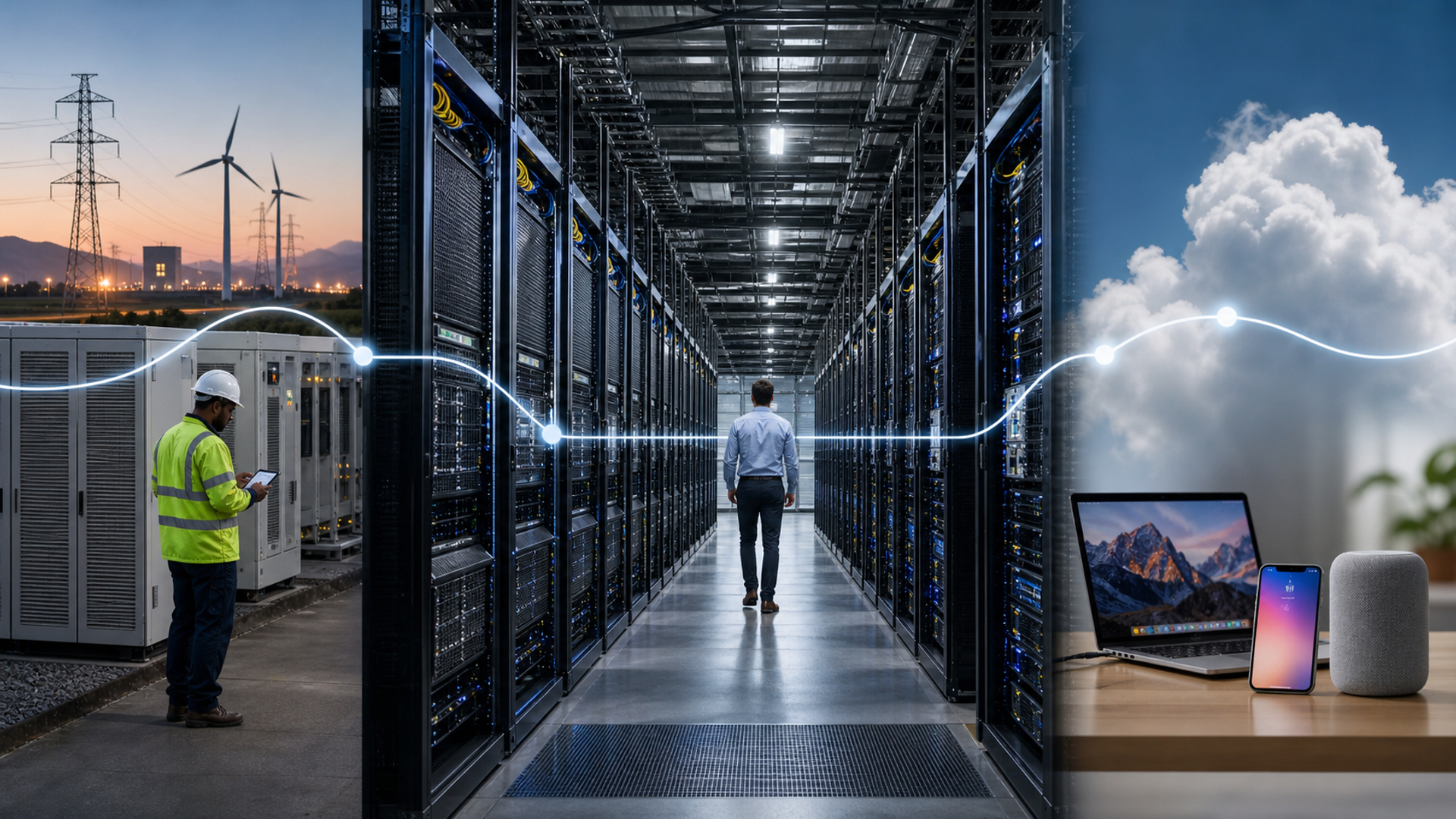
Alphabet has raised its 2026 capital-expenditure forecast to $195 billion–$205 billion, according to its Q2 results coverage. The range is about $15 billion above the company’s previous guidance and is one of the clearest signs that the AI race is now an infrastructure race.
The money is not a single cheque for a new Gemini model. Capital expenditure builds assets that can serve many products over several years: data centres, servers, networking, accelerators, power systems, land and supporting equipment. Alphabet needs those assets for Google Cloud, Search, YouTube, Workspace, the Gemini app and developer APIs.
The practical question is what this spending can change for users. More capacity can reduce waiting, support larger models and make new AI features available to more people. It can also create pressure to turn expensive infrastructure into revenue, shape product bundling and increase the environmental and regulatory scrutiny attached to data-centre growth.
A map of the AI infrastructure stack
| Investment layer | What Alphabet is likely funding | Why it matters to users and customers | Main constraint |
|---|---|---|---|
| Data-centre sites | Buildings, land, cooling and physical security | More regional capacity and service resilience | Permits, construction time and local acceptance |
| Compute | Google TPUs, GPUs, CPUs and servers | Faster training and more inference capacity | Chip supply, utilisation and rapid obsolescence |
| Networking | Optical links, switches and data-centre interconnects | Lower latency and larger distributed workloads | Complex deployment and congestion |
| Power | Grid connections, substations, backup systems and energy contracts | Determines how much compute can actually run | Generation, transmission and long lead times |
| Storage | High-performance and archival systems | Supports multimodal data, retrieval and enterprise workloads | Cost, governance and data residency |
| Cloud platform | Managed services, developer tools and security controls | Makes raw compute usable by organisations | Reliability, lock-in and skills |
| Product integration | Search, Workspace, Android, YouTube and Gemini serving | Converts infrastructure into everyday AI experiences | Trust, economics and product quality |
The range was reported alongside Alphabet’s strong Q2 performance, including 82% year-on-year growth in Google Cloud revenue and 17% growth in Search revenue. Alphabet’s official Q2 remarks also put the Gemini app above 950 million monthly users and Gemini API throughput above 22 billion tokens a minute. Demand and infrastructure are therefore moving together.
Why AI needs more capital than conventional software
Traditional software can often serve another user at low incremental cost. Generative AI is different. Each request consumes compute. Longer prompts, richer reasoning, images, video and agentic workflows can multiply that cost.
Training a frontier model is the most visible expense, but serving it at global scale can be the longer commitment. A model used occasionally by researchers is one problem. A model embedded in Search, Android and Workspace for hundreds of millions of people is another. It needs capacity in several regions, redundancy for failures, low-latency networking and systems that keep sensitive data within required jurisdictions.
That is why Alphabet’s consumer scale matters. The Gemini Q2 adoption figures imply that Google is not building only for the next model release. It is building an industrial system capable of delivering AI continuously across established products.
Data centres are the visible part, not the whole system
A data centre without enough electricity or accelerators is an expensive shell. A room full of chips without efficient networking cannot behave like one large computer. The infrastructure stack has to advance together.
Google’s advantage is vertical integration. It designs Tensor Processing Units, operates a global network, runs a major cloud platform and owns consumer applications that generate demand. This can improve coordination: the company can optimise a model for its hardware, place capacity near product demand and reuse infrastructure across internal and external workloads.
Vertical integration does not remove bottlenecks. Power projects can take years. Construction competes for equipment and skilled labour. Advanced chips have supply constraints. A new generation of accelerators can make older equipment less attractive before it has fully depreciated. The capex figure tells us the intended scale, not that every asset will arrive on time or produce an acceptable return.
Where the $195–205 billion does not go
Capital expenditure is frequently confused with total AI spending. It does not include every cost. Research salaries, electricity consumed during operations, software development, sales, content licensing and many cloud expenses can sit elsewhere in the accounts.
The number also covers more than AI. Alphabet’s infrastructure supports Search indexing, video delivery, storage, advertising systems and other services. AI is the dominant growth driver discussed around the forecast, but it would be inaccurate to label every dollar “Gemini spending”.
This distinction matters when comparing companies. A cloud provider that owns data centres records spending differently from a model company that rents capacity. Two businesses can commit similar resources while reporting very different capex.
What more capacity could change for Gemini
Capacity can improve an AI product in five practical ways.
First, it can reduce rationing. Providers sometimes limit access to advanced models, long contexts or heavy tools because serving capacity is scarce. More infrastructure can expand availability.
Second, it can support lower latency. A powerful model that takes too long to answer is unsuitable for Search, voice and real-time assistance. Regional capacity and efficient inference are essential.
Third, it can make multimodal services more common. Image, audio and video processing generally demand more compute and bandwidth than short text responses.
Fourth, it can enable agents that remain active across several steps. A workflow that searches, reads, calls a tool, checks a result and asks for approval consumes more resources than a single answer.
Fifth, scale can lower unit cost if utilisation and model efficiency improve. That saving might appear as cheaper APIs, larger allowances or more features inside existing subscriptions. It could also remain with Alphabet. Infrastructure investment creates the possibility of lower cost; competition and product strategy determine whether users receive it.
The pressure to monetise will increase
Spending at this level creates a commercial obligation. Alphabet has several routes to monetisation: Cloud consumption, enterprise subscriptions, premium consumer plans, advertising formats, developer APIs and AI features that strengthen retention in existing products.
The balance will shape the user experience. If Google relies heavily on subscriptions, advanced models and storage may remain behind paid tiers. If advertising finances more of AI Mode, disclosure and commercial-result quality become important. If Cloud is the primary engine, enterprise governance, data residency and workload portability will receive more attention.
Buyers should avoid assuming that abundant infrastructure means unlimited free AI. Capital lowers scarcity only when capacity arrives and is efficiently used. Providers can still segment features by model quality, context, speed, region and support.
Power is becoming a product constraint
AI infrastructure planning increasingly begins with megawatts rather than server counts. A data centre must secure a grid connection, dependable generation, cooling and backup capacity. These requirements can affect where services are built and how quickly they come online.
Power also creates local consequences. Large projects can bring investment and jobs, but they may compete for electricity and water, require new transmission and attract questions about emissions. Alphabet has made environmental commitments, yet the absolute growth in compute makes execution harder.
For enterprise customers, regional infrastructure decisions can affect latency, availability and data-location options. For consumers, the effect is less visible but still real: the speed and reliability of an AI feature depend on physical systems somewhere.
A buyer checklist for Google Cloud and Gemini commitments
Organisations considering a deeper Google AI commitment should ask:
Which models and regions are guaranteed for the workload?
What are the quotas, latency objectives and failure procedures?
Can data remain within the required geography?
How are prompts, outputs and tool calls logged and retained?
What is the full cost of input, output, grounding, storage and orchestration?
Can the application switch models without a complete rewrite?
What evaluation proves that a larger model adds value?
What happens when a preview feature changes or disappears?
Alphabet’s capex plan makes capacity risk less likely than it would be for a small provider, but it does not answer architecture and governance questions for a customer.
The competitive consequence
Google’s plan raises the price of competing at the frontier. A rival needs not only a capable model but access to chips, power, networking, distribution and enough cash to keep building. This favours cloud companies and alliances between model developers and infrastructure suppliers.
The AMD–Anthropic agreement is one example of that response. Anthropic gains a large alternative supply path; AMD gains a major model customer and design partner. Our deal analysis explains why these partnerships are becoming part of model strategy.
Competition can still come from efficiency. A smaller or open model that completes a task with fewer tokens can beat a larger system economically. More capex does not guarantee better answers. It guarantees more attempts, more serving capacity and a stronger ability to distribute whatever works.
How to read the number over the next year
Three checkpoints will show whether the plan is working. Watch whether Cloud growth remains strong as capacity expands; whether Gemini products improve usage and monetisation; and whether management reports persistent shortages or delays despite the spending.
Also watch utilisation. Infrastructure only creates value when customers and internal products use it enough. Overbuilding can depress returns; underbuilding can constrain growth. The $195–205 billion range is therefore a bet on sustained AI demand, not merely a response to the last quarter.
The verdict
Alphabet’s raised capex forecast is the physical counterpart to Gemini’s adoption numbers. A consumer app approaching one billion monthly users, AI Mode above one billion and APIs processing tens of billions of tokens a minute require an enormous, distributed serving system.
The money will flow through data centres, chips, networks, power and cloud platforms rather than directly into one model. Users may experience the result as faster responses, broader access and more capable multimodal or agentic features. They may also see tighter monetisation and a greater need to understand data, cost and lock-in.
The number matters because it shows where the AI contest has moved. Model releases still attract attention, but durable advantage increasingly depends on who can build, power and operate the infrastructure behind them.