ChatGPT returned to WhatsApp in the European Economic Area on 13 July 2026, according to OpenAI’s release notes. The messaging channel is useful for quick questions, voice notes and images when WhatsApp is already open. The ChatGPT app or web interface remains the better fit for project structure, connected files, longer work and settings that require a fuller account experience.
The choice is not “which AI is smarter?” The underlying service may be the same, but the channel changes context, authentication, files, history, notifications and the chance of mixing personal messages with work.
Availability is not the same as organisational approval. A feature can be live in a country while an employer still restricts its use for client, employee or regulated information. Check both boundaries before choosing the convenient route.
What OpenAI announced
OpenAI’s release notes say people in the EEA can message the verified 1-800-CHATGPT contact, upload images, send voice notes, create images and use multiple languages. An account is optional; linking one can provide higher usage limits. Availability follows the country code and may roll out gradually.
Verify the contact through OpenAI’s current official instructions before starting. A copied number, QR code or forwarded “AI support” message is not enough. Never send a login code or payment credential to a contact merely because its profile uses a familiar name.
Channel-selection matrix
| Task | WhatsApp channel | ChatGPT app | ChatGPT web |
|---|---|---|---|
| Quick factual question | Strong convenience | Strong | Strong |
| Voice note while moving | Natural fit | Strong | Weak |
| One image for explanation | Convenient | Strong | Strong |
| Long document comparison | Constrained | Better | Best workspace |
| Project/file organisation | Limited channel context | Better | Best |
| Managed work account | Confirm policy first | Often appropriate if managed | Often appropriate if managed |
| Sensitive business content | Usually avoid unless explicitly authorised | Use approved workspace only | Use approved workspace only |
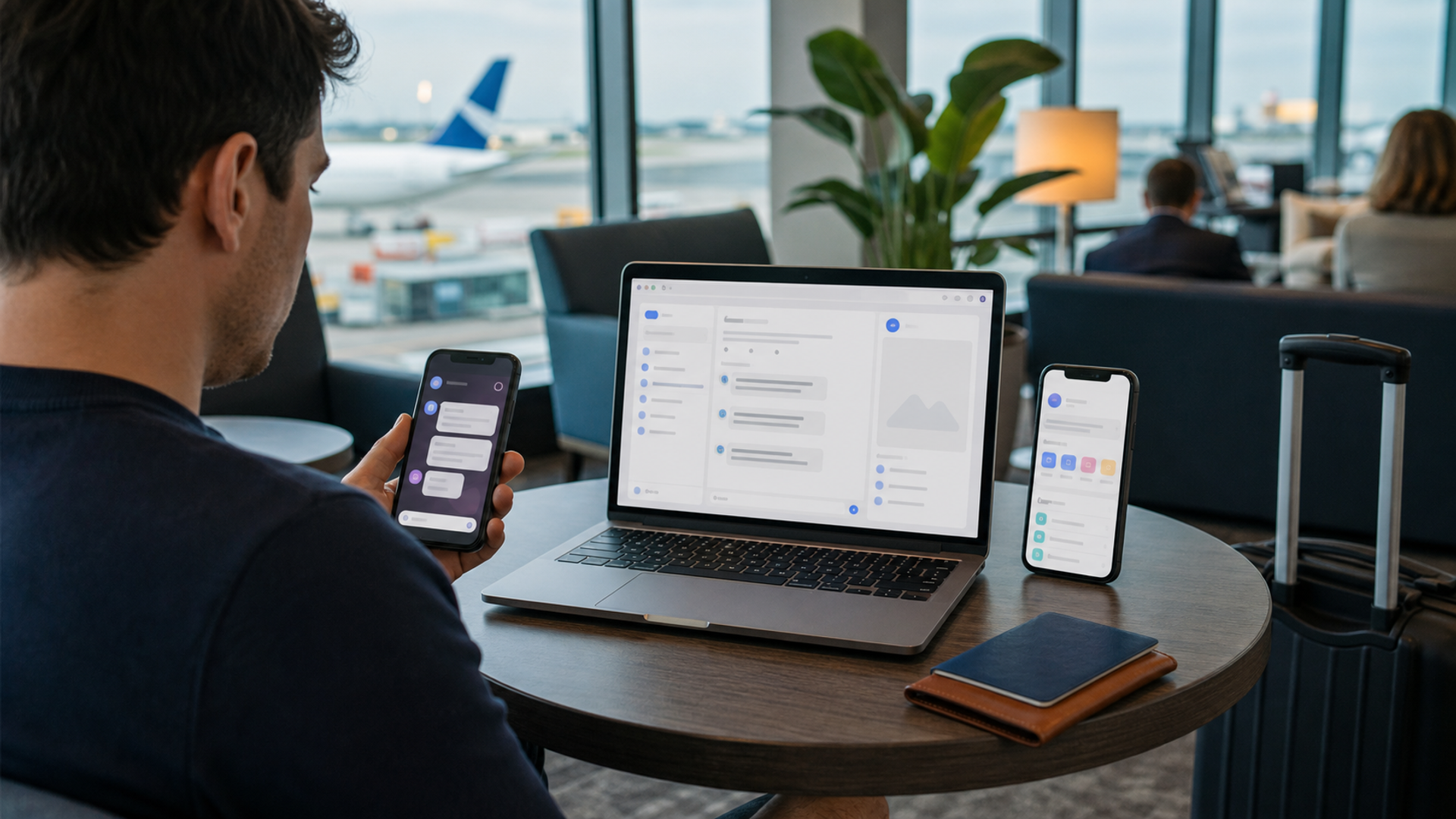
| Temporary travel use | Convenient if verified | Good | Good on trusted device |
This is a fit guide, not a guarantee of feature parity. Interfaces and regional availability change. Check current official documentation and your organisation’s policy.
WhatsApp is best for low-context, reversible tasks
The messaging route suits questions that can be safely separated from a large work archive:
translate a public sign;
summarise a non-confidential voice note;
explain an object in a photograph;
brainstorm a packing list;
draft a message you will review before sending.
Keep the task self-contained. State the necessary context in the message and verify results that affect bookings, health, money, law or safety against authoritative sources.
The app is better for personal continuity
The dedicated app provides a fuller account environment and clearer separation from ordinary messaging. It is a better default when you expect follow-up, want to organise work over several sessions or need account-level settings.
Review the app’s permissions rather than granting every request. Camera, microphone, photos, contacts and notifications each create a different exposure. Grant the minimum needed for the task and revisit settings after travel.
Web is better for deliberate knowledge work
On a trusted computer, the web interface makes it easier to compare documents, inspect sources and manage longer outputs. It also makes unsafe behaviour easier: uploading an entire folder when only one redacted page is required.
Use a preparation step:
identify the exact question;
remove irrelevant personal or client information;
use the authorised account/workspace;
upload the minimum file set;
verify the output against original sources;
remove or retain material according to policy.
Privacy is more than encryption in transit
WhatsApp says personal messages and calls are protected by default end-to-end encryption; its security information explains the service’s protections. An AI contact introduces a service interaction: the user intentionally sends content to that service for processing. Do not assume a conversation with an AI contact has the same boundary as a person-to-person chat.
Review OpenAI’s privacy policy and account data controls for the service you use. Also consider the phone itself: notification previews, cloud backups, linked desktop sessions, screenshots and physical access can expose content outside the transport layer.
For particularly private AI use, compare the boundary with the WhatsApp Incognito AI guide, which examines a different Meta feature. Do not merge the two products or their claims.
An executive decision tree
Is the content public or low sensitivity? If yes, the WhatsApp channel may be the fastest route.
Does the task need several files, a project archive or connected work systems? Use an approved app or web workspace.
Is the content confidential, regulated or client-owned? Stop and confirm policy, workspace, retention and authorisation before using any consumer channel.
Will the output trigger a booking, payment, message or business change? Treat it as a draft and add human confirmation.
Are you on a borrowed or public device? Do not link an account or expose recovery credentials. Use a trusted device and sign out of linked sessions you no longer need.
Five checks before the first message
Verify the official contact and country availability.
Decide whether account linking is necessary.
Turn off sensitive notification previews if the screen is visible to others.
Keep confidential files out unless an approved policy explicitly allows them.
Plan how you will verify and act on the answer.
The practical conclusion
Use WhatsApp for quick, self-contained and reversible tasks. Use the ChatGPT app for ongoing personal continuity. Use web for deliberate, file-heavy work in an approved workspace. The return of a convenient channel is useful, but convenience should not collapse the boundary between personal messaging, organisational data and significant action.
After the first week, review the channel rather than leaving it on autopilot. Check linked devices, account association, notification previews and the types of content actually sent. If a quick travel assistant has become a route for client files or approvals, move the workflow into an authorised workspace and close the informal path.
Also preserve a fallback. Messaging services, mobile networks and regional features can become unavailable. Keep important travel confirmations in the airline or hotel system, not only in an AI conversation, and retain access to official support channels.