Quick facts
The short version: ChatGPT crossed below 50% share, but the category itself is expanding. That is the important distinction. A product can lose share while still adding users if the total market is growing quickly enough.
For searchers asking "is ChatGPT losing users?" the cleaner answer is: ChatGPT is losing relative share, not necessarily absolute scale. Sensor Tower's report and follow-on coverage describe a market where usage is spreading across more assistants, especially Gemini and Claude.
What Sensor Tower actually measured
Sensor Tower's State of AI 2026 report is framed around the broader generative AI economy: app usage, web behavior, monetization, demographics, retention, and competitive share. The report is not a lab benchmark. It is not a ranking of model intelligence. It is a market-behavior snapshot that asks where users are actually spending time.
That matters because AI assistant share is not the same thing as "best model." A model can be stronger on code, another can be easier to access on a phone, and another can be better integrated into an office workflow. Market share blends all of those factors with distribution, habit, price, trust, and default placement.
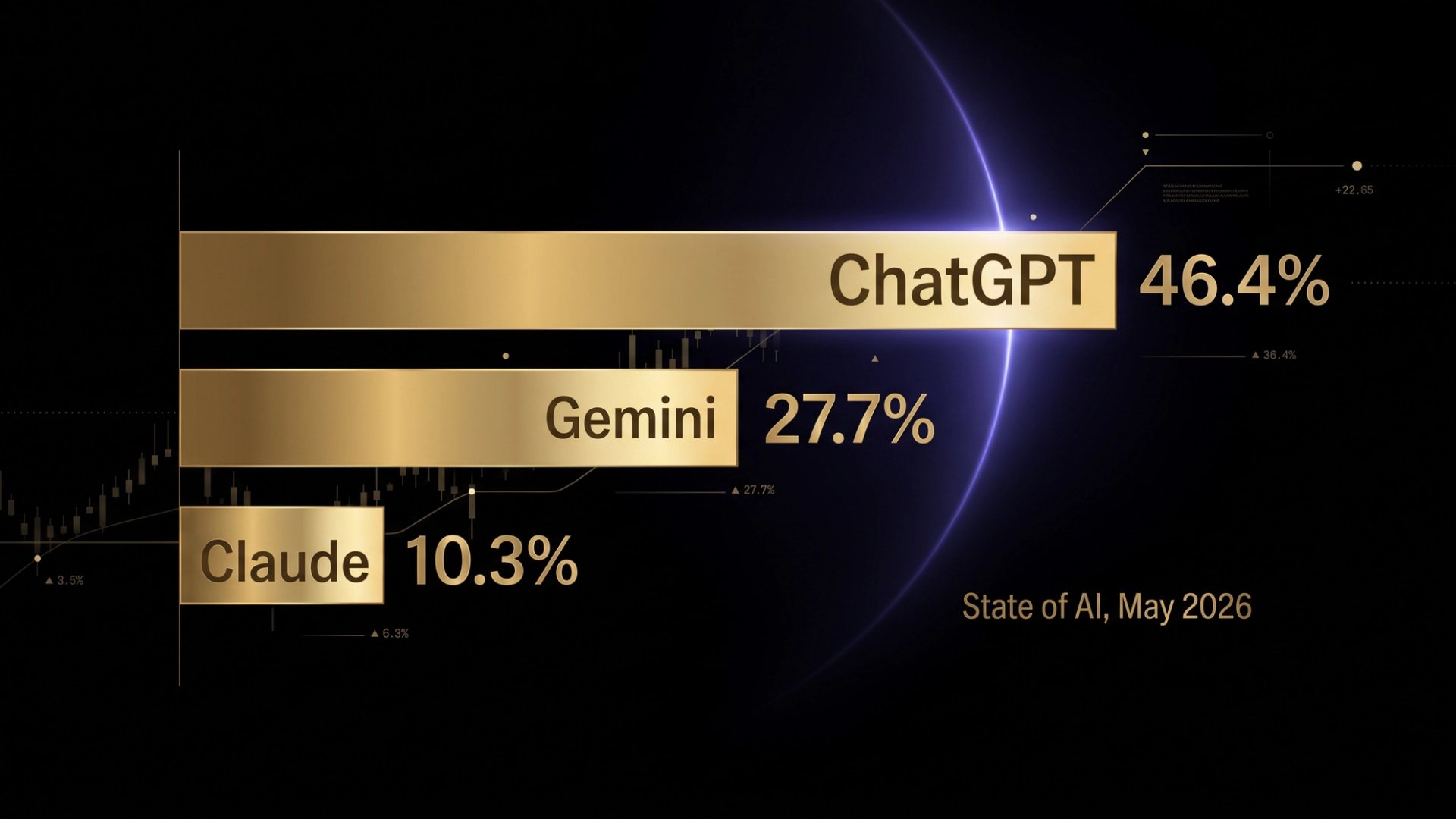
The core Sensor Tower takeaway is that the AI assistant market is no longer behaving like a single-default category. ChatGPT remains the most recognizable brand, but Gemini and Claude have created enough usage gravity to change the shape of the market. TechCrunch reported the May split as ChatGPT 46.4%, Gemini 27.7%, and Claude 10.3%, with other assistants such as Grok, Perplexity, DeepSeek, and Meta AI below the leading tier.
PYMNTS summarized the same trend as a loyalty problem: ChatGPT still leads, but consumers are increasingly assembling their own AI toolkits rather than sticking to one provider. Its coverage notes that ChatGPT crossed 1.1 billion monthly users while also slipping under majority share.
That combination is why the headline needs care. "Below 50%" sounds like a collapse. The better interpretation is fragmentation. The assistant market has expanded so quickly that users now have enough credible alternatives to split their attention.
The drop: from 65.3% to 46.4% in 18 months
The most dramatic comparison in the current coverage is the move from 65.3% in December 2024 to 46.4% by May 2026. Over roughly 18 months, ChatGPT went from a two-thirds-style market position to less than half of tracked global AI assistant users.
That decline has three visible causes.
First, early curiosity turned into workflow segmentation. In 2023 and 2024, many users treated ChatGPT as the default place to "ask AI." By 2026, the same user might ask Gemini to summarize a Gmail thread, Claude to rewrite a policy memo, Perplexity to check a live web claim, and ChatGPT to ideate or code. The user did not abandon AI. The user stopped treating one assistant as the whole category.
Second, trust became a switching factor. TechRadar's coverage of the Sensor Tower data points to user sensitivity around company decisions, safety concerns, and model behavior, with switching becoming easier because rival products are now good enough for everyday tasks. When users are not locked in by files, contacts, or workflow history, trust shocks can move behavior quickly.
Third, distribution started to matter more than brand memory. Gemini has Google Search, Android, Workspace, Chrome, and device-level entry points. Claude has enterprise credibility, strong long-context writing workflows, and a growing developer audience. ChatGPT has huge brand equity, but brand equity is not the same as owning every access point.
The drop is therefore less about one failure and more about market maturation. Once a category becomes normal, users stop rewarding the first brand simply for being first.
Where the users went
Gemini's 27.7% share is the number that changes the competitive map. Google does not need every user to open a standalone Gemini app. It can place Gemini inside surfaces where users already live: Android, Search, Workspace, Chrome, and potentially device assistant experiences. That lowers the activation cost.
For everyday users, Gemini's advantage is convenience. If a person already uses Gmail, Docs, Drive, Calendar, Android, Chrome, and Google Search, an assistant that appears inside those products feels less like a destination and more like a layer. That is why Gemini can gain share even when some users still think of ChatGPT as "the AI brand."
Claude's 10.3% share is a different kind of signal. Claude is less likely to win because it is preinstalled on a device. It wins when the work is long, high-context, writing-heavy, code-heavy, or compliance-sensitive. The product's reputation is especially strong in tasks where tone, reasoning, and document handling matter more than quick answers.
The smaller assistant group also matters. Grok, Perplexity, DeepSeek, Meta AI, Copilot, and other tools do not need to overtake ChatGPT to weaken its default status. Every credible niche assistant trains users to ask a more specific question: "which AI is best for this job?"
That is the real market shift. The category is moving from a search-engine-like winner-take-most model to a software-suite model. Professionals will use more than one assistant, the same way they use more than one productivity app.
Apple Intelligence + Gemini: the 2-billion-device channel
The most important distribution question for late 2026 is not a web leaderboard. It is the device layer. If Apple expands Gemini-backed AI features across iPhone, iPad, Mac, and Apple ecosystem surfaces, Gemini's reach could move from app competition into operating-system behavior.
Apple's own newsroom post on its next generation of Apple Intelligence and Siri AI describes new Siri AI features across iOS 27, iPadOS 27, macOS 27, and visionOS 27, with staged availability and regional limitations. MacRumors has reported a deeper Google Gemini role in Apple's new AI architecture, while additional reporting has described third-party AI extensions that could allow users to pick services such as Gemini or Claude inside Apple Intelligence workflows.
This is why the "2 billion Apple devices" framing is powerful, but it should be treated as distribution potential rather than immediate active usage. Installed base is not the same as activation. Many users will ignore AI features. Others will use them without knowing which model is behind the response.
Still, default placement changes markets. If Gemini becomes part of a large share of daily phone interactions, Google does not need to persuade every user to download a separate assistant. It can win by being near the keyboard, camera, browser, inbox, and voice interface.
ChatGPT can still compete in quality, brand, and workflow depth. But distribution through operating systems can change the cost of customer acquisition. The assistant that sits closest to the user's task often gets the first question.
What this means for enterprise AI procurement
For enterprises, the Sensor Tower numbers should end the fantasy that one assistant will cover every high-value use case. Procurement teams should separate consumer popularity from workflow fit.
A general-purpose assistant is useful for drafting, brainstorming, code snippets, and light research. But enterprise deployment adds harder questions: data handling, admin controls, audit logs, retention, identity, role-based access, model routing, legal review, and procurement risk. A tool can be popular with employees and still be unsuitable for regulated workflows.
This is where Claude's smaller share may understate its enterprise relevance. A 10.3% global user-share number does not capture whether a tool is overrepresented in law firms, software teams, analysts, customer-support operations, or executive staff work. The same is true for Gemini inside Google Workspace accounts and ChatGPT Enterprise inside organizations already standardized on OpenAI.
The procurement lesson is to buy around jobs, not brands:
- Use ChatGPT where broad capability, adoption, and ecosystem maturity matter.
- Use Gemini where Google account context, Android, Search, and Workspace integration matter.
- Use Claude where long documents, policy-sensitive writing, code review, and structured reasoning matter.
- Use narrow AI search tools where citation-first answers matter.
- Keep sensitive workflows out of unmanaged consumer accounts.
The wrong move is to treat the market-share leader as the only approved tool. That creates shadow AI. Employees will keep using the assistant that solves their problem fastest unless the approved stack is practical.
The multi-tool reality: why nobody is winning outright
The phrase "ChatGPT below 50%" invites a horse-race interpretation. But the more useful model is multi-tool reality. Users are not necessarily choosing one assistant for life. They are creating an AI bench.
That bench may look like this: ChatGPT for brainstorming, Gemini for Google-native work, Claude for long-form analysis, Perplexity for web-cited answers, Copilot for Microsoft workflows, and a local model for private experiments. The user does not see that as fragmentation. The user sees it as matching tool to task.
This pattern has two consequences for AI companies.
The first is that retention will depend on stored workflow value. If an assistant remembers projects, connects to documents, manages tasks, or sits inside a work platform, switching becomes harder. If the assistant is just a blank chat box, switching stays easy.
The second is that model quality alone will not decide market share. Distribution, trust, privacy, cost, integrations, and defaults all matter. A slightly weaker model in the right workflow can beat a stronger model that requires extra steps.
That also explains why the market can support several winners. ChatGPT can remain the largest standalone assistant. Gemini can become the strongest device and ecosystem assistant. Claude can become the preferred deep-work assistant. Other tools can own specialized research, coding, design, or local-privacy niches.
Action plan: how to pick a primary assistant in 2026
If you are choosing a primary AI assistant in 2026, start with the work rather than the leaderboard.
Step 1: classify your workload. Put every major use case into one of four buckets: quick answers, document work, operational workflow, or sensitive information. Quick answers need speed and convenience. Document work needs context length and writing quality. Operational workflow needs integrations and admin controls. Sensitive information needs privacy boundaries.
Step 2: define what the assistant is allowed to see. A tool used for public marketing copy can have a different data policy from a tool used for board minutes, legal analysis, financial planning, or customer records.
Step 3: test the same prompt across three assistants. Use a real prompt from your work, not a generic benchmark. Score the output on accuracy, usefulness, revision burden, citation quality, and privacy fit.
Step 4: assign a primary and a backup. In practice, the right structure is usually "one default assistant plus two approved alternatives." That gives employees flexibility without creating unmanaged chaos.
Step 5: review quarterly. This market is moving quickly. A choice made in July 2026 may look stale by October 2026 if a model update, pricing change, or platform integration shifts the workflow.
For individuals, the simplest rule is this: use the assistant that reduces the most revision time for your most frequent task. For companies, the better rule is: use the assistant that solves the workflow while keeping data governance explainable.
Sources checked
- Sensor Tower: State of AI 2026 report page
- TechCrunch: ChatGPT's market share slips below 50% for first time
- PYMNTS: ChatGPT Leads as Consumers Build Their Own AI Toolkits
- TechRadar: ChatGPT market share falls below 50% for first time
- YourStory: ChatGPT falls below 50% market share despite its lead
- Times of India: ChatGPT share falls below 50% for the first time ever
- Apple Newsroom: Apple unveils next generation of Apple Intelligence, Siri AI, and more
- MacRumors: Apple reveals new AI architecture built around Google Gemini models
Related reading from VERTU Guides
- Best Smart Phone in USA: Executive Buyer's Guide
- Best Phone for Business and Personal Use
- Luxury Mobile Phones Buyer's Guide
- Luxury Foldable Phone AI Assistant Price Tiers
For a Different Kind of Audience
If your workload is "summarize a doc, draft an email, ask an assistant to plan a trip," any of the three top assistants will do. If your workload is "an attorney-client conversation that cannot leave the room, a board memo that cannot be logged, or sensitive personal data that should never be aggregated to a third-party cloud," a different kind of device exists: see luxury phones with on-device AI assistants for hardware that runs frontier-class models without any cloud handoff.