| Company | Annual AI CapEx | Primary Focus |
|---|---|---|
| Google (Alphabet) | $91-93 billion | AI compute clusters |
| Apple | $14 billion | Supply chain optimization |
| Investment Gap | 6.5x difference | — |
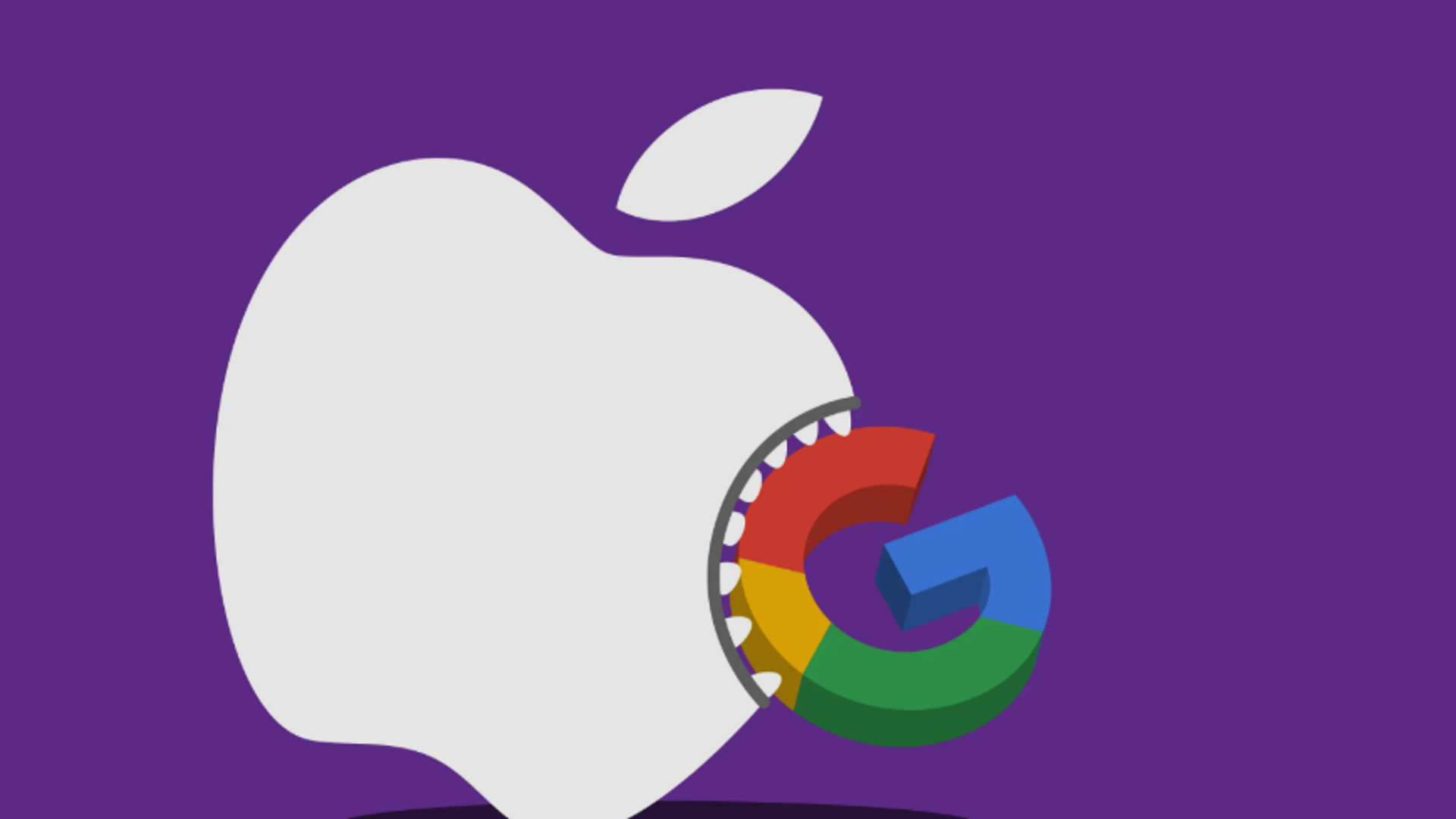
The Apple-Google AI partnership represents more than a technology deal—it's a strategic maneuver reshaping computational sovereignty in the AI era. This analysis examines the business logic, competitive implications, and long-term outcomes of this historic $1 billion annual agreement.
Why Did Apple Partner with Google for AI?
Apple partnered with Google because of a critical 'intelligence deficit' in AI capabilities. Despite Apple's engineering excellence, Google's massive infrastructure investment—$91-93 billion annually versus Apple's $14 billion—created an insurmountable gap in AI model development. Rather than spend years catching up while Siri became obsolete, Apple chose pragmatic collaboration to maintain iOS ecosystem dominance while secretly developing proprietary AI technology.
The Intelligence Deficit: Capital Expenditure Comparison
The stark reality of AI development costs reveals why Apple needed Google's partnership:
This 6.5x capital expenditure gap demonstrates why Apple could not compete in AI infrastructure development through internal resources alone.
Teacher-Student Architecture: How the Partnership Actually Works
The Apple-Google AI collaboration is not a simple API integration. Instead, it employs a sophisticated 'Teacher-Student' model distillation architecture with three distinct layers:
Layer 1: Edge Local Processing (The Gatekeeper)
Apple's on-device models (3-7 billion parameters) run on the Neural Processing Unit (NPU) and handle approximately 60% of daily tasks. These include email summaries, simple intent recognition, and basic queries. Processing occurs entirely on-device with zero data transmission, ensuring privacy and speed.
Layer 2: Gemini Logic Driver (The Teacher)
For complex queries, encrypted requests reach Google's customized trillion-parameter Gemini variant. Critically, Gemini functions as the 'teacher' in model distillation—it not only provides answers but transfers high-dimensional reasoning capabilities back to Apple's local models through synthetic data generation. Apple is essentially using Google's Gemini to train its own Apple Foundation Models (AFM).
Layer 3: Private Cloud Compute (The Sovereignty Layer)
Apple's Private Cloud Compute (PCC) runs on Apple Silicon servers with stateless processing—data is destroyed immediately after computation. This architecture theoretically maintains data sovereignty, though critics question whether Apple truly controls Siri's 'thinking' when all reasoning weights originate from Google.
The Glenwood Project: Siri's Agentic Transformation
Code-named 'Glenwood,' the reconstructed Siri represents the most comprehensive overhaul since its 2011 launch. Powered by Gemini 2.0 and future Gemini 3 models, the new Siri delivers three breakthrough capabilities:
- World Knowledge Answers (WKA): Provides citation-supported web summaries instead of blue links, leveraging Gemini's real-time web indexing
- Screen Awareness: Visual parsing enables commands like 'book this restaurant' while viewing a photo, without manual data entry
- Cross-App Orchestration: Multi-step workflows like 'find photos, crop, and send to wife' execute in single commands through advanced intent planning engines
This evolution transforms Siri from a command trigger into a true intelligent agent, fundamentally altering mobile productivity and user experience.
OpenAI's Marginalization and Hardware Counterattack
The Apple-Google partnership's biggest casualty is OpenAI. Once positioned as Siri's core AI brain following WWDC 2024 announcements, OpenAI rapidly descended to optional 'encyclopedia plugin' status once Google secured the foundational model partnership.
Sam Altman recognized this existential threat and launched 'Project Sweetpea'—a $6.5 billion hardware initiative. OpenAI acquired Jony Ive's startup and assembled former Apple hardware executives to build 'calm computing' devices: screenless, voice-first products bypassing smartphone app ecosystems entirely.
This reveals the fundamental conflict between AI model providers and platform owners. When AI assistants become primary interfaces, why should OpenAI pay Apple's 'toll fees'? The hardware push attempts to establish independent AI interaction anchors, however difficult the path.
Talent Exodus and Organizational Crisis
Internal reaction at Apple to the Google partnership has been devastating. Engineers who joined to build 'world's best' proprietary models view the Google deal as surrender, triggering massive talent hemorrhaging:
- Ruoming Pang, AFM (Apple Foundation Models) director, defected to Meta with multiple core researchers to build Meta's superintelligence
- Stuart Bowers, Siri's core executive, joined Google DeepMind
- Numerous senior researchers departed for startups or competitors
This creates a dangerous negative feedback loop: choosing Google demotivates talent, causing departures; talent loss forces greater Google dependence. Meta's Mark Zuckerberg capitalizes on this crisis, leveraging Meta's GPU cluster scale to absorb Apple's intellectual capital for fully self-developed AI models.
Privacy Sovereignty and Regulatory Threats
Two critical challenges threaten the partnership's sustainability:
| Challenge | Risk Details |
|---|---|
| Privacy Black Box | If Siri's intent extraction and value filtering originate from Google's weights, Apple loses ‘behavioral sovereignty.' Gemini's compressed black-box models could contain hidden data collection mechanisms, making privacy claims illusory. |
| Antitrust Scrutiny | US DOJ and EU Commission investigate whether this replicates Google Search monopoly through default distribution. EU's Digital Markets Act demands Google grant competitors equal Android system access and share search click data. |
These legal uncertainties could derail Google's AI dominance strategy through the Apple distribution channel.
Strategic Timeline: Temporary Bridge or Permanent Reshape?
The 2026 partnership represents a 'strategic bridge' rather than permanent dependence. Apple's historical pattern is clear: outsource, replicate, replace. Examples include Google Maps to Apple Maps, Intel chips to Apple Silicon.
Apple currently develops 'Project Ajax'—a proprietary trillion-parameter model—while accelerating custom AI server chip production. Long-term core experience dependence on competitors violates Apple's DNA.
Google accepts the risk of 'raising a tiger.' Its bet: before Apple matures, embedding Gemini across 2 billion devices will capture user habits and data stickiness irreversibly.
This is the most thrilling time-race among this generation's tech giants.
Three-Phase Outcome Projection
| Timeframe | Outcome | Key Dynamics |
|---|---|---|
| Short-term (2026-2027) | Win-Win | Apple closes capability gap, preserves iPhone sales; Google gains distribution, exceeds $4T valuation |
| Mid-term (2028-2029) | Strategic Competition | OpenAI and Meta counteroffensives; regulatory intervention destabilizes alliance |
| Long-term (2030+) | Alliance Dissolution | Apple's proprietary models mature or OpenAI hardware succeeds; partnership collapses |
Frequently Asked Questions (FAQ)
Why did Apple choose Google over OpenAI for core AI?
Google's infrastructure scale (6.5x higher capital expenditure) and Gemini's trillion-parameter architecture provided immediate competitive parity. OpenAI lacked equivalent computational resources and distribution capability, making Google the pragmatic choice for system-level integration.
Is Apple permanently dependent on Google AI?
No. Apple develops Project Ajax (proprietary trillion-parameter model) and custom AI server chips. Historical precedent (Apple Maps, Apple Silicon) shows Apple outsources temporarily then replaces competitors with in-house technology.
How does the Teacher-Student architecture work?
Google's Gemini acts as 'teacher,' processing complex queries while generating synthetic training data for Apple's on-device 'student' models. This allows Apple to gradually improve proprietary AI using Google's reasoning capabilities without permanent dependence.
What happened to OpenAI's Siri integration?
OpenAI descended from core AI provider to optional plugin. Recognizing marginalization, Sam Altman launched $6.5 billion Project Sweetpea to build proprietary screenless AI hardware, attempting to bypass Apple's iOS ecosystem entirely.
Why are Apple engineers leaving over this deal?
Engineers joined Apple to build world-leading proprietary AI. The Google partnership feels like technical surrender, causing mass defections to Meta, Google DeepMind, and startups. This talent exodus creates a negative feedback loop strengthening Google dependence.
Can Apple truly protect privacy using Google's AI?
Questionable. While Apple's Private Cloud Compute theoretically maintains data sovereignty, Siri's reasoning originates from Google's black-box model weights. Critics argue Apple loses 'behavioral sovereignty' when core logic resides in Google's compressed, opaque models.
What regulatory risks does this partnership face?
US DOJ investigates whether this replicates Google Search monopoly patterns. EU's Digital Markets Act may force Google to provide competitors equal system access and share proprietary data, potentially undermining the partnership's exclusivity.
When will this partnership likely end?
Long-term dissolution is inevitable—likely 2030+. Once Apple's Project Ajax matures or regulatory intervention intensifies, Apple will transition to proprietary AI infrastructure. The partnership is a strategic bridge, not permanent architecture.