| AI Detector | Approximate Cost | AI Detection Capability |
|---|---|---|
| aidetector.com | $20/month | Yes |
| Originality.AI | $12.95/month | Yes |
| TurnItIn | Varies by institution | Yes |
| GPTZero | $24.99/month | Yes |
| CopyLeaks | $7.99 – $13.99/month | Yes |

In 2025, advanced ai detector tools are very important. Tools like aidetector.com, Originality.AI, TurnItIn, GPTZero, and CopyLeaks are the top choices. They help find text made by ai. These ai detectors look for things like common ai phrases. They also check if sentences are all the same length. They notice if the grammar is too perfect. This helps them spot possible ai content. Many schools, publishers, and businesses use these tools. They want to make sure work is original. They also want people to trust what they read online. Some detectors can be right about ai content almost every time. Some can reach up to 99% accuracy.
Key Takeaways
- The best AI detectors in 2025 use deep learning and language study to find AI-written text very well. Many tools work with many languages and can find AI content in words, pictures, videos, and code. AI detectors help schools, publishers, and companies make sure their content is original and trusted. Changing AI-made text can make it harder to find, so using both AI tools and people works best. Picking the right AI detector depends on what you need, like how correct it is, how easy it is to use, privacy, and price.
Advanced AI Detector Overview
In 2025, there are new ai detector tools. Some of these are Winston AI, ZeroGPT, Sapling AI, GPTZero, Pangram Labs, and Copyleaks. Experts also like Insight7 and LangSmith by LangChain . Each detector uses strong technology to find ai-made text. They can spot ai writing with high accuracy. These tools help schools, publishers, and businesses. They check if writing is original or made by ai.
| AI Detector / Evaluation Tool | Key Features | Ideal Use Case |
|---|---|---|
| Winston AI | Deep learning, linguistic analysis, custom algorithms | Education, publishing, enterprise |
| ZeroGPT | DeepAnalyse™ algorithm, structure and burstiness checks | Academic and business writing |
| Sapling AI | Machine writing pattern detection, score highlights | Teams needing fast feedback |
| GPTZero | Perplexity and burstiness analysis, real-time results | Teachers, editors, content reviewers |
| Pangram Labs | Multimodal detection, supports vision and audio | Enterprises with diverse content |
| Copyleaks | AI logic with plagiarism scanning, low false positives | Academic and publishing sectors |
| Insight7 | Transcription, speaker tagging, call analysis | Sales teams, call centers |
| LangSmith by LangChain | Prompt tracking, evaluation metrics, human feedback | AI development teams |
Detection Methods
Popular ai detectors use a few main methods. Deep learning helps find patterns in text. Humans may not see these patterns. Linguistic pattern analysis checks sentence length, word choice, and grammar. Originality checks compare the text to other sources. This shows if the text is unique. Metadata analysis looks at hidden data in the file. It checks when and how the text was made. These methods work together to make detection better. They also help reduce mistakes.
| AI Detector | Primary Detection Methods | Claimed Accuracy | Effectiveness Notes |
|---|---|---|---|
| GPTZero | Analyzes text predictability (perplexity) and sentence variation (burstiness) | ~99% on fully AI-generated text , ~96% on mixed texts | Effective on fully AI text; struggles with paraphrased or edited content |
| ZeroGPT | Proprietary DeepAnalyse™ algorithm analyzing structure, perplexity, burstiness, linguistic markers | 98-99% | High accuracy but paraphrased text can evade detection |
| Copyleaks | Combines AI-detecting logic with classic plagiarism scanning | >99% accuracy, | Very low false positives; accuracy drops to ~50% with paraphrased text |
| Sapling | Uses AI model to detect machine writing patterns | >97% accuracy, | Provides score and highlights; fewer false positives |
Key Technologies
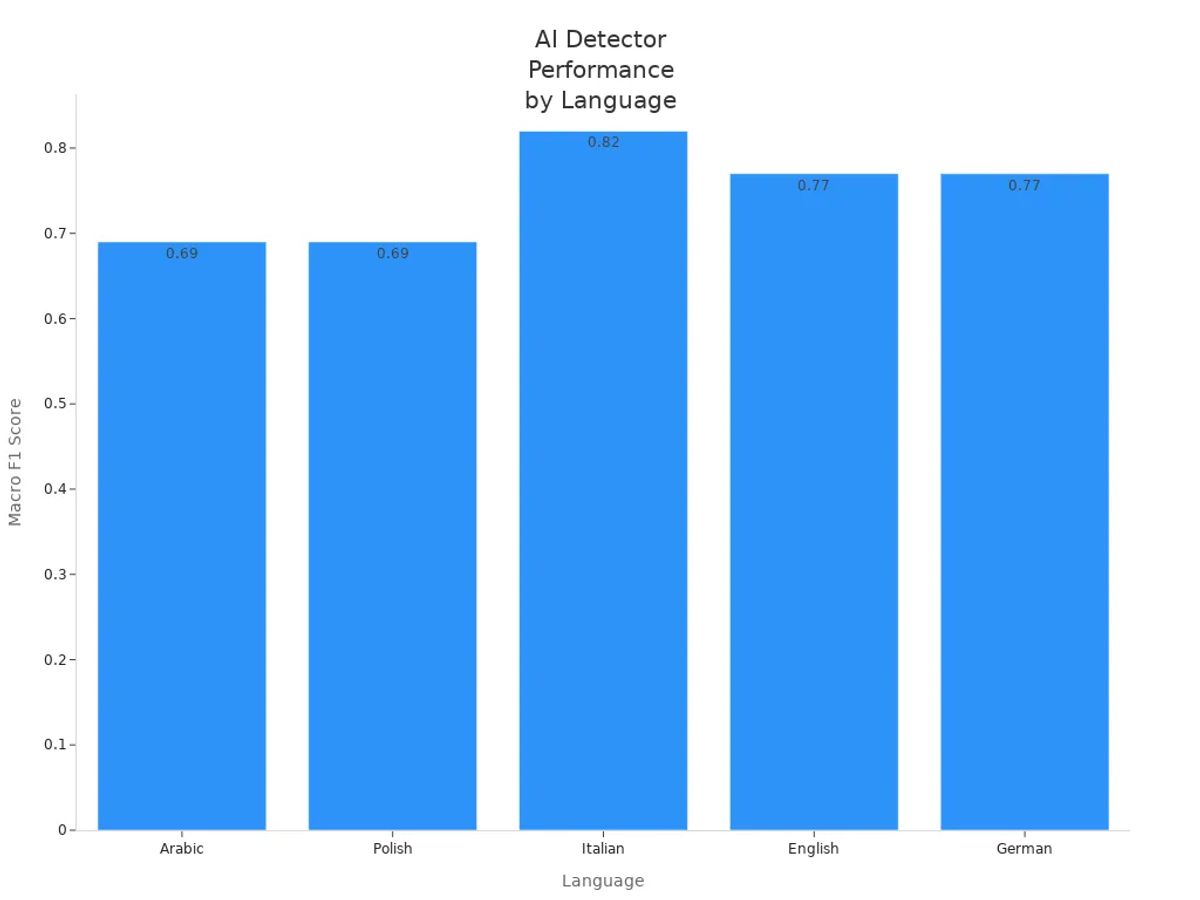
Advanced ai detectors use strong technology. Many use convolutional neural networks and deep learning models. These models can find small details in text and images. Some detectors use large language models. They work well with many languages. They show high macro F1 scores in Arabic, Polish, Italian, English, and German. This means they can find ai text in different languages with good accuracy.
The best ai detectors track prompt changes and support real-time analysis. They also offer custom evaluation metrics. These features help users trust the results. They help people pick the right ai detection tools for their needs.
Top AI Detection Tools
Features Comparison
In 2025, many groups use ai detection tools. These tools help check if something is written by ai or a person. Each tool has special features to find ai text fast and well. Some tools only check words. Others can also look at pictures, code, or videos.
| Tool Name | Unique Features | Accessibility & User Feedback |
|---|---|---|
| Copyleaks | Detects ai content in text, supports many languages, works well with mixed or edited content | Easy to use, praised for high accuracy, trusted by schools and publishers |
| Originality.ai | Finds ai writing in over 30 languages, checks for light editing, low false positives | Used by researchers and businesses, known for reliable results |
| GPTZero | Measures how predictable and varied the text is, gives real-time results | Popular with teachers and editors, simple interface |
| Pangram Labs | Checks text, images, and audio for ai content | Used by large companies, supports many types of content |
| ReviewerZero | Finds image duplication and manipulation in research papers | Helps keep research honest, fast and accurate |
| ScamAI | Detects ai in images, videos, and voices, offers real-time API | Used for online safety, works quickly |
| Improvado | Real-time monitoring, automated insights, natural language queries | Saves time for marketing teams, highly rated for uncovering hidden insights |
| Polymer | Automated dashboards, smart filtering, easy for non-technical teams | Fast setup, praised for ease of use, best for small to mid-sized organizations |
| Qlik | Predictive forecasting, supports large data, auto-generated visualizations | Strong for enterprise use, some features need technical setup |
Note: Now, many ai detection tools have dashboards and instant feedback. This makes it easier for people to see results and act fast.
Copyleaks and Originality.ai are very good at finding ai text. Studies show Copyleaks can spot ai from models like GPT-4.5, Gemini 2.5, and Claude 4 Opus . It works even if the text is mixed or changed a lot. Originality.ai also does well. It finds ai with over 99% accuracy and has few mistakes. These scores come from tests on student work and science papers.
Supported Models
The best ai detection tools in 2025 work with many ai models. They can check text from ChatGPT, Claude, Gemini, and Deepseek. Some tools also work with new or rare models. This makes them useful for many jobs.
| AI Detection Tool | Supported AI Models | Privacy/Open Source Options |
|---|---|---|
| Copyleaks | GPT-4.5, Gemini 2.5, Claude 4 Opus, and more | Privacy-focused, secure |
| Originality.ai | OpenAI (ChatGPT), Gemini, Claude, Deepseek, 30+ others | Privacy-focused |
| GPTZero | ChatGPT, Claude, Gemini | Privacy-focused |
| Pangram Labs | Text, vision, and audio models | Enterprise security |
| Gotcha-GPT | English text, code manuscripts | Open-source classifier |
| AI Or Not | Stable Diffusion, MidJourney, DALL-E, GAN (images) | Open-source option |
| ReviewerZero | Research image models | Secure, research-focused |
| ScamAI | Multimedia (images, videos, voices) | API-based, secure |
Some tools, like Gotcha-GPT and AI Or Not, are open-source. This means users can check text or images without sending data away. Privacy tools help schools and companies keep their info safe.
Real-Time Analysis, File Uploads, Reporting, and Team Collaboration
Modern ai detectors let people check content in many ways. Real-time analysis shows results right away. File uploads let users check big files, pictures, or code. Dashboards and smart filters help find key details fast.
| Tool | Real-time Analysis | File Upload & Reporting | Team Collaboration Features |
|---|---|---|---|
| Improvado | Yes | Yes | Yes |
| Polymer | Yes | Yes | Yes |
| Qlik | Yes | Yes | Yes |
| Copyleaks | Yes | Yes | Yes |
| Originality.ai | Yes | Yes | Yes |
| GPTZero | Yes | Yes | Yes |
Teams can share dashboards and reports to work together. Improvado saves time by giving quick answers and letting users ask questions in plain words. Polymer is easy for people who do not know much about tech. Qlik is good for big teams and lots of data, but it may need more setup.
Tip: Pick an ai detection tool with features you need. Look for real-time feedback, file support, and privacy controls.
Some tools check more than just text. ReviewerZero and Imagetwin can find copied or changed images in research. ScamAI can tell if images, videos, or voices are made by ai. Gotcha-GPT checks code and text, helping teachers and editors spot ai work in many forms.
In 2025, ai detection tools help check text, images, and code. They are very accurate, work with many ai models, and make teamwork easy. These tools help keep information true and trustworthy.
Technology and Accuracy

Deep Learning
In 2025, advanced ai detectors use deep learning to find ai text. They use models like DistilBERT and RoBERTa. These models look for patterns people might not see. Multi-head self-attention helps the models understand each sentence. This lets the ai detector find clues about who wrote the text.
| Model / Approach | Deep Learning Technique | Accuracy (%) | Notes |
|---|---|---|---|
| DistilBERT + TF-IDF + handcrafted | Transformer-based, multi-head self-attention | 98 | Captures global dependencies and contextual patterns effectively. |
| Fine-tuned RoBERTa | Transformer-based | 93.6 | Tested for cross-domain generalization. |
| BERT-based models | Transformer-based | 90.8 | Used on benchmark datasets for ethical AI evaluation. |
| Hybrid shallow + deep learning | Combined shallow and deep learning | 88.7 | High performance in news domain. |
| DistilBERT variant | Transformer-based | 90 | Good results on ai-generated vs human-generated text. |
| Transformer classifier on reviews | Transformer-based | 79 | Used on customer reviews dataset. |
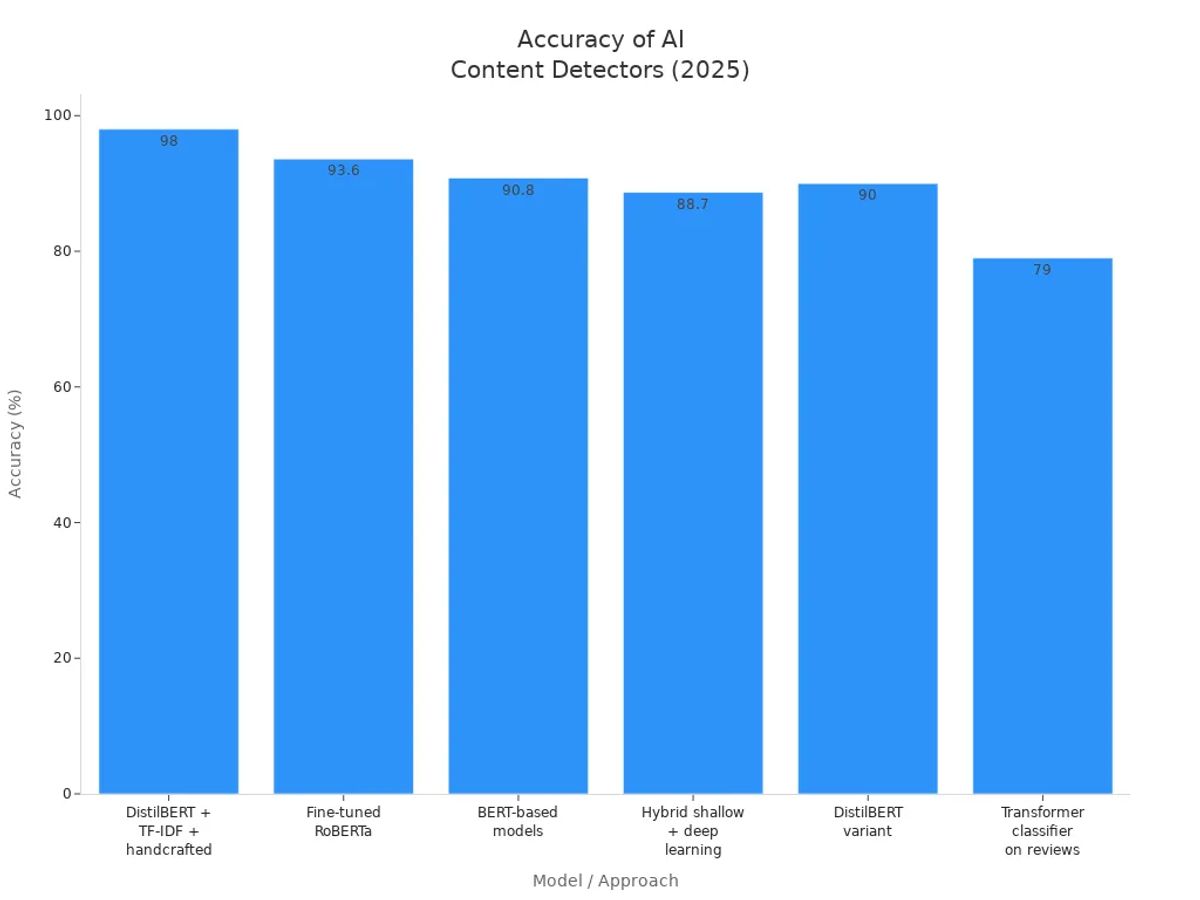
These models are very accurate. But they can have trouble with short posts. They also struggle with different languages.
Linguistic Analysis
Linguistic analysis helps ai detectors find writing patterns. The tools check how long sentences are. They look at word choice and grammar. They search for perfect grammar or common ai phrases. This works well for new writing. But if someone edits or changes ai text, it is harder to catch. Changing words or adding mistakes can trick the detector. Studies show mixing human edits with ai text makes it much harder to find.
Note: If you change or edit ai text, it is harder to detect. Many people use this trick to avoid being caught.
Watermarking
Watermarking puts hidden marks in ai text. In 2025, new watermarking uses small deep learning models. These models work on devices with less power. The watermark is invisible but helps prove ai made the text. New training tricks make the watermark strong and hard to remove. There is not much data on how many companies use watermarking. We also do not know how well it works in real life.
| Aspect | Description |
|---|---|
| Implementation Approach | Lightweight deep learning-based watermarking model for resource-constrained devices |
| Key Innovations | Decoding-oriented loss function, detachable projection head module |
| Model Efficiency | Uses only 2.2% of parameters compared to state-of-the-art models |
| Performance Characteristics | Maintains watermark invisibility and robustness |
| Practical Benefits | Enables copyright protection in real-world ai applications |
Accuracy, False Positives, and Text Editing
Ai detectors have different accuracy rates. GPTZero finds about 80% of ai text. It also finds 96.7% of human writing. Copyleaks can be 53% to 99% accurate, depending on the text. Sometimes, the tool says human writing is ai. Copyleaks can have up to 40% false positives. Sometimes, the tool misses ai text. GPTZero misses about 35% of ai content. Copyleaks misses about 20%. Editing or changing text makes it harder to detect ai. Mixing styles or adding human touches helps ai text escape detection.
Use Cases and Limitations
Education
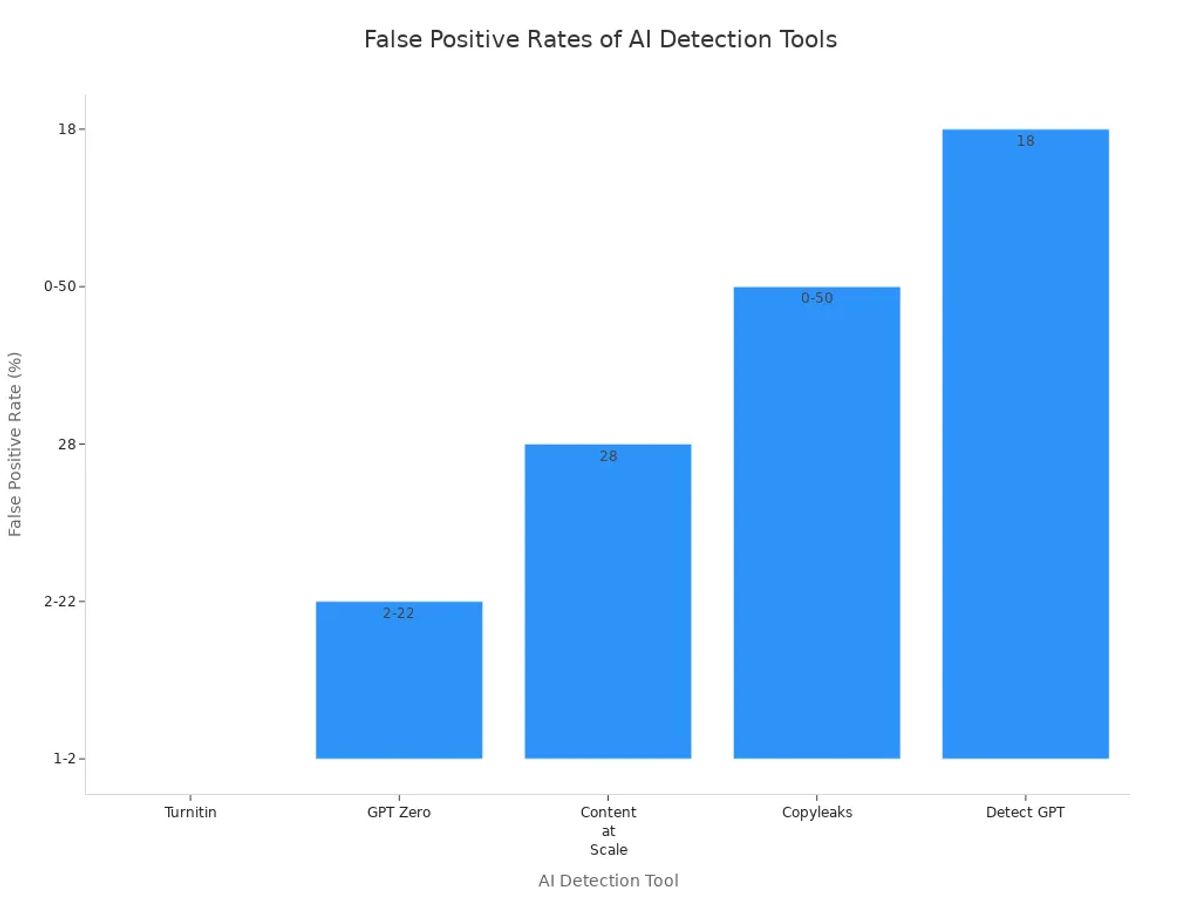
Schools and colleges use ai detection tools to stop cheating. Teachers check if students used ai to write their work. This helps keep tests and homework fair for everyone. Many teachers also look at the work themselves. Some tools, like Turnitin, almost never make mistakes. That is why schools trust them. But other tools, like Copyleaks, can give very different results. Even a few mistakes can cause big problems in large schools.
| Tool Name | False Positive Rate Range | Notes on Effectiveness and Limitations |
|---|---|---|
| Turnitin | ~1-2% | Reliable in education, low false positives |
| GPT Zero | 2-22% | Accuracy varies, sometimes higher false positives |
| Content at Scale | Up to 28% | High false positives in some studies |
| Copyleaks | 0-50% | Results can vary widely |
| Detect GPT | 18% | Moderate false positive rate |
Publishing
Publishers use ai detection to check news and articles. Editors want to find ai writing and make sure it is good. In 2025, more than half of digital publishers use ai for editing. These tools help editors work faster and save time. They also help find copied work and fix grammar. Editors now spend more time making ai writing better and checking the final text.
| Aspect | Detail |
|---|---|
| AI Adoption Rate | 58% of digital publishers use ai for editing and quality checks |
| Efficiency Improvement | Editorial turnaround time reduced by 40% |
| AI-Generated Content in News | Up to 30% of financial and sports news is ai-generated |
| Financial Impact | Over $300 million saved annually by 2026 |
Enterprise
Businesses use ai detection to keep data safe and work better. Companies add these tools to their main computer systems. They help find fake writing and stop fraud. Cybersecurity teams use ai to spot threats and block attacks. Banks use ai to catch fraud and check legal papers. Hospitals use ai to look at patient records and guess health trends. Stores use ai to track products and guess what will sell.
- Enterprises use ai detection for: Forecasting and anomaly detection
- Cybersecurity and threat prevention
- Identity verification
- Automating content moderation
- Improving customer experience
Challenges
Ai detection tools have some problems. If someone changes the text, the tools can be fooled. Sometimes, the tools say human writing is ai or miss ai writing. Some tools get confused by people who do not speak English well. Many tools do not work well with rare languages or noisy sound. Free tools can give different answers, which makes things hard. Not everyone can use the best tools. It is smart to use ai detection with human checks for the best results.
Tip: For better results, use test sets like the training data , check mistakes, and always have people review. Watch for changes in the model and update your tools when needed.
Picking the right AI detector depends on what you need. The table below lists what to look for when choosing:
| Criteria | Description |
|---|---|
| Quality of content | Gives results you can trust in real life. |
| Use cases | Good for chatbots, blogs, e-learning, and more. |
| User experience | Simple for everyone to use, even beginners. |
| Integrations | Works with other systems to help you get more done. |
| Price/value for money | Has prices that fit different people’s budgets. |
People should know that AI detection tools are not perfect. Sometimes, these tools make mistakes or show bias . Laws like the EU AI Act say tools must be fair and clear. It is important to double-check results and use your own judgment.
FAQ
How do AI detectors tell if text is written by AI?
AI detectors look for patterns in the writing. They check sentence length, word choice, and grammar. Some tools use deep learning to find clues that people might miss.
Can AI detectors find AI in images or videos?
Yes, some advanced detectors can check images, videos, and even voices. These tools use special models to spot signs of AI editing or creation.
Are AI detectors always correct?
No, AI detectors can make mistakes. Sometimes, they say human writing is AI or miss AI content. Editing or changing AI text can make it harder to detect.
Do AI detectors keep my data private?
Most top AI detectors protect user data. Some tools offer privacy-focused or open-source options. Users should always check the privacy policy before uploading sensitive files.