 Are you searching for the perfect timepiece in 2026? The decision often comes down to what lies beneath the dial—the very soul of the watch. Choosing between the battery-powered precision of quartz and the intricate craftsmanship of a mechanical movement can feel monumental.
The classic debate of quartz vs. mechanical watch is about more than just technology. It's a choice between modern efficiency and historical artistry. Understanding how each movement impacts your daily experience is crucial to finding the right fit for your wrist.
This guide is here to demystify the decision. We will break down the crucial differences in accuracy, durability, maintenance, and style. By exploring the best of both worlds, you'll gain the confidence to select a timepiece that perfectly complements your needs.
Understanding Watch Movements: The Engine on Your Wrist
A watch's movement is its internal engine, the mechanism that powers its hands and measures the passage of time. The two dominant types of movements define a watch's performance, maintenance, and character. Understanding the core technology behind each is key.
The Heart of Timekeeping: Quartz Movement
Quartz movements are remarkably efficient, battery-powered systems. An electrical current stimulates a quartz crystal, causing it to vibrate at a precise frequency of 32,768 times per second. An integrated circuit then translates these vibrations into consistent electrical pulses.
These pulses drive a tiny motor that moves the watch's hands. This electronic regulation offers incredible accuracy, often deviating by only 15-20 seconds per month. Because they have fewer moving parts, quartz movements are durable and require little maintenance.
The Art of Horology: Mechanical Movement
Mechanical movements operate without any electronic components, representing the pinnacle of traditional watchmaking. They derive power from a tightly wound mainspring. This spring stores and releases potential energy through an intricate series of gears.
The system's heart is the balance wheel, which oscillates to regulate the release of energy in a steady, controlled manner. An automatic movement uses a weighted rotor that winds the mainspring with the wearer's motion. These movements appeal to enthusiasts who value craftsmanship.
Quartz vs. Mechanical: Key Differences at a Glance
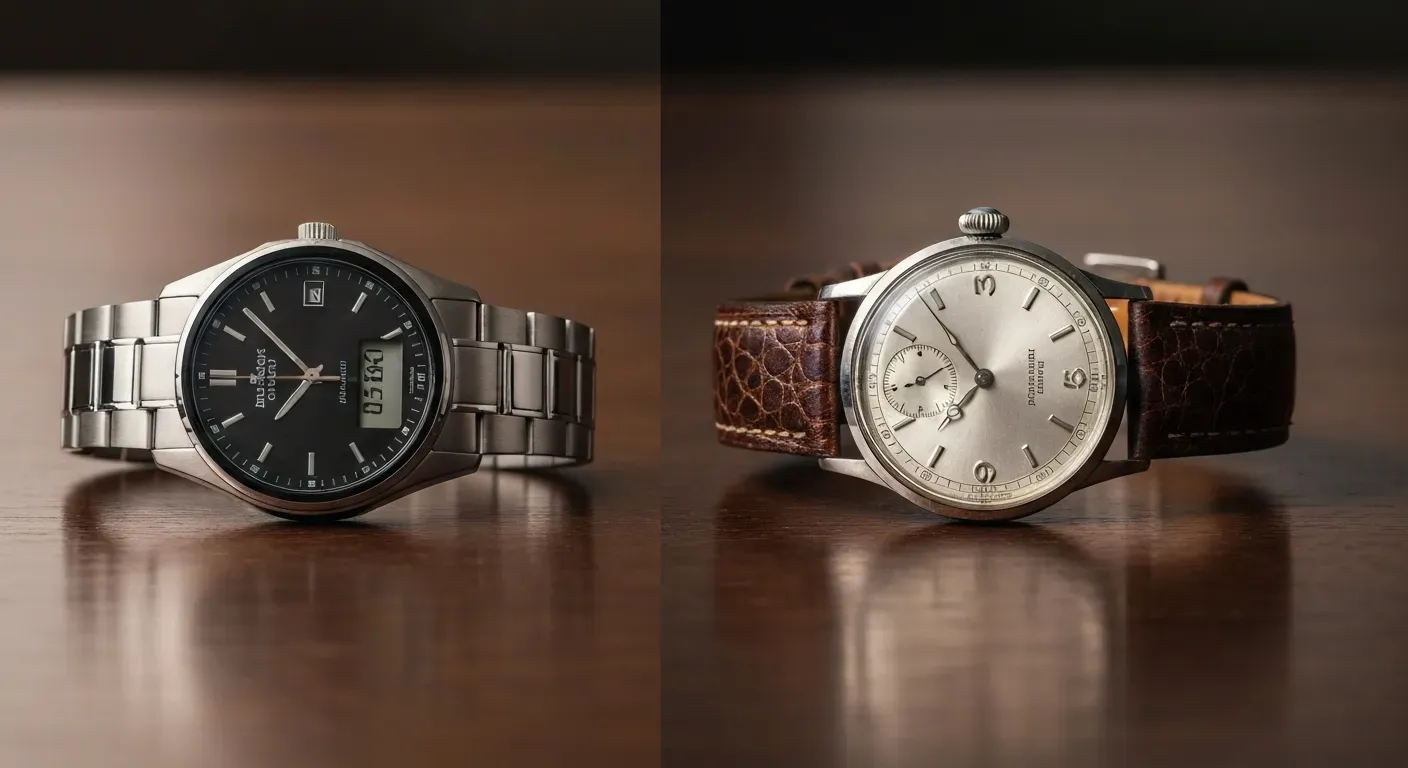
The quartz vs. mechanical watch debate centers on fundamental differences. Quartz offers modern precision and simplicity. Mechanical movements represent a legacy of intricate artistry and tradition, appealing to different values and priorities.
| Feature | Quartz Movement | Mechanical Movement |
|---|---|---|
| Power Source | البطارية | Wound Mainspring (Manual or Automatic) |
| Typical Accuracy | +/- 20 seconds per month | +/- 10 seconds per day |
| Maintenance | Battery change every 2-5 years | Full service every 3-5 years |
| Second Hand Motion | Ticks once per second (staccato) | Smooth, sweeping motion |
| Primary Appeal | Precision, affordability, and reliability | Craftsmanship, heritage, and tradition |
Top 5 Watches: Quartz vs. Mechanical in 2026
The quartz vs. mechanical watch debate is vividly illustrated in today's market. Quartz offers unmatched accuracy and low maintenance. Mechanical movements provide traditional craftsmanship and a tangible connection to history. This review examines five top models.
| Feature | Casio Duro | Citizen Promaster | Rado Captain Cook | Tissot Seastar 1000 | Seiko Prospex SPB143 |
|---|---|---|---|---|---|
| Movement | Quartz | Solar Quartz | Automatic | Automatic | Automatic |
| Water Resistance | 200m | 200m | 300m | 300m | 200m |
| Power Reserve | البطارية | Solar-Powered | ~80 hours | 80 hours | 70 hours |
| Case Material | Stainless Steel | Stainless Steel | Stainless Steel | Stainless Steel | Stainless Steel |
1. Casio Duro: Affordable Dive Watch (Quartz)
The Casio Duro offers exceptional value and rugged performance. It features a robust stainless steel case and a reliable Japanese quartz movement. This ensures precise, worry-free timekeeping for any activity.
With 200m of water resistance, it is a highly functional choice for daily wear. Its classic design prioritizes durability and legibility. This makes it a popular entry-point dive watch for good reason.
2. Citizen Promaster Diver: Solar-Powered Reliability (Quartz)
The Citizen Promaster Diver stands out with its solar-powered quartz movement. Its Eco-Drive technology converts any light source into energy. It stores it in a power cell, eliminating the need for battery changes.
This makes it both convenient and eco-friendly. The watch guarantees 200m water resistance and offers excellent legibility. It blends durability with set-it-and-forget-it functionality for the modern adventurer.
3. Rado Captain Cook: Retro Dive Watch Appeal (Mechanical)
The Rado Captain Cook masterfully captures retro dive watch aesthetics with a modern twist. It appeals to those who appreciate vintage style combined with contemporary performance. The watch operates on a high-quality Swiss automatic movement.
It offers a significant 300m of water resistance. Its design elements, like the concave bezel and arrow-shaped hands, recall classic dive watches. They are built with today's superior manufacturing standards.
4. Tissot Seastar 1000 Powermatic 80: Swiss Precision (Mechanical)
The Tissot Seastar 1000 Powermatic 80 delivers formidable Swiss precision and power. Its celebrated automatic movement features an impressive 80-hour power reserve. It can run for over three days without being worn or wound.
Built for performance with 300m water resistance, a ceramic bezel, and an elegant design, the Seastar represents a compelling blend of accessible luxury and robust functionality.
5. Seiko Prospex SPB143: Refined Classic (Mechanical)
The Seiko Prospex SPB143 offers a refined dive watch experience. It is inspired by the iconic 1965 Seiko 62MAS, the brand's first-ever diver. The watch contains Seiko's reliable 6R35 automatic movement with a 70-hour power reserve.
With its superb case finishing, flawless dial, and durable construction, it harmonizes its rich heritage with contemporary watchmaking. It creates a perfect link between past and present for enthusiasts.
Choosing Your 2026 Timepiece: Factors to Consider
Selecting the right watch involves more than just looks; it's about understanding its core technology. The movement dictates performance. The central decision in the quartz vs. mechanical watch debate comes down to your personal priorities.
Accuracy and Reliability
If pinpoint accuracy is your top priority, quartz movements are the undisputed champions. They use a battery-powered crystal oscillator to maintain precision. They are also less susceptible to external factors like gravity and temperature.
Mechanical watches, while marvels of engineering, are inherently less precise. Their accuracy is a testament to the watchmaker's skill, but they require more frequent adjustment. For many, this charming imperfection is part of the appeal.
Durability and Resistance
Both quartz and mechanical watches can be incredibly durable. Look for features like shock resistance, which protects the movement from impacts. Magnetic resistance preserves accuracy near electronic devices.
Water resistance is also crucial, measured in meters (m) or atmospheres (ATM). This indicates how well the case is sealed against moisture. Dive watches are engineered for extreme conditions with robust seals.
Maintenance and Servicing
Long-term care differs significantly between the two movements. Quartz watches are low-maintenance, typically needing only a battery replacement every 2-5 years. This process is simple and inexpensive for most models.
Mechanical watches benefit from periodic professional servicing every 3-5 years. This involves disassembling, cleaning, and lubricating the movement. This process ensures its longevity and accuracy over decades of use.
Craftsmanship and Style
Mechanical watches are celebrated for their visible craftsmanship. Many feature exhibition case backs that display the intricate, rhythmic dance of the movement. The smooth, sweeping motion of the second hand is another beloved hallmark.
In contrast, quartz watches champion functional precision. They appeal to users who prioritize grab-and-go reliability. They offer straightforward, accurate timekeeping without the fuss of regular winding or servicing.
FAQ (Frequently Asked Questions)
Q1: Is a quartz or mechanical watch more accurate?
A1: Quartz watches are significantly more accurate. They may deviate by only 15-20 seconds per month. A mechanical watch can vary by that much in a few days, making quartz the clear winner for precision.
Q2: What is the lifespan of a quartz vs. a mechanical movement?
A2: Both can last for decades with proper care. A quartz movement can last 20-30 years. A well-maintained mechanical movement can last a lifetime and become a family heirloom passed down through generations.
Q3: How often does a mechanical watch need servicing?
A3: A mechanical watch should be professionally serviced every 3 to 5 years. This regular maintenance ensures all internal parts are clean, lubricated, and functioning correctly to maintain accuracy and longevity.
Q4: Can a quartz watch be a luxury item?
A4: Yes. Luxury is defined by materials, finishing, and brand heritage, not just the movement. Brands like Grand Seiko and Cartier produce high-end quartz watches that are undeniably luxurious and highly sought after.
خاتمة
The quartz vs. mechanical watch debate is a personal journey. Quartz offers modern accuracy and convenience. Mechanical watches provide a tangible connection to horological tradition and intricate craftsmanship.
Your choice depends on your priorities. Consider your lifestyle, budget, and appreciation for engineering. Aligning these factors will guide you to a timepiece that perfectly suits your needs and personal style.
Now that you understand the key differences, it's time to choose. Evaluate your needs for accuracy, maintenance, and style to make an informed decision. Select the timepiece that not only fits your wrist but also tells your unique story with every tick.