
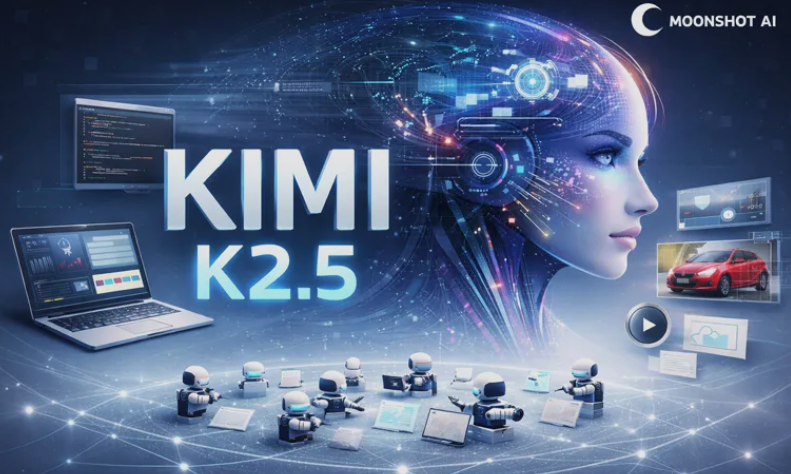
China's AI race accelerates as Kimi launches K2.5, a multimodal model competing directly with Google's Gemini 3 Pro. This comprehensive review examines K2.5's visual coding capabilities, agent collaboration features, and real-world performance across multiple test cases.
What is Kimi K2.5?
Kimi K2.5 is a unified multimodal AI model developed by Chinese AI company Moonshot AI, featuring vision understanding, advanced coding abilities, and agent collaboration. Released in early 2026, K2.5 represents China's first serious competitor to Gemini 3 Pro in terms of frontend design and visual understanding capabilities.
Key capabilities include:
- Multimodal support for both image and video understanding
- Dual reasoning modes (with and without chain-of-thought)
- Advanced frontend development and UI replication
- Agent swarm technology supporting up to 100 collaborative AI agents
Kimi K2.5 Core Features Breakdown
1. Visual Coding Capabilities
K2.5's visual coding functionality allows developers to replicate websites and applications from screenshots or videos:
- Screenshot-to-code conversion: Upload an image of any website, and K2.5 generates functional HTML/CSS/JavaScript code
- Video-based replication: Record interactions on a website or app, and K2.5 understands the UI flow and recreates it with working interactions
- One-click deployment: Generated code can be deployed immediately without manual configuration
Test case results:
- Successfully replicated Twitter/X homepage with all visual elements intact, including actual images (not placeholders)
- Recreated Xiaohongshu (RedNote) homepage with accurate styling
- Built interactive Bilibili homepage from a video demonstration, capturing all click interactions
- Replicated mobile app interfaces from screen recordings with functional interactions
2. Multimodal Understanding
Unlike previous Kimi models, K2.5 supports comprehensive multimodal input:
- Image analysis: Processes photographs, screenshots, diagrams, and architectural drawings
- Video comprehension: Understands video content up to 100MB in file size
- Interactive detection: Recognizes UI interactions and gestures in video recordings
The model demonstrates particular strength in understanding technical diagrams and converting them to editable formats, as evidenced by successful architecture diagram replication tests.
3. Agent Swarm Technology
Agent Swarm represents K2.5's most innovative feature—a multi-agent collaboration system:
- Creates up to 100 specialized AI agents for complex tasks
- Agents work in parallel, dividing responsibilities automatically
- Particularly effective for creative projects requiring diverse perspectives
Real-world application: In testing, K2.5 successfully deployed 5 parallel agents to create 50 workplace-themed emoji stickers (10 per agent) representing different artistic styles and emotional states (anger, anxiety, resignation, fake smiling, chaos). The parallel processing significantly reduced generation time compared to sequential execution.
4. Kimi Code – CLI Integration
Kimi Code is K2.5's command-line interface, offering:
- Direct media input: Drag-and-drop images and videos into the terminal
- Built-in Skills system: Pre-configured capabilities without requiring MCP (Model Context Protocol)
- ReadMediaFile agent: Automatically processes visual content up to 100MB
- Hierarchical Skills loading: Prioritizes user-created skills, then project-specific, then global skills
Included default Skills:
kimi-cli-help: Comprehensive CLI documentation and configuration guidanceskill-creator: Templates and best practices for creating custom Skills
Kimi K2.5 Product Suite Comparison
| Product | Primary Function | Key Advantage | Target Users |
|---|---|---|---|
| Kimi Code | CLI development environment | Skills support, native video input without MCP | Developers, engineers |
| Visual Coding | Screenshot/video to code | One-click deployment, interaction understanding | Frontend developers, designers |
| Agent Swarm | Multi-agent collaboration | 100 parallel agents, automatic task division | Project managers, creative teams |
| Office Agent | Document creation (PPT/Word/Excel) | Enhanced design aesthetics, professional templates | Business users, content creators |
K2.5 vs Gemini 3 Pro: Performance Analysis
Frontend Design Quality
K2.5 advantages:
- More complete element replication (includes actual images vs. placeholders)
- Better attention to visual detail in complex layouts
- Faster code generation speed in testing
Comparative test results: When tasked with replicating the Twitter/X homepage using identical prompts, K2.5 generated more accurate visual representations, including:
- All navigation elements with correct styling
- Tweet cards with proper spacing and typography
- Actual image placeholders filled with contextually appropriate content
- Sidebar widgets matching the original design
Gemini 3 Pro's output, while functional, relied more heavily on generic placeholders and simplified layouts.
Advanced Coding Demonstrations
K2.5 successfully completed several complex coding challenges in single attempts:
- macOS UI recreation: Generated a complete macOS-style operating system interface with characteristic design language
- Gesture-controlled game: Built a particle explosion game using webcam input for hand gesture recognition
- Architecture diagram conversion: Transformed static architecture diagrams into editable, interactive versions
Video Understanding Capabilities
K2.5's video processing demonstrates practical applications:
- App interface replication: Recorded a video of using the Jike app, fed it to K2.5 with the prompt “Replicate the APP pages in the video, including interactions, ensure functionality”—the model successfully generated a working prototype
- Video translation and dubbing: Combined with Remotion best practices and voiceover Skills to add Chinese dubbing to English videos
Limitations and Considerations
Despite impressive capabilities, K2.5 has notable limitations:
Reported Weaknesses
- Text-to-image generation: Native image generation quality described as “poor” by early testers
- Response time: Some users report 10+ minute wait times for image generation tasks
- Access restrictions: Agent Swarm currently limited to premium subscribers (199 CNY membership)
- Medical data analysis: Acknowledged weakness in complex medical/scientific data interpretation
User Skepticism
Community reactions reveal mixed sentiment:
- Concerns about “typical Chinese AI launch hype” followed by disappointing real-world performance
- Questions about sustainability of claimed capabilities
- Comparison fatigue as multiple Chinese models claim “world-class” status
One user noted: “Every time a domestic model launches, the promotional articles make it sound invincible, but actual testing is often disappointing.”
Pricing and Availability
Free tier limitations:
- Basic K2.5 access with standard features
- Limited concurrent requests
- Slower processing speeds
Premium membership (199 CNY/~$28 USD):
- Agent Swarm beta access
- Priority processing
- Extended token limits
- Office Agent advanced features
API access:
- Available for developers
- Pricing competitive with domestic alternatives
- Reported to be more cost-effective than international models
Technical Architecture Insights
K2.5 builds on the K2 architecture, which reportedly utilizes DeepSeek v3 foundations according to community discussions. This architectural choice positions K2.5 within the broader ecosystem of Chinese open-source AI development, where models frequently build upon and improve each other's innovations.
Skills System Hierarchy:
The Skills loading mechanism follows this priority order:
- User-created Skills (highest priority)
- Project-specific Skills
- Global Skills
- Built-in Skills (lowest priority)
This hierarchical approach allows customization while maintaining baseline functionality.
Real-World Use Cases
For Developers
- Rapid prototyping: Convert design mockups to working code in minutes
- Legacy system documentation: Upload screenshots of old UIs to generate modern code equivalents
- Cross-platform porting: Record mobile app interactions to generate web versions
For Designers
- UI replication: Study competitor interfaces by generating editable code versions
- Design handoff: Convert static designs to functional prototypes for developer collaboration
- Interaction documentation: Record interaction flows for clearer specification documentation
For Content Creators
- Presentation design: Office Agent's enhanced aesthetics for professional PPT creation
- Batch content generation: Agent Swarm for creating multiple variations simultaneously
- Video processing: Automated translation and dubbing workflows
FAQ: Kimi K2.5 Common Questions
Q: Can K2.5 really match Gemini 3 Pro's performance?
A: In frontend design and visual coding tasks, real-world tests show K2.5 performing at comparable or superior levels to Gemini 3 Pro, particularly in element completeness and design fidelity. However, overall general intelligence and reasoning may vary by use case.
Q: Is Kimi Code available internationally?
A: Kimi Code is currently available for download, though documentation and support are primarily in Chinese. International users may experience limited customer service options.
Q: Does K2.5 require technical expertise to use effectively?
A: Visual Coding and Office Agent are designed for non-technical users with intuitive interfaces. Kimi Code and Agent Swarm require basic programming knowledge for optimal results.
Q: How does the Skills system work in Kimi Code?
A: Skills are pre-configured capabilities that extend K2.5's functionality. Users can create custom Skills or use built-in ones. The system automatically loads relevant Skills based on task context, with user-created Skills taking priority.
Q: What file formats does K2.5 support for video input?
A: K2.5 accepts standard video formats up to 100MB in size through the ReadMediaFile agent. Exact format specifications should be verified in official documentation.
Q: Is Agent Swarm worth the premium subscription?
A: For users requiring parallel processing of creative tasks or complex multi-perspective analysis, Agent Swarm offers significant time savings. Single-task users may not require this feature.
Q: How does K2.5 compare to DeepSeek models?
A: While K2.5 reportedly builds on DeepSeek v3 architecture, it adds significant multimodal capabilities and specialized agents. DeepSeek remains strong in pure reasoning tasks, while K2.5 excels in visual and coding applications.
Q: Can K2.5 generate images from text descriptions?
A: K2.5 includes text-to-image capabilities, but early user reports indicate this feature underperforms compared to specialized image generation models. The primary strength lies in understanding and working with existing visual content.
Bottom line: Kimi K2.5 represents a significant milestone in Chinese AI development, offering genuine competition to international models in specific domains. While skepticism about promotional claims is warranted based on past AI launches, documented test cases demonstrate real capabilities in visual coding and frontend development. Users should evaluate K2.5 based on specific use case requirements rather than general “GPT-killer” narratives.