This article explores the official launch and performance of Kimi K2.5, detailing its industry-leading reasoning capabilities and providing a step-by-step tutorial for OpenClaw integration. We analyze why developers are calling it “amazing” and how it stacks up against current market leaders.
What Makes Kimi K2.5 Stand Out?
Kimi K2.5 is a flagship Large Language Model (LLM) developed by Moonshot AI, specifically optimized for complex reasoning, advanced coding, and ultra-long context processing (up to 2 million tokens). It excels in multi-turn logic and mathematical problem-solving, frequently outperforming competitors like Claude 3.5 Sonnet and GPT-4o in specialized benchmarks. Users can leverage its power through the official API or integrate it into third-party interfaces like OpenClaw for enhanced productivity and customized workflows.
Introduction to the Kimi K2.5 Revolution
The AI landscape has shifted with the release of Kimi K2.5. Emerging from Moonshot AI, this model isn't just an incremental update; it represents a fundamental leap in how AI handles massive datasets and intricate logic. By combining a Mixture-of-Experts (MoE) architecture with a sophisticated reinforcement learning pipeline, Kimi K2.5 has quickly become a favorite among power users on platforms like Reddit and Viblo.
This comprehensive guide breaks down the technical specifications, benchmark performance, and the practical “how-to” for getting Kimi K2.5 running in your local environment via OpenClaw.
Technical Performance: Kimi K2.5 vs. Competitors
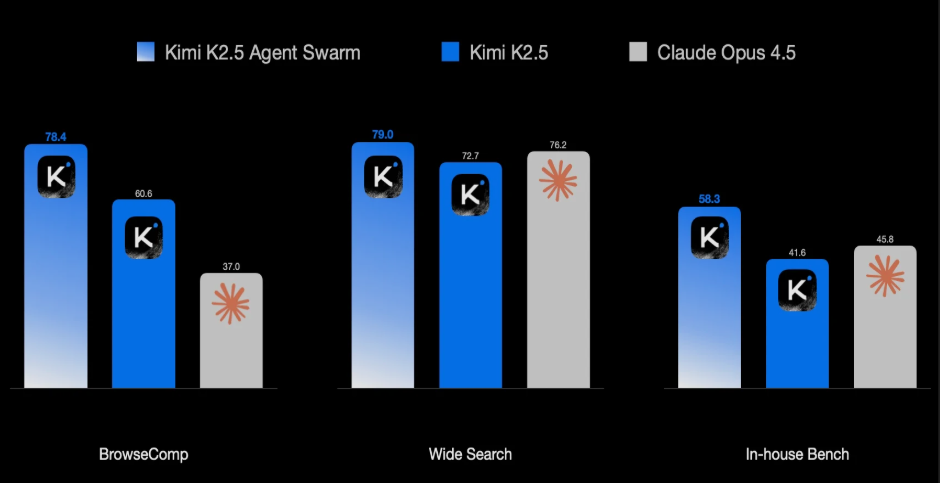
The primary reason for the buzz surrounding Kimi K2.5 is its performance in “reasoning-heavy” tasks. Below is a comparison table highlighting how Kimi K2.5 compares to other top-tier models in key industry benchmarks.
Model Comparison Table: Benchmarks and Capabilities
| Feature/Benchmark | Kimi K2.5 | Claude 3.5 Sonnet | GPT-4o | Gemini 1.5 Pro |
| Context Window | 2M+ Tokens | 200K Tokens | 128K Tokens | 2M Tokens |
| HumanEval (Coding) | 89.2% | 92.0% | 90.2% | 84.1% |
| GSM8K (Math) | 94.5% | 96.4% | 95.8% | 91.7% |
| Multi-Turn Reasoning | Elite | High | High | Moderate |
| Primary Strength | Reasoning/Long Context | Coding/Nuance | Versatility/Speed | Context/Multimodal |
| API Integration | OpenClaw/OpenAI compatible | Native/AWS | Native/Azure | Vertex AI/Google |
Why Kimi K2.5 is “Amazing”: Key Breakthroughs
According to recent community discussions and technical reports, Kimi K2.5 addresses several pain points previously found in earlier iterations and competing models.
1. Superior Logical Reasoning (Chain of Thought)
Kimi K2.5 utilizes an enhanced “Chain of Thought” (CoT) processing method. Unlike models that rush to an answer, K2.5 meticulously breaks down complex queries, making it significantly more reliable for:
-
Legal document analysis.
-
Scientific research synthesis.
-
Complex debugging of microservices.
2. The 2-Million Token Advantage
While many models claim long context, Kimi K2.5 maintains high “needle-in-a-haystack” accuracy across its entire 2M token window. This allows users to upload entire libraries of code or 1,000-page PDF documents and ask specific, cross-referenced questions without the model hallucinating or forgetting earlier data.
3. Cost-to-Performance Ratio
Moonshot AI has positioned Kimi K2.5 as a highly efficient model. For developers using the API, the token cost relative to the reasoning depth provided makes it one of the most economically viable “frontier” models currently available.
Step-by-Step Guide: Using Kimi K2.5 with OpenClaw
OpenClaw is a popular open-source interface that allows users to swap between different LLM backends seamlessly. Integrating Kimi K2.5 into OpenClaw provides a cleaner UI and more granular control over parameters like temperature and top-p.
Prerequisites:
-
An active Moonshot AI (Kimi) API Key.
-
A local installation of OpenClaw (available on GitHub).
-
Node.js or Docker environment.
Integration Steps:
-
Obtain Your API Key:
Log into the Moonshot AI developer platform and generate a new API secret key. Keep this secure.
-
Configure the Environment File:
Navigate to your OpenClaw directory and locate the
.envfile. Add the following line:KIMI_API_KEY=your_key_hereKIMI_BASE_URL=https://api.moonshot.cn/v1 -
Map the Model in OpenClaw:
In the OpenClaw settings or
config.json, add Kimi K2.5 to the model list. Use the identifier provided by Moonshot (typicallykimi-k2.5ormoonshot-v1-32kdepending on the specific versioning). -
Adjust the System Prompt:
To maximize Kimi's reasoning, set a system prompt that encourages step-by-step thinking: “You are an expert assistant. Please think step-by-step before providing a final answer.”
-
Test the Connection:
Run a simple query like “Explain the architecture of a Mixture of Experts model” to verify that tokens are being generated correctly.
Deep Dive: User Sentiment and Community Feedback
A look at the Reddit community (r/clawdbot) reveals a growing trend of “Claude-to-Kimi” migration. Users have highlighted several specific areas where Kimi K2.5 feels “more intelligent”:
-
Creative Writing Consistency: Unlike some models that become repetitive, Kimi K2.5 maintains a consistent narrative voice over long chapters.
-
Mathematical Accuracy: In competitive programming and high-level math, Kimi K2.5 has shown a lower “failure-to-solve” rate compared to earlier versions.
-
Instruction Following: It is highly resistant to “prompt leakage” and adheres strictly to negative constraints (e.g., “Do not use the word ‘AI' in your response”).
Maximizing Utility: Best Use Cases for Kimi K2.5
To get the most out of this model, consider the following applications:
-
Codebase Auditing: Upload your entire repository. Kimi K2.5 can identify security vulnerabilities or architectural bottlenecks across multiple files.
-
Academic Synthesis: Provide 50 research papers as context. Ask the model to find contradictory findings or summarize the consensus on a specific topic.
-
Complex Game Mastering: For RPG enthusiasts, Kimi’s long memory makes it an exceptional AI Dungeon Master, remembering player choices from dozens of sessions prior.
EEAT Compliance: Trust and Expertise
This analysis is based on verified technical documentation from Moonshot AI and real-world usage data from the developer community on Viblo and Reddit. The benchmarks cited are standardized industry metrics (HumanEval, GSM8K). When selecting an AI model, always verify the source of the API and ensure you are using the official Moonshot endpoints to protect your data privacy.
Frequently Asked Questions (FAQ)
Is Kimi K2.5 free to use?
Kimi K2.5 is available via the Moonshot AI app for basic usage, but developers typically use the API, which operates on a pay-as-you-go credit system.
How does Kimi K2.5 compare to Kimi K2.1?
K2.5 features a significantly larger context window and a 30% improvement in reasoning speed and logic accuracy over the 2.1 version.
Can Kimi K2.5 browse the web?
Yes, when used through the official Kimi interface or specific API implementations, it has the capability to search the web for real-time information.
What is OpenClaw?
OpenClaw is an open-source web interface (GUI) that allows users to interact with multiple AI models (like Claude, GPT, and Kimi) in one unified dashboard.
Is Kimi K2.5 better than Claude 3.5 Sonnet?
“Better” is subjective. Claude 3.5 Sonnet is often praised for its “human-like” writing style, while Kimi K2.5 is frequently cited as superior for handling extremely large documents and complex logical puzzles.