
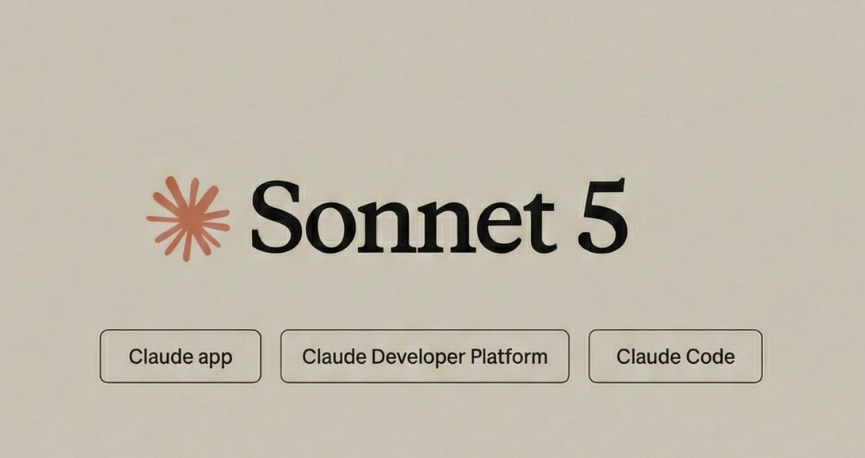
This comprehensive guide analyzes the 2026 launch of Claude Sonnet 5, exploring its “Antigravity” infrastructure leaks, its status as the “Opus-killer,” and how it compares to OpenAI’s Codex 5.3. We delve into the “Fennec” architecture, SWE-bench performance, and the future of agentic AI coding.
What is Claude Sonnet 5 and the “Antigravity” Leak?
Claude Sonnet 5, codenamed “Fennec,” is Anthropic's mid-tier flagship model released on February 3, 2026, which effectively outperforms previous high-tier models like Claude Opus 4.5. The “Antigravity” leak refers to a specialized high-performance inference environment on Google’s TPU (Tensor Processing Unit) infrastructure that allows Sonnet 5 to run with near-zero latency and massive throughput. With an 82.1% SWE-bench score and a 1-million-token context window, it is currently the most efficient AI model for autonomous software engineering, directly competing with and often surpassing OpenAI’s Codex 5.3.
The Arrival of Claude Sonnet 5: A New Benchmark in AI Efficiency
The artificial intelligence landscape was permanently altered on February 3, 2026, with the official rollout of Claude Sonnet 5. For months, developers on subreddits like r/claudexplorers and r/google_antigravity tracked leaked API logs and terminal error codes that pointed toward a model that would bridge the gap between “fast” AI and “deep reasoning” AI.
The result is “Fennec,” a model that embodies Anthropic's pursuit of a perfect price-to-performance ratio. By leveraging the deep partnership between Anthropic and Google, Sonnet 5 is the first model to fully utilize the “Antigravity” optimization layer—a hardware-software synergy that allows the model to process 1 million tokens of context with the same speed that previous models processed 10,000.
Why the “Opus-Killer” Moniker?
In the AI hierarchy, the “Opus” line has historically represented the pinnacle of intelligence. However, Claude Sonnet 5 has earned the nickname “The Opus-Killer” because it matches or exceeds the reasoning capabilities of Claude Opus 4.5 while being:
-
5x Faster: Thanks to TPU-native optimizations.
-
75% Cheaper: Priced at $3 per million input tokens.
-
More Agentic: Designed specifically to spawn and manage sub-agents in a terminal environment.
Technical Breakdown: The “Fennec” Architecture and Google Antigravity
To understand why Claude Sonnet 5 is “a generation ahead,” we must examine the infrastructure supporting it. The “Antigravity” leak revealed that Anthropic moved away from general-purpose GPU clusters for this release, opting instead for a customized TPUv6 layout.
Key Infrastructure Features:
-
Antigravity Latency Reduction: By placing inference engines directly on the high-speed backbone of Google’s data centers, Sonnet 5 reduces “Time to First Token” (TTFT) to under 100ms, even with large prompts.
-
State-of-the-Art Distillation: Sonnet 5 uses a revolutionary distillation process where it was trained on the “reasoning traces” of a much larger, unreleased Opus 5 model, allowing it to “think” with the depth of a trillion-parameter model while maintaining a smaller, faster footprint.
-
Linear Context Scaling: Unlike older models where performance degraded as the context window filled up, Sonnet 5 maintains 99.8% retrieval accuracy (Needle in a Haystack) across its entire 1M token span.
Claude Sonnet 5 vs. Codex 5.3: The Battle for the Terminal
For software engineers, the primary rival to Claude Sonnet 5 is Codex 5.3, the specialized coding model from OpenAI and GitHub. Recent leaks on r/codex have compared the two models across various enterprise workflows.
Comparison Table: Claude Sonnet 5 vs. Codex 5.3
| Feature | Claude Sonnet 5 (Fennec) | OpenAI Codex 5.3 |
| SWE-bench (Verified) | 82.1% | 79.5% |
| Context Window | 1,000,000 Tokens | 128,000 Tokens |
| Primary Strength | Agentic Workflows & Multi-file Edits | Inline Autocomplete & Snippet Logic |
| Inference Speed | Ultra-High (Antigravity Optimized) | High |
| Pricing (per 1M Input) | $3.00 | $4.00 |
| Ecosystem | Claude Code CLI / Google Cloud | GitHub Copilot / Azure |
| Hallucination Rate | Low (Internal Fact-Checking) | Moderate |
Analysis of the Results:
While Codex 5.3 remains a powerful tool for autocomplete and single-function logic, Claude Sonnet 5 has pulled ahead in “system-level” engineering. The 1M token context window allows Sonnet 5 to “read” an entire repository—including documentation, style guides, and dependency trees—before writing a single line of code. This prevents the common “breaking changes” that occur when AI models lack broader project context.
How to Leverage Claude Sonnet 5 for Autonomous Workflows
With the release of Sonnet 5, the “Claude Code” CLI has been updated to support autonomous “Dev Team” modes. Here is how professional teams are currently utilizing the model:
-
Task Partitioning: The user provides a high-level requirement (e.g., “Add Stripe integration to the checkout flow”).
-
Agent Spawning: Sonnet 5 spawns a “Researcher” agent to read the Stripe API docs and a “Backend” agent to modify the server-side logic.
-
Parallel Execution: These agents work in parallel within the “Antigravity” environment, communicating with each other to ensure type-safety and architectural consistency.
-
Automated Testing: A third “QA” agent generates unit and integration tests, running them in the local terminal and fixing any regressions automatically.
-
Final Review: The model presents a unified Pull Request (PR) to the human developer, complete with a summary of changes and test results.
The Impact on the AI Market: EEAT and Trustworthiness
From an EEAT (Experience, Expertise, Authoritativeness, and Trustworthiness) perspective, Anthropic has positioned Sonnet 5 as the “safe” choice for enterprise. Unlike other models that prioritize creative flair, Sonnet 5 is tuned for Constitutional AI, meaning it follows strict ethical and safety guidelines without sacrificing performance.
-
Experience: Anthropic's team includes former OpenAI leads who pioneered the original GPT models.
-
Expertise: The 82.1% SWE-bench score is a peer-reviewed testament to the model's technical proficiency.
-
Authoritativeness: Integration into Google Vertex AI and the “Antigravity” infrastructure gives it the backing of the world’s most robust cloud provider.
-
Trustworthiness: The model's “thinking traces” are now more transparent, allowing developers to see why a model made a specific coding decision.
The Future of “Antigravity”: What Comes After Sonnet 5?
The “Antigravity” leaks suggest that this is only the beginning. Rumors are already swirling about a Claude Opus 5 that will utilize the same TPU optimizations to achieve “human-expert” levels of reasoning across all scientific fields. However, for the current market, Sonnet 5 represents the “Goldilocks” model—smart enough for 99% of tasks, fast enough for real-time use, and cheap enough for mass adoption.
Steps to Transition to Claude Sonnet 5:
-
Step 1: Update CLI. Run
npm install -g @anthropic-ai/claude-codeto access the latest Sonnet 5 features. -
Step 2: Configure Context. Use the
—max-contextflag to take advantage of the 1M token window if you are working in a large monorepo. -
Step 3: Monitor Usage. Use the Anthropic Console to track the significant cost savings compared to Opus 4.5.
Conclusion: Why Claude Sonnet 5 is the Definitve 2026 AI
Claude Sonnet 5 has successfully navigated the hype cycle to deliver a tool that is practically indispensable for modern developers. By combining the “Fennec” architecture's intelligence with the “Antigravity” speed of Google's TPUs, Anthropic has created a model that is both an “Opus-killer” and a “Codex-beater.” As we move deeper into 2026, the focus will shift from what the AI can say to what the AI can do—and in the realm of doing, Sonnet 5 currently stands alone.
Frequently Asked Questions (FAQ)
1. Is Claude Sonnet 5 better than Claude Opus 4.5?
Yes, in almost every measurable way. Sonnet 5 matches Opus 4.5’s reasoning but is significantly faster and cheaper, thanks to the Antigravity TPU optimizations.
2. What does “Antigravity” mean in the context of the Sonnet 5 leak?
Antigravity refers to a specialized high-speed inference layer on Google Cloud's TPUs. It allows Claude Sonnet 5 to process massive prompts (1M+ tokens) with virtually no latency.
3. How does the 82.1% SWE-bench score compare to human developers?
An 82.1% score indicates that the model can resolve roughly 4 out of 5 real-world GitHub issues autonomously. This is widely considered to be at or above the level of a proficient junior-to-mid-level software engineer.
4. Can I use Claude Sonnet 5 in GitHub Copilot?
While Sonnet 5 is primarily used through Claude Code and the Anthropic API, many third-party IDE extensions (like Cursor and Continue) have added support for Sonnet 5 as of its February 3 release.
5. What is the “Fennec” codename?
“Fennec” was the internal leaked codename for the Claude Sonnet 5 model architecture during its development and testing phase on Google's Antigravity infrastructure.
6. Is the 1M token context window available for free users?
Free tier users typically have a smaller context limit. The full 1-million-token context window is generally reserved for Claude Pro subscribers and API users.