
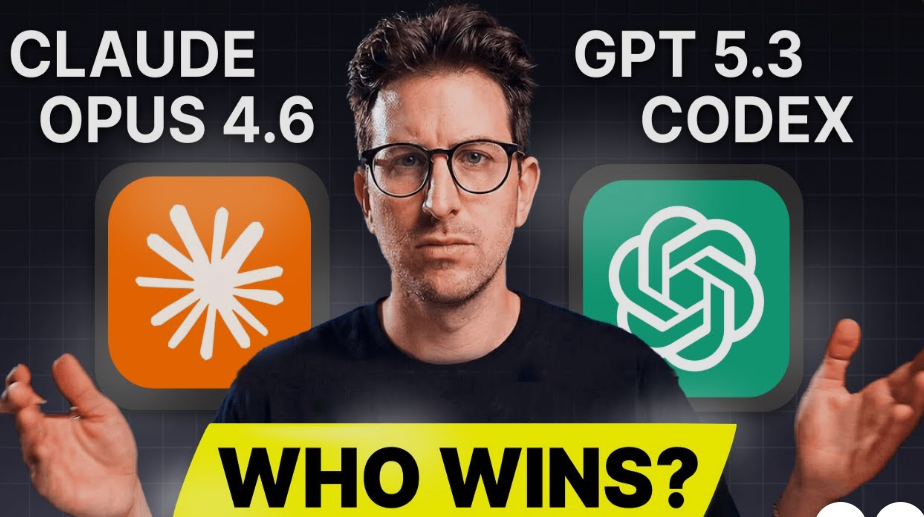
On February 6, 2026, Anthropic and OpenAI simultaneously released flagship AI models Claude Opus 4.6 and GPT-5.3-Codex in a dramatic head-to-head launch. Both models feature unprecedented coding capabilities, expanded context windows, and multi-agent team coordination—marking a new competitive phase in enterprise AI development.
What Are Claude Opus 4.6 and GPT-5.3-Codex?
Claude Opus 4.6 is Anthropic's flagship AI model upgrade featuring 1 million token context window, multi-agent team coordination in Claude Code, and industry-leading performance on enterprise benchmarks including GDPval-AA and Terminal-Bench 2.0. GPT-5.3-Codex is OpenAI's advanced coding-focused model achieving 56.8% on SWE-Bench Pro, 77.3% on Terminal-Bench 2.0, with 25% speed improvement and enhanced reasoning capabilities—both released simultaneously on February 6, 2026.
Simultaneous Release Timeline
The synchronized launch occurred early morning Beijing time February 6, 2026:
- Claude Opus 4.6: Released by Anthropic with immediate availability on claude.ai, API, and major cloud platforms
- GPT-5.3-Codex: Launched by OpenAI with ChatGPT paid tier access (API access pending)
This marked the latest escalation in the AI arms race, with both companies competing for enterprise developer mindshare.
Claude Opus 4.6 vs GPT-5.3-Codex: Complete Comparison
| Feature | Claude Opus 4.6 | GPT-5.3-Codex |
| Context Window | 1 million tokens | Not disclosed |
| Terminal-Bench 2.0 | Top score (highest) | 77.3% |
| SWE-Bench Pro | Not reported | 56.8% |
| GDPval-AA Score | +144 Elo vs GPT-5.2, +190 vs Opus 4.5 | Not reported |
| Multi-Agent Teams | Yes (Claude Code research preview) | Yes (Codex parallel agents) |
| Speed Improvement | Improved context retention | 25% faster than previous version |
| Pricing (API) | $5/$25 per million tokens (unchanged) | Included in ChatGPT paid tiers, API pending |
| Availability | Immediate: claude.ai, API, all major cloud platforms | ChatGPT paid users now, API coming later |
| Primary Focus | Enterprise knowledge work, extended autonomy | Coding excellence, beyond-coding capabilities |
Claude Opus 4.6: Key Features and Capabilities
Anthropic's flagship upgrade delivers unprecedented scale and enterprise-focused enhancements:
- 1 Million Token Context Window
First Claude model featuring 1M token capacity, enabling processing of:
- Entire codebases for comprehensive analysis
- Multiple lengthy documents simultaneously
- Extended autonomous workflows without context loss
Context Retention Breakthrough:
MRCR v2 8-needle 1M test results demonstrate dramatic improvement addressing ‘context rot' problem:
- Opus 4.6: 76% accuracy
- Sonnet 4.5: 18.5% accuracy
This 4x improvement enables reliable information retrieval across massive contexts.
- Multi-Agent Team Coordination
Claude Code introduces ‘agent teams' (similar to Kimi K2.5) allowing multiple AI agents to autonomously coordinate on complex coding projects. Demonstration project: 16 agents built complete Rust-based C compiler from scratch:
- Output: 100,000 lines of code
- Capability: Compiles Linux kernel
- Cost: $20,000
- Duration: 2 weeks, 2,000+ Claude Code sessions
- Testing: 99% GCC stress test pass rate, compiles FFmpeg, Redis, PostgreSQL, QEMU
- Ultimate validation: Compiled and ran Doom game
- Enterprise Benchmark Dominance
Opus 4.6 leads competitors across critical business metrics:
- Terminal-Bench 2.0: Highest score (agent coding evaluation)
- Humanity's Last Exam: Top performance (complex multidisciplinary reasoning)
- GDPval-AA: +144 Elo vs GPT-5.2, +190 vs Opus 4.5 (economic knowledge work tasks)
- BrowseComp: Superior performance (online information retrieval)
- Cowork Integration
Opus 4.6 powers enhanced Cowork environment capabilities:
- Autonomous multi-tasking across applications
- Financial analysis execution
- Research compilation
- Document/spreadsheet/presentation creation and editing
GPT-5.3-Codex: Key Features and Capabilities
OpenAI's release emphasizes coding excellence while expanding beyond traditional development tasks:
- Record-Breaking Coding Benchmarks
GPT-5.3-Codex sets new standards across major coding evaluations:
- SWE-Bench Pro: 56.8% (real-world software engineering tasks)
- Terminal-Bench 2.0: 77.3% (agent coding performance)
- Speed: 25% faster than previous version
- Efficiency: Reduced token consumption
- Hybrid Architecture
Combines GPT-5.2-Codex coding prowess with GPT-5.2 reasoning and domain expertise, creating versatile capabilities for:
- Research-intensive projects
- Complex tool utilization
- Extended autonomous execution
- Beyond Coding: Full Lifecycle Support
GPT-5.3-Codex transcends traditional code generation to handle complete software development lifecycle:
- Debugging and deployment
- Monitoring and analytics
- Product requirements documentation
- Copywriting and content editing
- User research
- Testing and metrics analysis
- Enhanced Interactivity
Real-time collaboration features transform AI from batch processor to interactive colleague:
- Continuous progress updates on key decisions
- Voice narration of execution process
- Real-time feedback responsiveness
- Mid-task guidance and discussion
- Self-Improvement Bootstrap
OpenAI used Codex to optimize GPT-5.3-Codex itself:
- Research team: Monitored and debugged training runs, tracked patterns, analyzed interaction quality
- Engineering team: Optimized framework, identified rendering errors, diagnosed cache inefficiencies, dynamically scaled GPU clusters
The Shifting Role of Human Developers
Both releases signal fundamental transformation in software development workflows. The C compiler project demonstrates this shift:
- No human-written code: AI agents handled all implementation
- Human role evolution: Designing tests, building CI pipelines, creating workarounds when agents deadlock
Future workflow: Humans transition from writing code to constructing environments enabling AI to write code.
What's Next: DeepSeek V4 and Chinese AI Competition
The simultaneous Western releases precede anticipated Chinese model launches. DeepSeek V4 expected imminently, continuing competitive escalation as domestic AI companies respond to international advances.
Frequently Asked Questions (FAQ)
Which model is better: Claude Opus 4.6 or GPT-5.3-Codex?
Depends on use case. Claude Opus 4.6 excels at enterprise knowledge work with 1M token context and superior performance on GDPval-AA business tasks. GPT-5.3-Codex leads coding benchmarks (56.8% SWE-Bench Pro, 77.3% Terminal-Bench) with 25% speed advantage and full software lifecycle support.
Can I access Claude Opus 4.6 and GPT-5.3-Codex now?
Claude Opus 4.6 available immediately on claude.ai, API, and major cloud platforms at $5/$25 per million tokens. GPT-5.3-Codex included in ChatGPT paid subscriptions now; API access coming later.
What is the 1 million token context window?
Claude Opus 4.6's 1M token capacity processes approximately 750,000 words or entire codebases in single conversations. Solves ‘context rot' with 76% accuracy on MRCR v2 8-needle test versus 18.5% for Sonnet 4.5.
How do multi-agent teams work?
Multiple AI agents autonomously coordinate on different project aspects simultaneously. Claude Opus 4.6 demonstration: 16 agents built 100,000-line C compiler compiling Linux kernel in 2 weeks. Agents work in parallel, self-coordinate, handle separate modules.
What does ‘beyond coding' mean for GPT-5.3-Codex?
GPT-5.3-Codex handles complete software lifecycle beyond code generation: debugging, deployment, monitoring, product documentation, copywriting, user research, testing, and metrics analysis—functioning as comprehensive work assistant.
Which benchmarks matter most?
For coding: SWE-Bench Pro (real-world engineering) and Terminal-Bench 2.0 (agent performance). For enterprise: GDPval-AA (economic knowledge tasks). For reasoning: Humanity's Last Exam. GPT-5.3-Codex leads coding; Claude Opus 4.6 dominates enterprise/reasoning.
Why did both companies release simultaneously?
Coincidental timing reflecting intense AI arms race competition. Both aimed for pre-Spring Festival (Chinese New Year) launch window, creating dramatic head-to-head comparison. Demonstrates escalating pressure to maintain competitive positioning.
Will developers lose jobs to these models?
Role transformation rather than elimination. Developers shift from writing code to designing systems where AI writes code—creating test frameworks, building CI/CD pipelines, architecting environments. OpenAI reports research/engineering teams already working fundamentally differently than two months ago.