
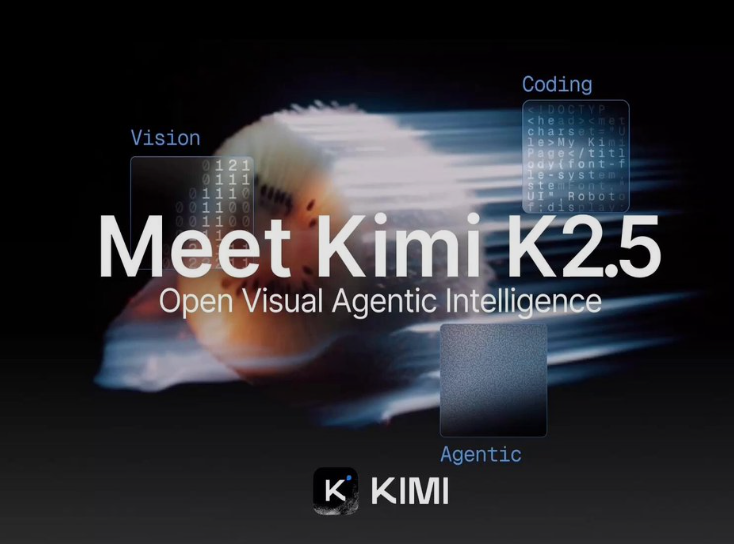
What is Kimi K2.5?
Kimi K2.5 is the latest flagship AI model released by Moonshot AI, representing a massive leap forward in native multimodal and agentic intelligence. Building on the architecture of its predecessor, Kimi K2, the K2.5 model is a Mixture-of-Experts (MoE) behemoth with 1 trillion total parameters and 32 billion activated parameters. Unlike traditional language models that process text only, Kimi K2.5 is a native multimodal agent, meaning it was pre-trained on a massive dataset of 15 trillion mixed visual and text tokens. This allow the model to not only “see” and “read” but to act autonomously across complex workflows. Key breakthroughs include its “Agent Swarm” technology, which coordinates up to 100 sub-agents for massive parallel tasks, and its industry-leading performance in vision-to-code generation, capable of turning natural language or UI designs into fully functional, high-fidelity interactive websites.
Introduction: The Evolution of Moonshot AI
The AI landscape is shifting from passive chatbots to active agents—systems that don’t just answer questions but solve problems by using tools, browsing the web, and writing code. Moonshot AI, an industry leader backed by giants like Alibaba, has positioned itself at the center of this shift with the release of Kimi K2.5.
While previous iterations focused on “thinking” and long-context reasoning, Kimi K2.5 introduces a native vision component that makes it one of the most versatile open-source models available today. By integrating vision and language into the core pre-training phase, Kimi K2.5 achieves a level of cross-modal reasoning that rivals or even surpasses proprietary models like GPT-4o and Gemini 1.5 Pro.
The Architecture: A 1-Trillion Parameter MoE Powerhouse
Kimi K2.5 utilizes a sophisticated Mixture-of-Experts (MoE) architecture. This design allows the model to maintain a massive library of knowledge (1 trillion parameters) while remaining computationally efficient by only activating a specific subset (32 billion parameters) for any given task.
-
Model Scale: 1 trillion total parameters with 32 billion active parameters per token.
-
Expert System: Features 384 specialized experts, with 8 experts selected dynamically during inference to handle specific domains like coding, math, or visual reasoning.
-
Attention Mechanism: Employs Multi-Head Latent Attention (MLA), which significantly reduces memory overhead and enables a 256k context window.
-
Pre-training Depth: Trained on 15 trillion tokens of diverse data, including high-quality web text, scientific papers, code, and a vast library of images and videos.
-
Vision Encoder: Integrates the proprietary “MoonViT” encoder (400M parameters) to process visual inputs natively.
This architecture ensures that Kimi K2.5 can handle extremely complex, long-horizon tasks without the performance degradation typically seen in smaller models.
Native Multimodality: Vision Grounded in Action
One of the most significant upgrades in Kimi K2.5 is its “native” approach to multimodality. Most AI models are “stitched” together—a vision model is connected to a language model after training. Kimi K2.5, however, was trained on interleaved text and visual data from the start.
This native integration leads to several key advantages:
-
Visual Knowledge: The model possesses a deep understanding of physical world concepts, UI design patterns, and spatial reasoning.
-
Interleaved Reasoning: It can process a document containing both images and text (like a technical manual or a financial report) and reason about the relationships between the two.
-
Visual Tool Use: Kimi K2.5 can look at a browser screen, identify buttons and input fields, and autonomously navigate websites to complete tasks.
-
Video Understanding: The model can analyze video sequences to summarize events, detect anomalies, or extract specific information from a timeline.
Agent Swarm: Scaling Intelligence through Parallelism
The “Agent” era of AI often hits a bottleneck when tasks become too large for a single thinking process. Kimi K2.5 introduces a revolutionary “Agent Swarm” feature (currently in beta) that mimics the behavior of a coordinated team of experts.
-
Task Decomposition: When faced with a massive goal (e.g., “Analyze the last 5 years of financial data for 10 competitors and write a summary”), Kimi K2.5 decomposes the project into smaller, parallel sub-tasks.
-
Dynamic Instantiation: It spins up specialized “sub-agents”—up to 100 at a time—each focused on a narrow part of the problem.
-
Parallel Execution: These agents work simultaneously, making up to 1,500 tool calls in a single session.
-
Swarm Orchestration: The “lead” agent coordinates the outputs of the sub-agents, resolves conflicts, and synthesizes the final result.
-
Speed Advantage: This swarm approach is reported to be up to 4.5 times faster than a single-agent setup for large-scale research and coding projects.
Breakthrough in Coding: Turning “Taste” into Code
For developers and designers, Kimi K2.5 offers a “Coding with Vision” capability that is a game-changer for frontend development. Moonshot AI emphasizes that Kimi K2.5 doesn't just write code; it writes “code with taste.”
-
Visual-to-UI: You can upload a screenshot of a design or a screen recording of a website's animation, and Kimi K2.5 will generate the equivalent React, Vue, or Tailwind CSS code.
-
Expressive Motion: The model has a specific “breakthrough” in generating complex animations and scrolling effects that usually require senior-level frontend expertise.
-
Interactive Prototyping: It can create fully functional web applications from a simple natural language description, including interactive charts and dynamic layouts.
-
Aesthetic Sensitivity: Unlike many AI models that produce “utilitarian” code, Kimi K2.5 is optimized to understand aesthetic principles, ensuring that the generated UIs are modern and professional.
Benchmarking Success: Outperforming the Frontier
Kimi K2.5 has set new records across several prestigious AI benchmarks, particularly those focused on “Agentic” capabilities and high-level reasoning.
-
Humanity’s Last Exam (HLE): Achieved a 50.2% score on the full set, proving its ability to handle PhD-level multi-step reasoning.
-
BrowseComp: Scored 74.9%, establishing it as the global State-of-the-Art (SOTA) for autonomous web browsing and information retrieval.
-
SWE-Bench Verified: Reached 76.8%, a SOTA for open-source models in real-world software engineering tasks.
-
MMMU Pro: Achieved 78.5% in multimodal reasoning, demonstrating superior visual-language integration.
-
VideoMMMU: Scored 86.6%, highlighting its strength in long-context video understanding.
These scores indicate that Kimi K2.5 is not just a competitive model in China but a global leader in the most difficult categories of AI performance.
Open Source and Developer Accessibility
Moonshot AI has taken a bold step by making Kimi K2.5 an open-weights model. This moves the “moat” of AI from proprietary access to algorithmic excellence.
-
Hugging Face Availability: The model weights and code are accessible to the public, allowing researchers to run the model locally on high-end hardware.
-
API Compatibility: The Kimi Open Platform is fully compatible with the OpenAI API format, meaning developers can switch their existing applications to Kimi K2.5 with minimal code changes.
-
Cost Efficiency: Through native INT4 quantization support, the model provides high performance with significantly lower memory requirements, making it more accessible for deployment.
-
Licensing: Released under a strategic license that encourages the generation of synthetic data, further accelerating community-driven innovation.
Practical Applications: How to Use Kimi K2.5 Today
The versatility of Kimi K2.5 makes it suitable for a wide range of enterprise and creative applications:
-
Autonomous Research: Use the model to browse dozens of research papers, extract data points, and build a comprehensive comparative table.
-
Full-Stack Development: Build rapid prototypes of web apps by describing the logic and uploading design inspirations.
-
Marketing & Creative: Generate aesthetic websites and promotional landing pages with high-fidelity animations.
-
Data Analysis Swarm: Process massive datasets in parallel by deploying an agent swarm to clean, analyze, and visualize data points.
-
Technical Support: Create an agent that can “see” customer screenshots of errors and provide step-by-step visual guidance for troubleshooting.
Summary of Key Features and Benefits
| Feature | الوصف | Benefit |
| 1T Parameter MoE | 1 trillion parameters total; 32B active per token. | High intelligence with low latency/cost. |
| Native Multimodal | Pre-trained on 15T mixed text/vision tokens. | Seamless vision and language reasoning. |
| Agent Swarm | Coordination of up to 100 parallel sub-agents. | 4.5x faster execution of massive tasks. |
| Vision-to-UI | Generates aesthetic code from visual specs. | Rapid, high-quality frontend development. |
| Open Weights | Available on Hugging Face for the community. | Full control and transparency for builders. |
| 256k Context | Massive window for long documents/videos. | Coherent reasoning over large datasets. |
Final Outlook: The Era of the Agent Has Landed
The launch of Kimi K2.5 marks the end of the “simple chatbot” era. We are now entering the age of the Multimodal Agent, where AI is no longer a passive text generator but an active participant in the digital world.
By combining massive-scale MoE architecture with native vision and a coordinated swarm logic, Moonshot AI has provided a blueprint for the future of productivity. Whether you are a developer looking to automate complex coding pipelines, a researcher handling thousands of documents, or a business owner building the next generation of AI-driven tools, Kimi K2.5 offers a level of open-source power that was previously unimaginable.
As the gap between open-source and proprietary models continues to close, Kimi K2.5 stands as a testament to the power of algorithmic scaling. The era of agentic intelligence is here, and it is more open, visual, and capable than ever before.