
The Month That Changed Everything
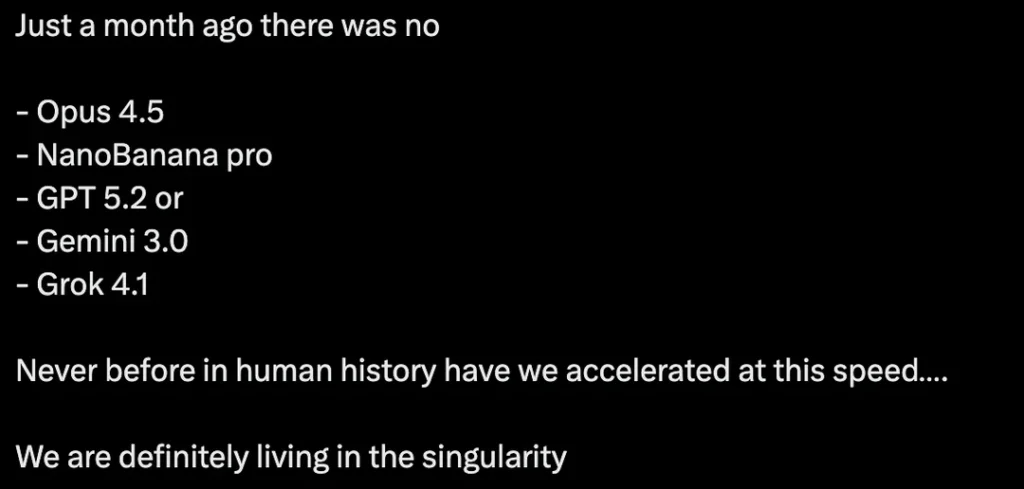
From November 17 through December 11, 2025, the artificial intelligence industry witnessed an unprecedented concentration of frontier model releases that fundamentally reshaped the competitive landscape. Within just 25 days, four major AI companies launched their most powerful models yet: xAI's Grok 4.1 (November 17), Google's Gemini 3 (November 18), Anthropic's Claude Opus 4.5 (November 24), and OpenAI's GPT-5.2 (December 11).
This explosive sequence represents something never before seen in technology history—a compression of innovation so intense that each company's flagship release was immediately challenged by the next. The rapid-fire cadence has prompted serious discussions about whether we're witnessing the early acceleration phase of an AI singularity, where progress compounds so quickly that it becomes difficult to track.
The Chronological Cascade: Four Weeks That Redefined AI
Week 1: xAI Drops Grok 4.1 (November 17, 2025)
The sequence began when xAI released Grok 4.1, which immediately claimed the top position on LMArena's Text Arena leaderboard with a commanding 1483 Elo rating. After a silent testing phase from November 1-14 where users preferred it 64.78% of the time over the previous model, xAI made it available across grok.com, X (formerly Twitter), and mobile apps.
What made this release remarkable was its focus on emotional intelligence and creative capabilities. Grok 4.1 reduced hallucinations by 65% compared to its predecessor, dropping from 12.09% to just 4.22% on information-seeking queries. The model achieved a breakthrough score of 1586 Elo on EQ-Bench3, establishing new standards for AI emotional understanding.
The technical architecture employed large-scale reinforcement learning originally built for Grok 4, but repurposed to optimize style, personality, helpfulness, and alignment. By using frontier reasoning models as automated evaluators, xAI created a system that could autonomously score and refine responses at scale.
Week 1: Google Counters with Gemini 3 (November 18, 2025)
Just 24 hours after Grok 4.1's launch, Google unveiled Gemini 3 on November 18, 2025, deploying it instantly to over 2 billion Google Search users and 650 million Gemini App users. This wasn't a gradual rollout—it was a day-one platform-wide deployment across Search, Vertex AI, AI Studio, and mobile apps.
Gemini 3 Pro achieved a historic 1501 Elo score on LMArena, becoming the first model ever to surpass the 1500-point threshold. The model introduced a 1-million-token context window and state-of-the-art multimodal processing capabilities that could handle text, code, images, video, audio, and PDFs seamlessly.
The breakthrough came from Gemini 3's ability to execute complete 10-15 step reasoning chains without losing coherence—something previous models struggled with after 5-6 steps. Google also introduced Deep Think mode, a high-intensity reasoning configuration that pushed benchmark scores even higher. Alongside the model, Google launched Antigravity, a Gemini-powered coding interface combining chat, terminal, and browser capabilities for agentic development.
Week 2: Anthropic's Claude Opus 4.5 (November 24, 2025)
One week after Gemini 3's launch, Anthropic released Claude Opus 4.5 on November 24, 2025, positioning it as “the best model in the world for coding, agents, and computer use”. The release came with significantly improved pricing—$5/million input tokens and $25/million output tokens—making it 67% cheaper than the previous Opus generation.
Claude Opus 4.5 achieved state-of-the-art results with 80.9% on SWE-bench Verified and 66.3% on OSWorld for computer use capabilities. Early testers reported that tasks “near-impossible for Sonnet 4.5 just weeks ago” were now within reach. The model featured a 200,000-token context window, 64,000-token output limit, and a March 2025 knowledge cutoff.
Internal testing revealed that Opus 4.5 cut token usage in half while achieving higher pass rates on complex coding tasks, delivering up to 65% efficiency gains. The model particularly excelled at long-horizon autonomous tasks requiring sustained reasoning across 30-minute coding sessions. Microsoft immediately integrated it into Foundry, GitHub Copilot, and Copilot Studio, signaling enterprise confidence.
Week 3: OpenAI's “Code Red” Response with GPT-5.2 (December 11, 2025)
After watching competitors dominate headlines, OpenAI launched GPT-5.2 on December 11, 2025, calling it “the most capable model series yet for professional knowledge work”. The release came less than a month after GPT-5.1 and was directly triggered by what OpenAI internally called a “code red” response to Gemini 3's superiority.
GPT-5.2 arrived in three variants: Instant (optimized for speed), Thinking (for complex structured work), and Pro (for maximum accuracy). The model featured a 400,000-token context window, 128,000 max output tokens, and a significantly updated knowledge cutoff of August 31, 2025—ten months newer than GPT-5.1.
On OpenAI's GDPval benchmark, GPT-5.2 beat or tied top industry professionals on 70.9% of well-specified knowledge work tasks across 44 occupations. The model demonstrated breakthrough performance in scientific reasoning, with GPT-5.2 Pro achieving 93.2% on GPQA Diamond and GPT-5.2 Thinking solving 40.3% of expert-level FrontierMath problems.
The pricing represented a rare increase in the industry—$1.75/million input and $14/million output tokens, 1.4x the cost of GPT-5.1—but OpenAI justified this with substantially improved capabilities. Internal sources revealed that some employees had asked for the release to be delayed for further improvement, but competitive pressure forced the accelerated timeline.
The Competitive Dynamics: A Code Red Arms Race
The launch sequence created what one CEO called a “tit-for-tat arms race” where each company's release immediately pressured competitors to respond. OpenAI's Sam Altman issued an internal “code red” memo in early December after Gemini 3 topped leaderboards and Anthropic's Claude gained enterprise market share in coding applications.
ChatGPT traffic had declined and the company faced concerns about losing consumer market share to Google. The code red called for shifting priorities, including stalling on commitments like introducing ads to focus on creating a better ChatGPT experience. CEO Sam Altman told CNBC that the company expected to exit code red status by January after GPT-5.2's deployment.
The competitive pressure drove unprecedented development velocity. Companies that typically released major models annually or semi-annually were now shipping frontier models within weeks of each other. Each release incorporated learnings from the previous week's competitive announcements, creating a feedback loop of rapid iteration.
Technical Breakthroughs Across the Board
Context Windows Expand Dramatically
The November-December launches pushed context windows to new extremes, with Grok 4.1 Fast offering a massive 2-million-token context window—enough to process entire codebases or lengthy document collections in a single query. Gemini 3 Pro offered 1,048,576 tokens, while GPT-5.2 featured 400,000 tokens. These expanded windows enable entirely new use cases around long-document analysis, multi-file coding, and comprehensive research synthesis.
Reasoning Capabilities Reach New Heights
All four models demonstrated significant advances in multi-step reasoning. Gemini 3's ability to maintain coherence through 10-15 logical steps represented a fundamental breakthrough. Grok 4.1 introduced reasoning modes that could be toggled for different speed-intelligence tradeoffs. Claude Opus 4.5 excelled at sustained reasoning through 30-minute autonomous sessions. GPT-5.2 Pro's performance on graduate-level scientific questions approached human expert levels.
Tool Use and Agentic Capabilities
The new generation embraced agentic workflows, with Grok 4.1 Fast launching alongside an Agent Tools API that achieved 93% accuracy on t2-Bench for tool-calling tasks. Gemini 3 integrated seamlessly with Google services through managed MCP servers. Claude Opus 4.5 introduced Model Context Protocol for connecting to external data sources. GPT-5.2 demonstrated state-of-the-art tool use across multiple platforms.
Cost Efficiency Revolution
Despite increased capabilities, competitive pressure drove prices down across the board. Claude Opus 4.5's 67% price reduction made frontier performance accessible at scale. Grok 4 Fast achieved up to 98% cost reductions compared to previous generations. This democratization of access enables smaller companies to build sophisticated AI-powered applications without enterprise-scale budgets.
Benchmark Wars: Who Really Won?
The rapid-fire releases created confusion as models traded positions on various leaderboards:
Coding Excellence: Claude Opus 4.5 leads with 80.9% on SWE-bench Verified, though GPT-5.2 claims 80.0% on the same benchmark. Both substantially outperform competitors in software engineering tasks.
Conversational AI: Grok 4.1 achieved 1483 Elo on LMArena Text Arena, though Gemini 3 Pro's 1501 Elo overall score represents the highest general intelligence rating.
Scientific Reasoning: GPT-5.2 Pro scored 93.2% on GPQA Diamond, the highest recorded on this graduate-level science benchmark, edging out Gemini 3 and Claude.
Multimodal Understanding: Gemini 3 maintains clear leadership in processing and reasoning across text, images, audio, and video simultaneously.
Emotional Intelligence: Grok 4.1's 1586 Elo on EQ-Bench3 establishes it as the most emotionally aware AI system released to date.
Computer Use: Claude Opus 4.5's 66.3% on OSWorld represents state-of-the-art autonomous computer interaction capabilities.
The Enterprise Response: Adoption at Lightning Speed
Major platforms moved with unprecedented speed to integrate the new models. Microsoft added Claude Opus 4.5 to Foundry, GitHub Copilot, and Copilot Studio within days of release. Google made Gemini 3 immediately available through Google Cloud's Vertex AI. OpenAI partners including Notion, Box, Shopify, Harvey, and Zoom had early access to GPT-5.2 for testing weeks before public release.
Development tools integrated the models in real-time. GitHub Copilot offered all major models through a unified picker interface. Cursor and other AI-powered IDEs added support within 48-72 hours of each launch. This platform-level competition ensures developers can easily switch between models based on specific task requirements.
What This Means for Different Industries
Software Development Transformed
Testers noted that Claude Opus 4.5 “figures out the fix” when pointed at complex multi-system bugs, completing tasks that were “near-impossible for Sonnet 4.5 just weeks ago”. The new generation of models can refactor entire codebases, migrate legacy systems, and maintain context across dozens of files simultaneously. Development velocity has increased measurably, with some teams reporting 50-70% productivity gains.
Knowledge Work Revolution
The average ChatGPT Enterprise user reports AI saves them 40-60 minutes per day, with heavy users saving more than 10 hours per week. GPT-5.2's improvements in spreadsheets, presentations, and document creation amplify these gains. Professionals across law, finance, accounting, and consulting are fundamentally restructuring workflows around AI capabilities.
Creative Industries Disrupted
Grok 4.1's top-3 global ranking in creative writing benchmarks, combined with its emotional intelligence, makes it exceptional for content creation, marketing copy, and storytelling. The model's personality and voice control opens new possibilities for brand-aligned AI writing that feels authentically human.
Research and Analysis
The expanded context windows enable researchers to analyze entire libraries of papers, synthesize findings across hundreds of documents, and identify patterns that would take months of manual work. Scientific researchers using GPT-5.2 Pro report breakthroughs in mathematical proofs and experimental design.
The Economic Implications
The November-December sprint represents billions in R&D investment compressed into weeks. Training frontier models requires massive compute clusters—Google's infrastructure for Gemini 3 reportedly cost tens of billions, while OpenAI's partnership with Microsoft leverages NVIDIA H100, H200, and GB200-NVL72 GPUs across Azure data centers.
Yet competitive pressure has driven down consumer prices even as capabilities soar. What cost hundreds of dollars per task a year ago now costs cents. This creates a paradox: companies must invest more to compete while charging less to maintain market share. The sustainability of this dynamic remains an open question.
Looking Ahead: What's Next?
The breakneck pace shows no signs of slowing. xAI's Elon Musk has already teased Grok 4.20 for release in 3-4 weeks, suggesting the cycle will continue into early 2026. OpenAI is rumored to be working on GPT-5.3 enhancements. Google's Gemini 3.5 development is reportedly underway. Anthropic's roadmap includes extended thinking capabilities and deeper tool integrations.
Several trends are emerging for 2026:
Specialization Over Generalization: Rather than one model dominating all tasks, we're seeing strategic positioning—Claude for coding, Grok for conversation, Gemini for multimodal tasks, GPT for professional knowledge work.
Agentic AI Goes Mainstream: The November-December models represent a transition from question-answering systems to autonomous agents that can plan, execute, and iterate on complex multi-step projects without constant human oversight.
Cost Compression Continues: Competitive pressure will drive prices lower even as capabilities increase, potentially making frontier AI universally accessible.
Safety and Alignment Focus: All four companies emphasized enhanced safety testing, reduced hallucinations, and improved alignment with human values. As capabilities grow more powerful, responsible development becomes critical.
The Singularity Debate: Are We There Yet?
The unprecedented concentration of breakthroughs has reignited discussions about technological singularity. When four companies can each independently achieve human-expert-level performance on complex reasoning tasks within a single month, traditional models of gradual progress clearly no longer apply.
However, experts remain divided. Some view the November-December sprint as evidence that AI development is entering an exponential phase where each generation of models accelerates the development of the next. Others argue this represents a one-time catch-up period as companies released models that had been in development for months.
What's undeniable is the practical impact: the AI landscape of mid-December 2025 is fundamentally different from late October. Capabilities that seemed years away arrived in weeks. Competitive dynamics that typically played out over quarters compressed into days.
Conclusion: Living Through History
Whether we're witnessing a true singularity or simply an intense competitive sprint, the November-December 2025 AI model releases represent a watershed moment in technology history. The sequence from Grok 4.1 through Gemini 3, Claude Opus 4.5, and GPT-5.2 delivered more capability advancement in 25 days than most previous years achieved in total.
For developers, the message is clear: staying current with AI capabilities is no longer optional. A model you integrated last month may already be surpassed by something significantly more capable. For businesses, the challenge is balancing the desire to leverage cutting-edge AI with the need for stable, reliable production systems.
For society, the rapid acceleration raises profound questions about adaptation, workforce transformation, and regulatory frameworks. When AI capabilities advance faster than our ability to fully comprehend their implications, we must develop new frameworks for responsible innovation.
One thing is certain: the pace of change shows no signs of slowing. The companies that launched these four models are already working on the next generation, and the cycle will likely repeat—perhaps even faster—in the months ahead. We're not just living through a period of rapid AI advancement; we're experiencing a fundamental phase transition in how quickly intelligence itself can evolve.
The question is no longer whether AI will transform every industry, but how quickly organizations and individuals can adapt to an innovation velocity unprecedented in human history. Welcome to the singularity speed era—where last month's breakthrough is this month's baseline, and tomorrow's possibilities arrive today.
Keywords: Grok 4.1, Gemini 3, Claude Opus 4.5, GPT-5.2, AI model releases November 2025, December 2025 AI models, artificial intelligence singularity, xAI Grok, Google Gemini, Anthropic Claude, OpenAI GPT, AI benchmark comparison, frontier AI models, LMArena leaderboard, AI code red