
Introduction: The Evolution of Search
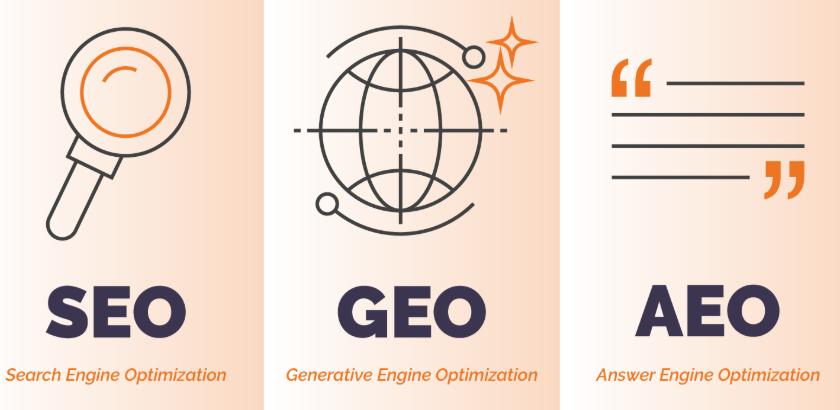
The search landscape has fundamentally transformed. No longer confined to Google's blue links, today's consumers search across AI chatbots, voice assistants, social media platforms, and traditional search engines simultaneously. This fragmentation has given rise to three distinct yet interconnected optimization strategies: Search Engine Optimization (SEO), Answer Engine Optimization (AEO), and Generative Engine Optimization (GEO).
Understanding these three approaches isn't optional anymore—it's essential for brands that want to remain visible wherever their customers are searching.
What is Search Engine Optimization (SEO)?
The Foundation of Digital Visibility
Search Engine Optimization has been the cornerstone of digital marketing for over two decades. SEO encompasses the strategies and techniques used to improve a website's visibility in traditional search engine results pages (SERPs) on platforms like Google, Bing, and Yahoo.
Core Components of SEO
Keyword Targeting: Identifying and strategically implementing search terms that align with user intent and business objectives.
On-Page Structure: Optimizing headers, meta descriptions, alt text, and URL structures to improve content discoverability and relevance.
Technical SEO: Ensuring fast loading times, mobile responsiveness, secure connections (HTTPS), and proper site architecture for optimal crawling and indexing.
Off-Page SEO: Building authoritative backlinks, earning citations, and establishing domain authority through external validation.
Content Quality: Creating comprehensive, valuable content that addresses user needs and demonstrates expertise, authoritativeness, and trustworthiness (E-A-T).
The Primary Goal of SEO
The fundamental objective of SEO is to drive organic traffic to your website. Success is measured by keyword rankings, click-through rates, organic sessions, and ultimately, conversions generated from search engine visitors.
SEO in 2025
While the core principles remain relevant, SEO continues evolving. Today's SEO strategies must account for AI-powered features like Google's AI Overviews, local pack listings, featured snippets, and increasingly sophisticated ranking algorithms that prioritize user experience and content quality over manipulation tactics.
What is Answer Engine Optimization (AEO)?
Optimizing for Direct Answers
Answer Engine Optimization represents a paradigm shift from ranking first to becoming the answer itself. AEO focuses on structuring content so AI-powered systems can extract and present it as direct responses to user queries.
Where AEO Appears
AI Overviews: Google's AI-generated summaries that appear at the top of search results.
Voice Assistants: Responses from Alexa, Siri, Google Assistant, and other voice-activated devices.
Featured Snippets: Position zero results that provide immediate answers without requiring clicks.
Knowledge Panels: Information boxes that display structured data about entities, businesses, and topics.
AEO Optimization Strategies
Schema Markup Implementation: Adding structured data to help machines understand content relationships, context, and meaning.
FAQ Format Content: Writing in question-and-answer formats using natural, conversational language that mirrors how people actually speak.
Knowledge Graph Development: Creating interconnected content entities that provide context and demonstrate topical authority.
Concise, Clear Answers: Leading with direct responses to common questions before providing detailed explanations.
معالجة اللغات الطبيعية: Crafting content that aligns with how people ask questions verbally rather than typed keyword queries.
The Primary Goal of AEO
Unlike SEO's focus on driving clicks, AEO aims to position your brand as the authoritative source that AI systems reference when providing direct answers. Success means being selected as the single answer presented to users, establishing trust and brand recognition even without website visits.
Why AEO Matters Now
With over 65% of searches now resulting in zero-click outcomes—where users find their answer without leaving the search results page—brands must optimize for visibility in these AI-generated responses or risk becoming invisible to modern searchers.
What is Generative Engine Optimization (GEO)?
The Next Frontier of Search Optimization
Generative Engine Optimization goes beyond appearing in search results or providing direct answers. GEO focuses on ensuring AI-driven search engines and large language models (LLMs) can understand, cite, and incorporate your content into the comprehensive responses they generate.
Where GEO Applies
AI Search Platforms: ChatGPT, Perplexity, Claude, Gemini, and other conversational AI systems.
LLM-Powered Tools: Enterprise AI assistants, research tools, and productivity applications that synthesize information from multiple sources.
Multimodal AI: Systems that process and cite information across text, images, audio, and video content.
GEO Optimization Strategies
Machine-Readable Content: Structuring information so AI systems can easily parse, understand, and extract relevant data points.
Contextual Richness: Providing depth, nuance, and connections between concepts that help AI understand broader context and relationships.
Citation-Worthy Sources: Creating authoritative, well-researched content that AI systems can confidently reference and attribute.
Multi-Format Distribution: Ensuring content is accessible across platforms and formats where AI systems source information.
Entity Relationship Building: Establishing clear connections between topics, people, places, and concepts that AI can map and reference.
The Primary Goal of GEO
GEO aims to increase your brand's authority and citation frequency in AI-generated responses. When AI systems synthesize answers from multiple sources, GEO ensures your content is among those trusted sources, building long-term visibility and credibility in the AI-powered information ecosystem.
The GEO Advantage
As AI-powered search continues growing—with billions of queries processed monthly across platforms like ChatGPT, Perplexity, and others—brands optimized for GEO will have a significant competitive advantage in capturing attention and establishing thought leadership.
Key Differences: SEO vs AEO vs GEO
Purpose and Objectives
SEO: Ranks your website higher in traditional search results to drive organic traffic and conversions.
AEO: Positions your brand as the direct answer to specific queries across voice assistants and AI overviews.
GEO: Ensures AI systems can understand and cite your content when generating comprehensive responses.
Success Metrics
SEO KPIs: Keyword rankings, organic traffic volume, click-through rates, bounce rates, conversion rates.
AEO KPIs: Featured snippet appearances, voice search visibility, AI overview inclusion, zero-click presence.
GEO KPIs: Citation frequency in AI responses, source attribution in generated content, presence across multiple AI platforms.
Content Optimization Approach
SEO: Long-form, keyword-rich content with strong internal linking, backlinks, and technical optimization.
AEO: Concise, structured content in FAQ format with schema markup and conversational language.
GEO: Authoritative, contextually rich content that's machine-readable and distributed across multiple formats and platforms.
User Intent Addressed
SEO: Users researching topics, comparing options, or seeking detailed information willing to click through to websites.
AEO: Users wanting immediate, specific answers without navigating away from their current platform.
GEO: Users engaging with AI assistants for research, analysis, or synthesized information from multiple sources.
Why All Three Strategies Matter
The Fragmentation of Search
Search no longer happens in a single location. Today's consumers search across:
Traditional Search Engines: Google, Bing, and regional search platforms for comprehensive research.
Social Media: TikTok, Instagram, and Facebook for visual content, real experiences, and authentic reviews.
AI Platforms: ChatGPT, Perplexity, and Gemini for synthesized answers and comparative analysis.
Voice Assistants: Alexa, Siri, and Google Home for quick, hands-free information retrieval.
Community Forums: Reddit, Quora, and specialized forums for unfiltered opinions and detailed discussions.
Map Applications: Google Maps, Apple Maps, and Waze for location-based searches and local business information.
The Hybrid Search Behavior
Modern consumers don't choose one platform—they use multiple sources simultaneously. Someone researching restaurants might check Google Maps for proximity, read Reddit for honest reviews, ask ChatGPT for recommendations based on dietary preferences, and watch TikTok videos to see the ambiance.
Brands must be visible across all these touchpoints to capture attention and influence decisions throughout the customer journey.
The Competitive Advantage
Organizations that quickly adapt to multi-channel search optimization gain significant advantages:
Increased Visibility: Appearing across traditional search, AI responses, voice assistants, and social platforms maximizes brand exposure.
Enhanced Authority: Consistent citations and presence across platforms establish credibility and thought leadership.
Future-Proofing: As search technology evolves, brands optimized for SEO, AEO, and GEO remain visible regardless of platform shifts.
Customer Meeting Points: Being present wherever customers search ensures you're discoverable at crucial decision-making moments.
How to Implement SEO, AEO, and GEO Together
Start with a Strong SEO Foundation
Before expanding into AEO and GEO, ensure your basic SEO fundamentals are solid:
Conduct Comprehensive Keyword Research: Understand what your audience searches for and their intent at each stage of the customer journey.
Optimize Technical Infrastructure: Ensure your website loads quickly, functions properly on mobile devices, and has clean, crawlable architecture.
Build Authoritative Backlinks: Earn citations from reputable sources in your industry to establish domain authority.
Create Quality Content: Develop comprehensive resources that address user needs and demonstrate expertise.
Layer in AEO Optimization
Once your SEO foundation is established, enhance it with AEO strategies:
Add Schema Markup: Implement structured data across your website to help AI systems understand content relationships.
Create FAQ Sections: Develop comprehensive FAQ pages that directly answer common customer questions using natural language.
Optimize for Voice Search: Write content using conversational phrases and long-tail keywords that match spoken queries.
Target Featured Snippets: Structure content with clear headings, bullet points, and direct answers to ranking questions.
Develop a Knowledge Graph: Create interconnected content that provides context and demonstrates topical authority across your domain.
Advance with GEO Strategies
Finally, optimize for the AI-powered future with GEO tactics:
Ensure Machine Readability: Structure all content with clear hierarchies, proper formatting, and semantic HTML.
Build Comprehensive Authority: Create in-depth resources that AI systems can confidently cite as authoritative sources.
Distribute Across Platforms: Ensure content is accessible where AI systems source information, including knowledge bases, directories, and specialized databases.
Maintain Data Consistency: Keep business information, facts, and figures consistent across all platforms to build AI trust.
Monitor AI Citations: Track how and where AI systems reference your content, adjusting strategy based on performance.
Measurement and Optimization
Success across SEO, AEO, and GEO requires comprehensive tracking:
Traditional SEO Metrics: Monitor rankings, traffic, and conversions through Google Analytics and Search Console.
AEO Performance: Track featured snippet wins, AI overview appearances, and voice search queries.
GEO Visibility: Use specialized tools to monitor AI platform citations, source attributions, and response inclusion.
Cross-Platform Analysis: Assess how your brand appears across different search environments and identify optimization opportunities.
Real-World Application Examples
Local Business Strategy
A restaurant chain should optimize across all three:
SEO: Optimize location pages with local keywords, earn local backlinks, and maintain consistent NAP (Name, Address, Phone) citations.
AEO: Create FAQ content answering common questions like “What are your hours?” and “Do you offer gluten-free options?” with schema markup.
GEO: Ensure AI systems can access and cite menu information, dietary accommodations, and unique offerings when recommending restaurants.
E-Commerce Approach
An online retailer should implement:
SEO: Optimize product pages with detailed descriptions, customer reviews, and high-quality images while building backlinks from industry blogs.
AEO: Structure product information in Q&A format addressing sizing, materials, care instructions, and shipping details.
GEO: Provide comprehensive product specifications in machine-readable formats that AI shopping assistants can reference when making recommendations.
B2B Marketing Strategy
A software company should focus on:
SEO: Create thought leadership content, case studies, and technical documentation targeting decision-maker search queries.
AEO: Develop detailed FAQ sections addressing common implementation questions, integration concerns, and feature comparisons.
GEO: Publish authoritative whitepapers, research reports, and technical specifications that AI systems cite when comparing solutions.
Common Challenges and Solutions
Challenge: Resource Constraints
Solution: Start with SEO fundamentals, then progressively add AEO elements to existing content before expanding into comprehensive GEO strategies. Prioritize high-impact optimizations first.
Challenge: Measuring ROI
Solution: Establish baseline metrics for each strategy, track visibility across platforms, and monitor indirect indicators like brand search volume and citation frequency alongside traditional conversion metrics.
Challenge: Keeping Pace with Change
Solution: Stay informed about search technology updates, regularly audit your visibility across platforms, and maintain flexibility to adapt strategies as new AI platforms emerge.
Challenge: Content Creation Volume
Solution: Focus on creating comprehensive hub content that can be repurposed across SEO long-form articles, AEO FAQ sections, and GEO-optimized structured data rather than treating each as separate initiatives.
The Future of Search Optimization
Emerging Trends
Multimodal Search: AI systems increasingly process queries across text, voice, image, and video simultaneously.
Personalized AI Responses: Search results becoming more tailored to individual user preferences, history, and context.
Real-Time Information: AI systems accessing and citing more current information rather than relying solely on training data.
Cross-Platform Integration: Seamless search experiences spanning social media, voice assistants, traditional search, and AI platforms.
Preparing for What's Next
Brands that invest in SEO, AEO, and GEO now position themselves advantageously for future search evolution. The principles remain consistent: create authoritative, accessible, well-structured content that serves user needs regardless of how or where they search.
خاتمة
SEO, AEO, and GEO aren't competing strategies—they're complementary approaches essential for comprehensive search visibility. SEO establishes your foundation in traditional search, AEO positions you as the direct answer to user questions, and GEO ensures AI systems recognize and cite your authority.
The brands that will thrive in the evolving search landscape are those that embrace all three strategies, maintaining visibility across traditional search engines, AI platforms, voice assistants, and social media. Search is everywhere now, and your brand needs to be everywhere too.
Start by auditing your current presence across different search environments, identify gaps in your optimization strategy, and systematically implement improvements across SEO, AEO, and GEO. The future of search visibility belongs to brands willing to adapt, evolve, and optimize for the hybrid search reality that defines modern consumer behavior.