This comprehensive analysis explores the technical specifications, performance benchmarks, and agentic capabilities of Moonshot AI’s Kimi K2.5 and OpenAI’s GPT-5. We examine how these two titans compare in multimodal reasoning, coding efficiency, and cost-to-performance ratios.
How do Kimi K2.5 and GPT-5 Compare?
Kimi K2.5 and GPT-5 are the two leading frontier AI models of 2026, with Kimi K2.5 serving as the world’s most powerful open-source alternative to OpenAI’s proprietary GPT-5. While GPT-5 maintains a slight lead in general-purpose linguistic nuance and zero-shot reasoning, Kimi K2.5 is the superior choice for agentic workflows and vision-to-code tasks. Kimi K2.5 utilizes a 1.04 trillion parameter Mixture-of-Experts (MoE) architecture that matches GPT-5’s performance in specialized benchmarks like Humanity's Last Exam (HLE) and VideoMMMU. For enterprises, Kimi K2.5 offers unmatched cost-efficiency and data sovereignty via open-weights deployment, whereas GPT-5 excels in ecosystem integration and polished consumer-facing features.
مقدمة
The AI landscape in 2026 is defined by the competition between closed-source giants and high-performance open-source models. Kimi K2.5, developed by Moonshot AI, has shocked the industry by achieving parity with GPT-5 across several key metrics. This article breaks down the architectural innovations, multimodal strengths, and deployment strategies for both models to help you decide which is right for your project.
1. Architectural Deep Dive: MoE vs. Dense Frontiers
Understanding the “brain” of these models is essential for predicting their performance in real-world applications.
-
Kimi K2.5 (Mixture-of-Experts): Kimi employs a sparse Mixture-of-Experts (MoE) architecture with 1.04 trillion total parameters. Only 32 billion parameters are activated per token, making it incredibly fast and cost-effective. It features 384 specialized experts, with 8 routed per token.
-
GPT-5 (Scaling Laws): While OpenAI remains secretive, GPT-5 is believed to be a massive dense or semi-sparse model optimized for maximum reasoning depth. It focuses heavily on “computation at inference time,” allowing the model to “think” longer to solve complex math and logic puzzles.
-
Context Windows: Kimi K2.5 offers a 256k context window in its “Thinking Mode,” which is highly optimized for long-document analysis. GPT-5 offers a variable context window, with top-tier enterprise versions supporting up to 1 million tokens for massive codebase ingestion.
2. Benchmarking the Leaders: A Side-by-Side Comparison
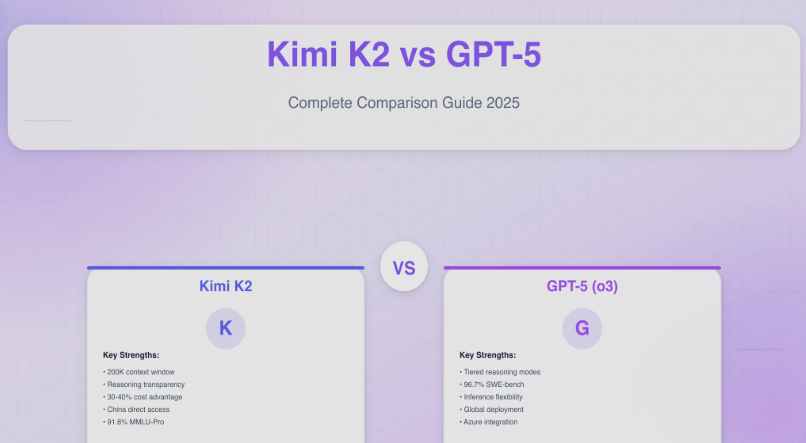
The following table summarizes the most recent performance data from Artificial Analysis and community-verified benchmarks.
Performance Comparison Table
| Metric / Benchmark | Kimi K2.5 (Open Source) | GPT-5 (Proprietary) | Winner |
| Humanity's Last Exam (HLE) | 50.2% | 52.4% | GPT-5 (Slight) |
| BrowseComp (Web Agents) | 74.9% | 71.2% | Kimi K2.5 |
| AIME25 (Mathematics) | 99.1% | 99.4% | Tie |
| SWE-bench Verified (Coding) | 76.8% | 78.5% | GPT-5 |
| VideoMMMU (Video AI) | 86.6% | 85.9% | Kimi K2.5 |
| Inference Cost (per 1M tokens) | ~$0.60 | ~$5.00+ | Kimi K2.5 |
Note: Kimi K2.5 shows a distinct advantage in autonomous web browsing and video reasoning, while GPT-5 remains the gold standard for software engineering and advanced linguistic tasks.
3. Agentic Capabilities: Swarms vs. Solo Intelligence
The shift from “Chatbots” to “Agents” is the defining trend of 2026. This is where Kimi K2.5 and GPT-5 diverge most significantly.
-
Kimi's Agent Swarm: Kimi K2.5 is built to act as an orchestrator. It can spawn up to 100 sub-agents to handle parallel tasks, such as simultaneous market research across dozens of websites. Its “Vision-to-Code” feature is natively integrated, allowing it to “see” a UI design and write the code instantly.
-
GPT-5’s System 2 Thinking: OpenAI has focused on “Reasoning Chains.” GPT-5 is better at “thinking through” a single, highly complex philosophical or architectural problem. It acts more like a “Senior Architect,” whereas Kimi acts like a “Project Manager with a Team.”
-
Tool Use and Plugins: GPT-5 has the advantage of the ChatGPT ecosystem, connecting seamlessly to Microsoft 365, Google Workspace, and thousands of proprietary plugins. Kimi K2.5 relies on open standards like the Model Context Protocol (MCP) and custom-built “Agent Skills.”
4. Multimodal Strengths: Vision and Video
Both models are “native multimodal,” meaning they were trained on text, image, and video data simultaneously.
-
Video Understanding: Kimi K2.5 currently leads in temporal reasoning. It can analyze a 10-minute video and pinpoint specific visual bugs or narrative shifts with higher accuracy than GPT-5.
-
UI/UX Generation: Kimi Code (the coding-specific version of K2.5) excels at turning Figma screenshots into production-ready React code. GPT-5 is highly capable here but often requires more prompting to reach the same level of “aesthetic taste.”
-
Image Generation: GPT-5 is paired natively with DALL-E 4, offering industry-leading prompt adherence for image generation. Kimi K2.5 focuses more on image analysis than generation.
5. Cost, Privacy, and Deployment: The Enterprise Choice
For business leaders, the decision between Kimi and GPT-5 often comes down to the “Moat” vs. “API” debate.
-
Data Sovereignty: Kimi K2.5 is open-weights. An enterprise can host it on their own VPC (Virtual Private Cloud) or local H100/H200 clusters. This ensures that sensitive data never leaves the company's control.
-
Vendor Lock-in: GPT-5 is an API-first model. While highly convenient, it subjects the user to OpenAI’s pricing, rate limits, and content filters.
-
Cost Efficiency: Kimi K2.5 is significantly cheaper to run at scale. Its MoE architecture and open-source nature have driven inference costs down to a fraction of GPT-5’s premium pricing.
6. How to Choose the Right Model for Your Needs
Choose Kimi K2.5 if:
-
You require local deployment for data privacy/compliance.
-
Your primary use case is autonomous web browsing or agentic workflows.
-
You are building frontend applications from visual designs.
-
You need to process high volumes of video data.
-
You are looking to minimize API token costs.
Choose GPT-5 if:
-
You need the absolute highest reasoning capability for scientific research.
-
You rely heavily on the OpenAI/Microsoft ecosystem.
-
You need a “polished” experience with minimum technical setup.
-
Your task requires extreme linguistic nuance in rare languages.
FAQ: Kimi K2.5 and GPT-5
Q: Is Kimi K2.5 really open source?
A: Yes, Moonshot AI has released the model weights for Kimi K2.5 on Hugging Face. However, commercial use at extreme scales may require specific licensing agreements with Moonshot.
Q: Does GPT-5 support “Thinking Mode” like Kimi?
A: GPT-5 uses “Inference-time Scaling” (often referred to as Strawberry or o1-style reasoning), which allows it to spend more compute “thinking” before answering. This is similar to Kimi's Thinking Mode but often more specialized for math and logic.
Q: Which model is better for coding?
A: It is a toss-up. GPT-5 is slightly better at deep architectural logic and complex backend refactoring. Kimi K2.5 is superior for frontend development, UI-to-Code, and autonomous debugging using visual inputs.
Q: Can I run Kimi K2.5 on a single GPU?
A: No. Due to its 1.04T parameter size, even the quantized INT4 version requires a cluster of GPUs (typically 8x H100 or H200) for optimal performance. Small-scale users should use the Kimi API.
Conclusion: The Dual-King Era
The comparison between Kimi K2.5 and GPT-5 shows that we are no longer in a world dominated by a single AI model. Instead, we have a dual-king era. GPT-5 is the sophisticated, proprietary engine driving the consumer AI revolution, while Kimi K2.5 is the open-source workhorse empowering developers to build custom, autonomous agents without limits. By understanding the specific strengths of each—Kimi for agents and vision, GPT-5 for deep logic and ecosystem—you can strategically position your AI infrastructure for the years ahead.